











Sales and marketing misalignment rarely presents itself as a catastrophic, overnight failure. It is, instead, a "slow-leak" problem. It manifests as a trickle of "qualified" leads that sales teams treat with skepticism, campaign messaging that feels disconnected from the realities of the sales floor, and a revenue pipeline that looks deceptively healthy on the surface until the quarter ends and the numbers fall short.
New research from Unbounce, based on a survey of over 500 SMB go-to-market (GTM) professionals, confirms that this disconnect is the silent killer of modern growth. While 87% of teams agree that better alignment would significantly boost performance, only 56% describe their organizations as "highly aligned."
This article dissects the "Anatomy of Aligned Go-to-Market Teams" report to uncover where the breakdown occurs, the hidden costs of inaction, and the structural shifts required to move from simple communication to true operational synergy.
The Reality Check: What "Alignment" Actually Means
The data reveals a stark paradox: while a majority of companies believe they are aligned, they are often confusing a "meeting cadence" with an "operating model."
Being truly aligned is not about having a weekly sync call or a shared Slack channel. It is about the plumbing of the organization. Truly aligned teams share granular lead data, follow documented handoff protocols, and hold both departments accountable to the same North Star metrics.

When teams focus only on communication frequency—the "meeting layer"—they often fail to address the underlying disagreements regarding what constitutes a "good" lead, when sales should initiate outreach, and who deserves credit for a conversion. In these instances, marketing counts the lead, sales counts the close, and the two sets of data never reconcile. The team is going through the motions of alignment, but the system remains fundamentally broken.
The Perception Gap: Why Leadership is Out of Touch
Perhaps the most alarming finding in the report is the disconnect between the C-suite and the front lines. Approximately 69% of executives report strong sales and marketing alignment, while only 47% of non-executives agree.
This perception gap creates a dangerous "structural information lag." Executives often view alignment through the lens of strategy decks and organizational charts, whereas individual contributors experience it through the daily friction of data silos, inconsistent definitions, and limited communication. When leadership believes the ship is running smoothly while the crew is struggling with a broken compass, the organization loses the ability to diagnose its most pressing operational failures.
The Hidden Costs of Misalignment
Misalignment is often dismissed as a "culture issue," but the data suggests it is a massive operational drain. When marketing and sales aren’t speaking the same language, the financial consequences compound:
- Employee Frustration: 29% of professionals cite this as the top consequence. When sales reps feel they are being sent "junk" leads and marketers feel their efforts are being ignored, morale inevitably plummets.
- Revenue Leakage: Delayed follow-up times are a direct result of process friction. When leads sit idle because the handoff criteria are unclear, conversion rates suffer.
- Duplicated Effort: Teams often end up reinventing the wheel, with marketing building content that sales never uses, and sales creating its own ad-hoc collateral that violates brand guidelines.
This is a "lose-lose" scenario. Marketing generates volume, sales ignores the noise, and the pipeline stalls. Fixing this requires moving beyond blaming "lead quality" as a symptom and addressing the root cause: the lack of an agreed-upon Service Level Agreement (SLA) between the two departments.

The Root Causes: Why Communication Isn’t Enough
54% of GTM teams cite increasing the frequency of communication as their primary fix for alignment. However, the data suggests this is a superficial solution. The real blockers are operational (53%), goal-oriented (43%), and structural (34%).
1. Siloed Data and Inconsistent Information
Marketing relies on CRM reports and attribution models, while sales relies on territory-specific spreadsheets and intuition. When these two sources of truth do not overlap, the team cannot optimize for the same reality. The report highlights that 68% of teams encounter regular data inconsistencies, which fragments execution and undermines campaign strategy.
2. The Trap of Tool Bloat
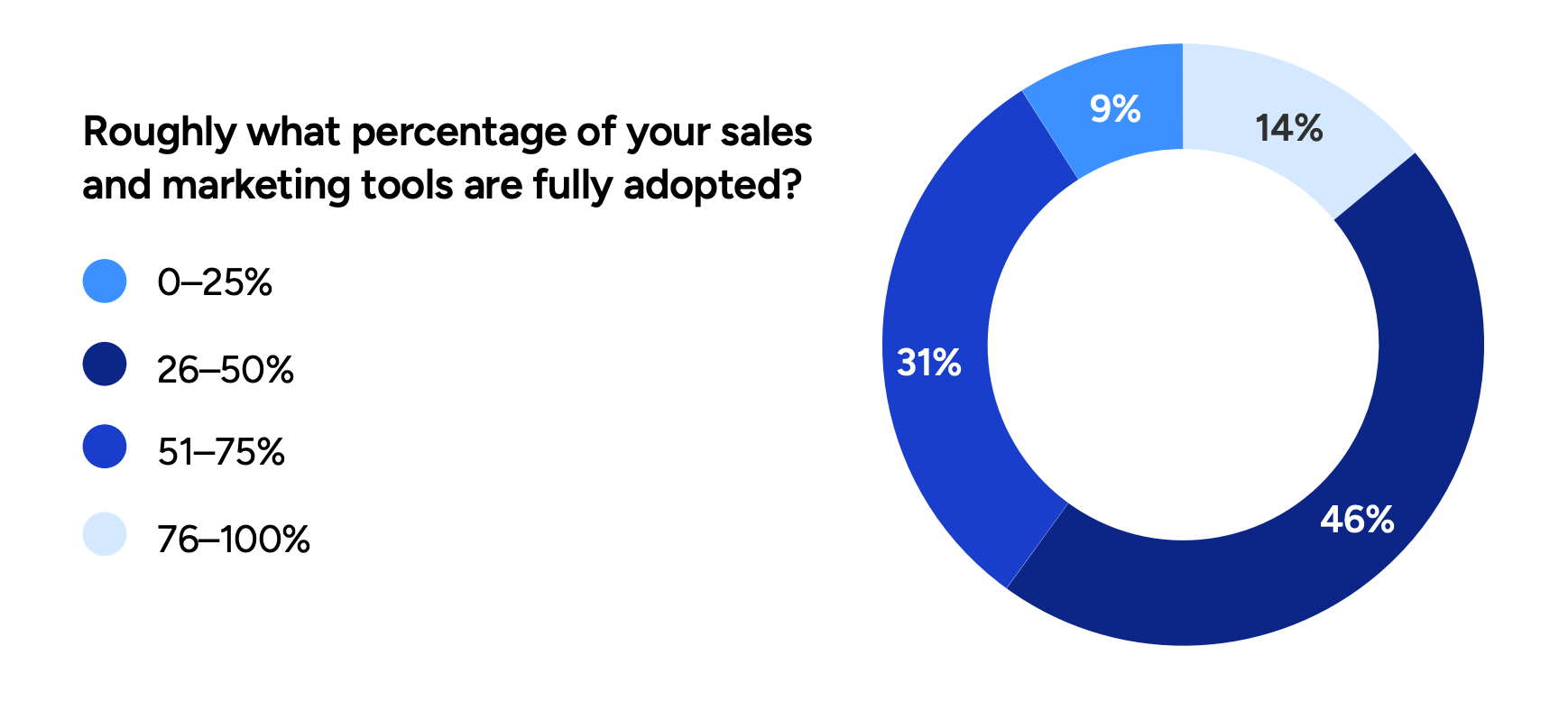
When alignment fails, the instinctive response is often to "buy" a solution. Unfortunately, this leads to tool bloat. 60% of GTM professionals report using less than half of their available tech stack. Instead of adding new software, the report suggests that leaner, better-adopted stacks outperform bloated collections of disparate tools.
3. Incentives and KPIs
As the investor Charlie Munger famously said, "Show me the incentive and I will show you the outcome." When marketing is compensated on MQL volume and sales is compensated on closed revenue, they are structurally incentivized to prioritize their own silos. True alignment requires shared KPIs that bridge the gap between "interest" and "revenue."
How High-Performers Outpace the Rest
The 56% of teams that are "highly aligned" share specific, replicable characteristics that set them apart:
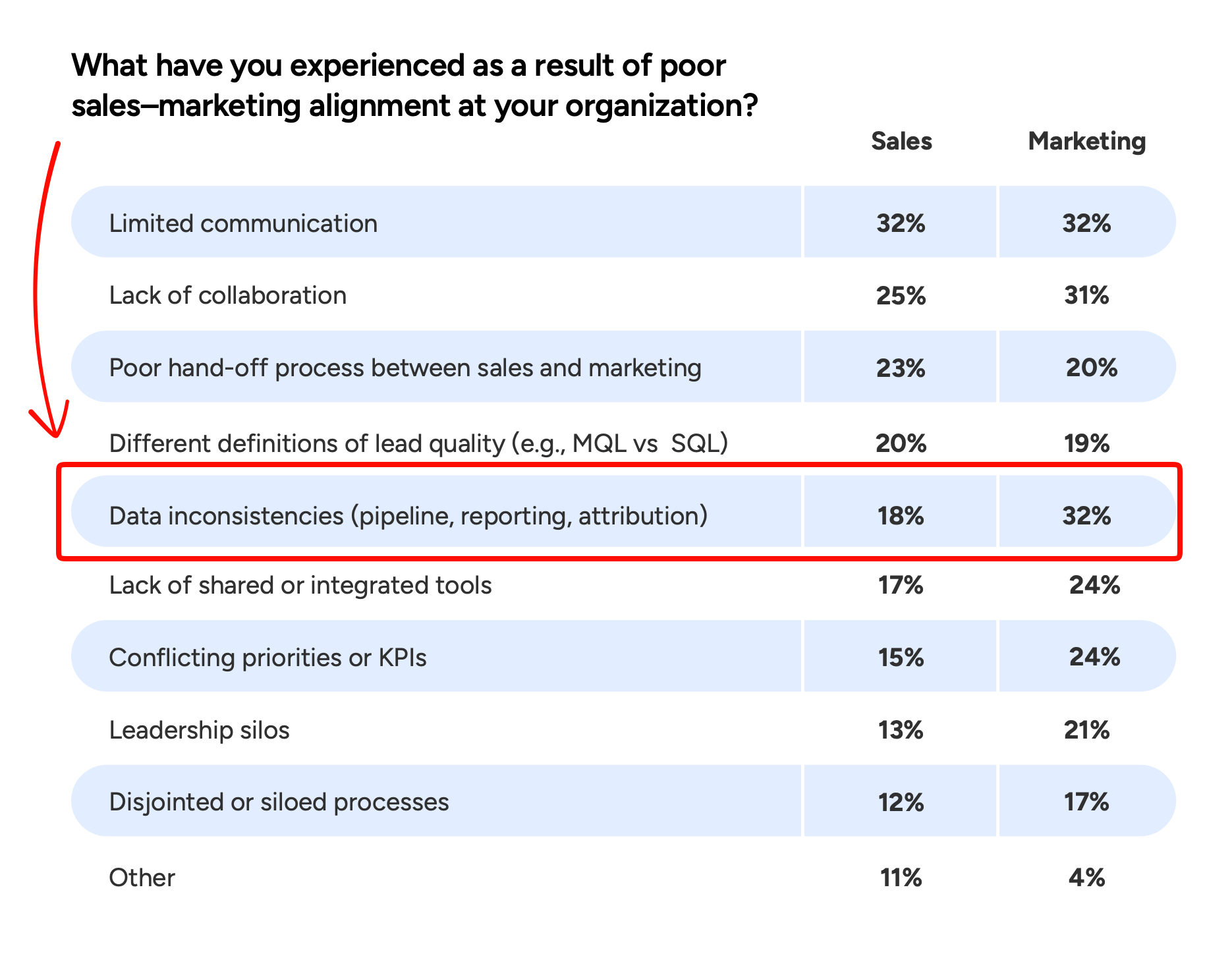
Cross-Functional Data Sharing
Aligned teams are 3.5 times more likely to have robust, shared data systems. They do not just "discuss" data; they build infrastructure where marketing data feeds both teams from a single source of truth. This turns meetings from argumentative sessions into decision-making forums.
Consistent Messaging
A disjointed buyer’s journey is a trust-killer. In high-performing organizations, sales reps have input into campaign messaging before it goes live. By sharing buyer personas and incorporating real-world objections heard on sales calls into marketing content, these teams ensure that the transition from a marketing touchpoint to a sales conversation is seamless.
Lean Tech Adoption
The data is clear: teams that consolidate their tech stack are twice as likely to rate their lead quality as "excellent." By focusing on a smaller set of tools that both teams actually use, they eliminate the "maintenance overhead" that plagues larger, less efficient organizations.
Three Actions to Move the Needle
If your organization is suffering from the "Great Divide," you can begin the recovery process with three specific operating moves:
- Co-Create Buyer Personas and Lead Definitions: Stop treating buyer personas as a "marketing project." Make them a joint artifact. If sales doesn’t agree on what a "Sales Qualified Lead" (SQL) looks like, the handoff will always fail.
- Formalize the Handoff Process: Define the SLA. What specific information must accompany a lead? How quickly must a rep follow up? What happens if a lead is rejected? Formalizing these rules turns a messy process into a predictable pipeline.
- Unify Reporting Systems: Move away from team-specific dashboards. Align on a set of "Shared Metrics"—such as Customer Acquisition Cost (CAC) and overall Conversion Rate—that both teams own.
Conclusion: Alignment as an Operating Model
The era of treating sales and marketing as separate, occasionally intersecting functions is over. In the current SMB landscape, the organizations that win are those that break down the wall between "generating demand" and "capturing demand."
Alignment is not a destination; it is an ongoing state of operational health. By focusing on shared data, clear handoff rules, and unified incentives, teams can stop fighting each other and start focusing on the only metric that truly matters: sustainable, efficient revenue growth.
For more insights, benchmarks, and a deeper look at the data from 500+ GTM professionals, download the full Unbounce "Anatomy of Aligned Go-to-Market Teams" report.