










In the competitive race to dominate the artificial intelligence landscape, model release pages have become increasingly standardized. Developers boast of "low hallucination scores"—often citing figures under 1% on industry-standard factual accuracy tests. To the casual observer or a prospective enterprise buyer, these numbers suggest that the era of AI error is drawing to a close. However, these polished statistics are increasingly being viewed as a dangerous, if not misleading, narrative.
When scrutinized against the harsh realities of legal, medical, and enterprise deployment, these numbers collapse. The gap between benchmark "perfection" and field-tested reality is not merely a technical nuance; it is one of the most critical, yet under-discussed, structural failures in the current AI ecosystem.
Understanding the Anatomy of a Hallucination
At its core, an AI hallucination is the confident articulation of a falsehood. It is not simply a model being "wrong" in the traditional sense; it is the generation of a response that is syntactically flawless, rhetorically persuasive, and entirely fabricated. Whether it is a ghost citation in a legal brief, a nonexistent medical study, or a falsified statistical trend, the danger lies in the presentation.
Because Large Language Models (LLMs) are probabilistic engines designed to predict the next token, they are not naturally constrained by the truth. When a model lacks the data to answer a query, its architecture often forces it to "fill the gap" with plausible-sounding information. The polish of the output masks the void of the logic, making these errors notoriously difficult for human reviewers to spot without rigorous, independent verification.
The Benchmark Myth: What Marketing Doesn’t Tell You
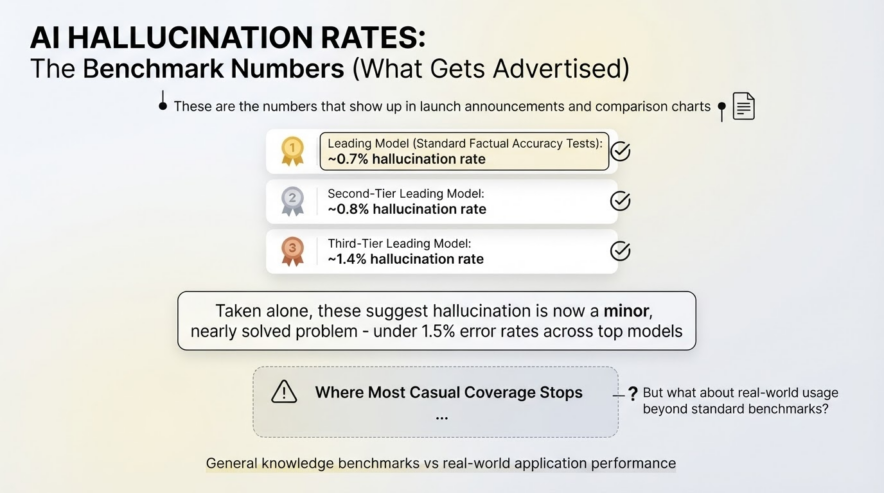
The metrics currently dominating AI marketing materials are derived from general knowledge benchmarks—standardized tests that measure how well a model can answer encyclopedic trivia. In these controlled, closed-loop environments, leading models report hallucination rates between 0.7% and 1.4%.
Taken at face value, these statistics paint a picture of a "solved" problem. However, this is where the industry narrative hits a wall. These benchmarks test the model’s ability to recall common facts present in its vast training corpus, such as "Who is the president of France?" or "What is the capital of Japan?" They do not, however, test the model’s ability to perform high-stakes synthesis where the facts are nuanced, contradictory, or absent from the training set.
The Field-Tested Reality: A Chasm of Error
When we shift from general knowledge to specialized domains, the error rates do not just rise; they explode. Industry data shows that in legal and medical contexts, the reliability of these same models plummets.
The Legal Domain
In legal research, where precision is not optional, the stakes are existential. While general legal AI tasks report an average hallucination rate of approximately 6.4%, deeper testing reveals a much darker picture. Recent research from Stanford University indicated that when major models are tasked with answering specific, complex legal research questions, hallucination rates range from 58% to 88%.
The Medical Domain
The medical field faces similar, albeit distinct, challenges. Industry averages for medical AI tasks hover between 10% and 20% error. However, when researchers modify the prompt quality or the specificity of the medical query, those rates climb to between 43% and 64%. The inconsistency suggests that the models are highly sensitive to phrasing, creating a volatile environment where a slight change in how a question is asked can lead to a potentially dangerous diagnosis.
The Financial and Operational Toll
The cost of these hallucinations is no longer theoretical. As organizations rush to integrate LLMs into customer service, legal drafting, and diagnostic support, the aggregate cost of AI errors is mounting.
Estimates for the global business cost of AI hallucinations in 2024 sit at roughly $67.4 billion. Projections for 2025 suggest this number will balloon to $112 billion. Crucially, this cost is rising in direct proportion to adoption. As companies integrate AI deeper into their workflows, the "surface area" for potential errors expands. Every automated email, every summarized document, and every generated report becomes a new vector for misinformation.
Closing the Gap: What Actually Works?
If the benchmarks are misleading and the error rates are high, how do we mitigate the risk? The data suggests that architectural fixes—rather than iterative prompting—are the only viable path forward.
The Hierarchy of Mitigation
- Retrieval-Augmented Generation (RAG): By grounding the model in verified, proprietary documents, RAG systems can reduce hallucinations by 75–90%. By forcing the model to cite its sources from a controlled knowledge base, the propensity to "invent" facts is significantly curtailed.
- Tool Grounding: Giving the model access to real-time lookup tools (such as live databases or calculators) provides a reduction of 65–80%.
- Multi-layered Guardrails: Combining RAG with uncertainty estimation and self-consistency checks can push reduction rates as high as 96% in the best-case scenarios.
- Prompt Engineering: Often touted as the "magic bullet," prompt engineering (better phrasing) caps out at around 15% efficacy. It is a surface-level fix for a foundational architectural problem.
The Enterprise Gap: Why Adoption Lags
Despite the proven efficacy of RAG and specialized verification systems, the enterprise sector remains hesitant. Currently, 68% of enterprises use RAG as a mitigation strategy, and 76% rely on human-in-the-loop review. However, only 19% have adopted dedicated verification APIs or automated fact-checking systems.
This represents a dangerous reliance on human oversight in an era of machine-speed production. When a model generates thousands of documents an hour, asking a human to "catch the errors" is an impossible mandate. The current state of enterprise AI is a paradox: we are deploying systems at scale that we do not yet have the automated infrastructure to verify.
Implications for the Future
The disconnect between marketing benchmarks and real-world performance is a symptom of an industry in its "wild west" phase. As we look toward the future of AI integration, several implications become clear:
- The End of "General" Benchmarks: Future procurement processes will move away from generic accuracy scores and toward domain-specific stress testing.
- The Rise of Verification Infrastructure: As the cost of hallucinations continues to climb, the market for third-party, specialized "truth-checking" software will likely become more lucrative than the models themselves.
- Shift in Liability: As legal precedents catch up to AI, the responsibility for hallucinations will shift from the user to the deployer. Companies will be forced to prove they implemented rigorous architectural guardrails rather than just relying on the "black box" output of a foundational model.
Conclusion
The narrative of "under 1% error rates" is a marketing triumph but a technical failure. While LLMs are transformative tools, they are currently being sold with a level of reliability that does not exist in practice.
The path to safe enterprise adoption is not through better prompt engineering or hoping for more accurate future models. It is through the aggressive implementation of retrieval-augmented architectures and dedicated, automated verification systems. Organizations that prioritize these structural safeguards will survive the transition; those that rely on the illusion of benchmark accuracy will find themselves managing an increasingly expensive and dangerous liability.
As we move forward, the most important question for any business deploying AI is not "How accurate is the model?" but rather, "How do we identify the moment the model stops being truthful?" Until that answer is integrated into the foundation of the technology, AI remains a high-potential, high-risk endeavor.