










In the rapidly evolving landscape of artificial intelligence, the industry’s focus is shifting from "bigger is better" to "smarter and leaner." For developers tasked with deploying AI in narrow automation scenarios—such as customer support ticket classification, data extraction, or sentiment analysis—Small Language Models (SLMs) have emerged as the gold standard. However, the true utility of these models in production environments hinges not just on their parameters, but on the architectural efficiency of their implementation.
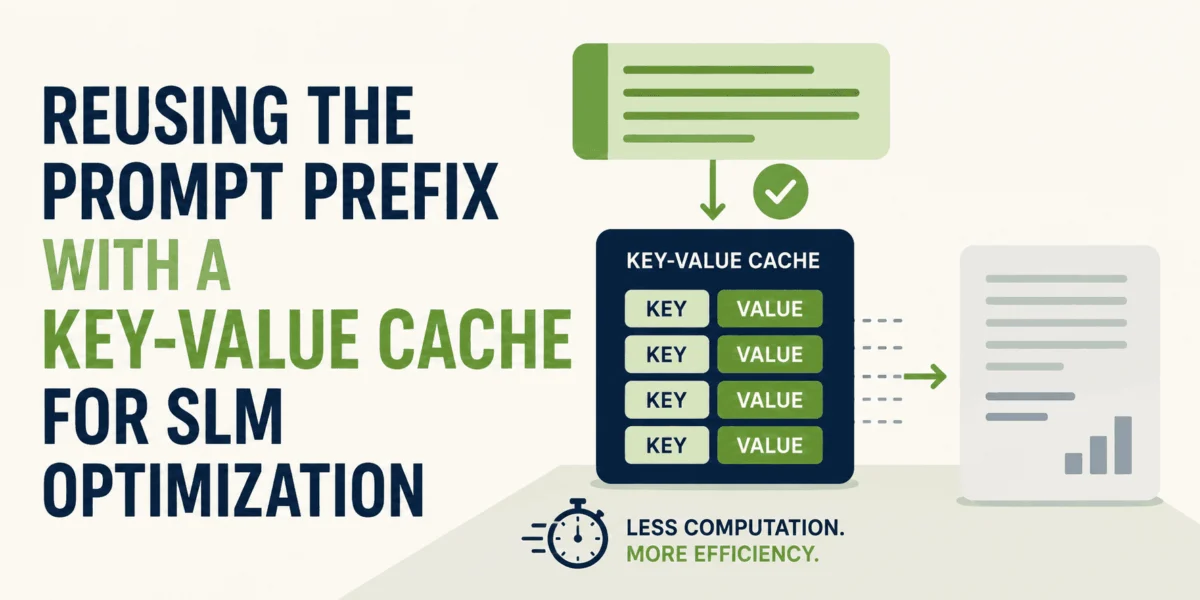
In our previous exploration, we discussed how constraining the output space of an SLM can significantly enhance performance. Today, we move to the second installment of our optimization series: Prefix Caching. By reusing the key-value (KV) cache for static prompt prefixes, developers can slash latency and compute costs by more than half, transforming SLMs from interesting experiments into high-performance production workhorses.
The Core Challenge: Redundancy in Automation
Narrow automation tasks—those defined by rigid instructions, taxonomy definitions, and few-shot examples—are inherently repetitive. When a model processes a customer support ticket, the "instruction block" (the system prompt) often comprises several hundred tokens, while the actual variable content (the specific user ticket) adds only a fraction of that length.
In a standard implementation, every time a new ticket arrives, the model re-encodes the entire sequence. It recalculates the key and value vectors for the static instructions from scratch, layer by layer. For high-volume systems, this is not merely inefficient; it is a profound waste of computational resources. Because the static prefix is byte-for-byte identical across every request, the model is essentially performing the same mathematical operations thousands of times per hour.
By leveraging the KV cache, we can treat the static instructions as a "warm" memory state, allowing the model to focus its compute power exclusively on the new, dynamic input.
Chronology of Optimization: From Baseline to Cached
To quantify the impact of this strategy, we utilized the Qwen2.5-0.5B-Instruct model, running in float16 precision on an M2 Macbook Air. The testing environment remained consistent: 600 sample tickets across three categories (billing, technical, and account).
Phase 1: The Baseline (The "Naive" Approach)
In our baseline test, every ticket was treated as a discrete, independent event. The system encoded the full prompt—inclusive of system instructions, taxonomy, and examples—alongside the specific ticket content.
- Static Prefix Length: 145 tokens.
- Total Prompt Length: 167 tokens.
- Efficiency: 87% of the prompt was redundant.
- Result: The process took 184.85 seconds, averaging roughly 308.1 milliseconds per ticket.
Phase 2: The Cached Implementation
We modified the architecture to perform a "pre-fill" pass. The system runs the static instructions through the model exactly once and stores the resulting KV cache in a DynamicCache object. For every subsequent ticket, the model initializes its internal state with this cache, processing only the few tokens that actually change.
- Result: The process concluded in 80.07 seconds, averaging 133.5 milliseconds per ticket.
- Performance Gain: An overall runtime reduction of approximately 57%.
Supporting Data: Why the Gains Scale
The data reveals a critical insight: the benefit of prefix caching is proportional to the size of the static instruction block. In our experiment, we saw a 57% improvement. However, in enterprise environments where instruction sets and "few-shot" examples are significantly longer (to improve accuracy and adherence to style guides), the percentage of static tokens often reaches 95% or higher.
In such scenarios, the performance gains are even more pronounced. Because the model skips the most computationally expensive part of the inference cycle—the initial encoding of the long instruction block—the time-per-ticket drops dramatically. This optimization effectively shifts the bottleneck from "model inference" to "data throughput," allowing for significantly higher concurrency on identical hardware.
Implications for Production AI
The shift from "naive" inference to "cached" inference has profound implications for developers and architects.
1. The Death of the "Small Model Compromise"
Historically, engineers have often reached for larger models (7B or 70B parameters) to ensure high-quality reasoning. However, when latency is the primary constraint, large models often fail to meet service-level agreements (SLAs). By optimizing a 0.5B model with prefix caching, developers can achieve sub-200ms response times while maintaining a level of accuracy sufficient for classification and routing.
2. Cost-Efficiency and Sustainability
For cloud-based deployments, compute costs are the single largest line item. Reducing inference time by 57% translates directly into a 57% reduction in cloud GPU/CPU hours. This is not just a financial win; it is an environmental one. As AI adoption scales, optimizing the energy footprint of these models is becoming a critical priority for organizations focused on ESG (Environmental, Social, and Governance) targets.
3. Improved User Experience
In real-time customer service applications, the difference between a 300ms response and a 130ms response is the difference between a "laggy" interface and an instantaneous one. Prefix caching ensures that the end-user receives a response that feels snappy, which is vital for building trust in automated systems.
Technical Nuances: Maintaining "Token Cleanliness"
A crucial, often overlooked aspect of this implementation is the "token-clean" boundary. To successfully merge a cached prefix with a new suffix, the encoding of the two parts separately must produce the exact same token IDs as encoding the entire string as a single unit.
If the tokenizer encounters a boundary where it might merge characters differently depending on the context (a common occurrence with sub-word tokenization), the cache will be corrupted. Our implementation uses a manual construction of the ChatML layout to ensure the boundary is perfectly clean. This level of precision is the difference between a system that functions flawlessly and one that produces nonsensical outputs due to cache misalignment.
Expert Perspective: Democratizing AI Efficiency
Matthew Mayo, managing editor of KDnuggets, notes that the future of data science lies in "making the complex accessible." The methodology described here is a prime example of this philosophy.
"We are moving past the era where we simply throw more parameters at a problem," says Mayo. "The real skill in modern AI engineering is understanding the underlying architecture of the Transformer. When you understand how the KV cache works, you aren’t just a user of models—you are a tuner of systems. For developers, this means the difference between a project that is too slow for production and one that provides massive, measurable business value."
Conclusion: The Path Forward
The transition to highly optimized SLMs is not merely a technical trend; it is a necessary evolution. As we continue to refine these strategies, the barrier to entry for building robust, intelligent automation will continue to fall.
By implementing prefix caching, we have demonstrated that a small, 0.5-billion parameter model can handle enterprise-grade tasks with incredible speed. We have effectively decoupled the complexity of our instructions from the latency of our response.
For the reader looking to implement this: start by auditing your current prompt structures. Identify the static components, isolate them, and begin caching your KV states. Your models will perform better, your infrastructure costs will drop, and your automation will finally be ready for the rigors of the production environment.
In our next installment of this series, we will delve into the integration of quantization and tensor fusion, further squeezing every ounce of performance out of our SLM stack. Stay tuned, as the journey to the ultimate efficient model is far from over.



