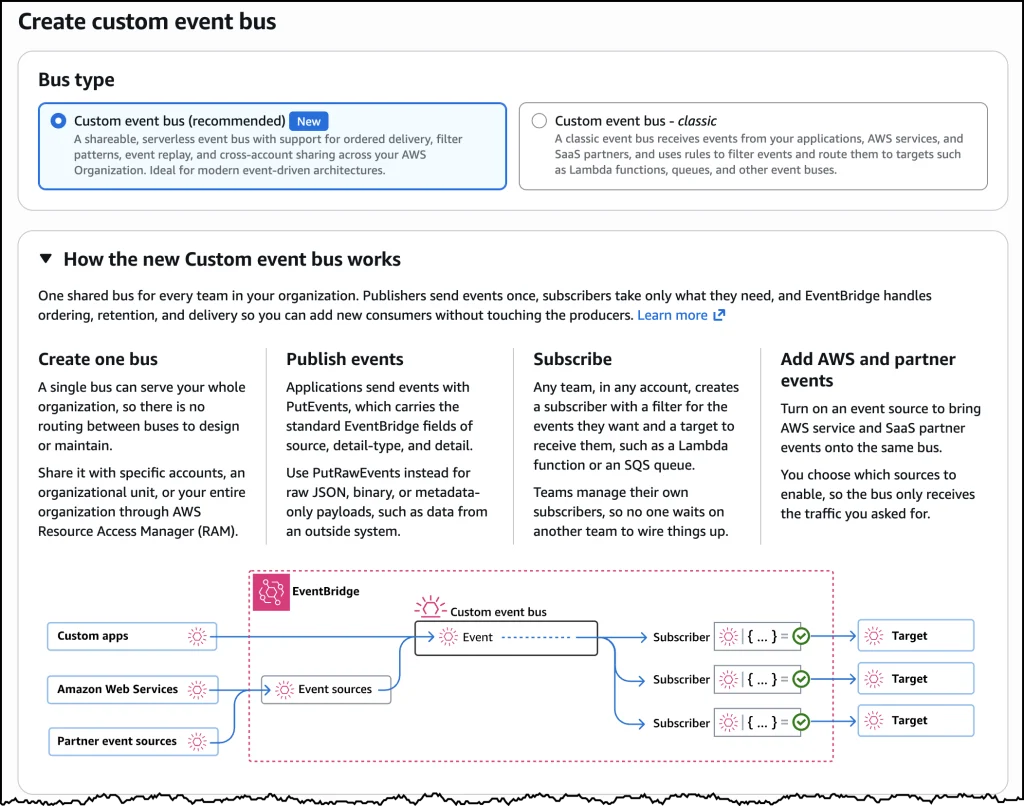
SEATTLE — In a major development for cloud architects and serverless developers, Amazon Web Services (AWS) has announced the general availability of an enhanced custom event bus in Amazon EventBridge. Purpose-built to address the operational friction of scaling event-driven applications across complex, multi-account enterprise environments, the new offering introduces organization-wide sharing, native event ordering, unified Subscriber resources, content-based deduplication, and a scalable pricing model.
The launch marks a significant evolutionary step for Amazon EventBridge, shifting the paradigm from complex, multi-bus topologies to a centralized, governed, and highly scalable event backbone. Existing event buses will remain fully supported under the newly designated "classic" tier, ensuring seamless continuity for legacy workloads while giving organizations a clear, modern path forward.
Main Facts: What is the Enhanced Amazon EventBridge Custom Event Bus?
As organizations embrace microservices and distributed serverless architectures, industry best practices have increasingly pointed toward a multi-account structure. In this model, individual teams operate within isolated AWS accounts to ensure security boundaries, fault isolation, and independent deployment lifecycles.
However, routing events across these isolated accounts previously required complex workarounds. Teams had to provision multiple custom event buses and connect them using cross-account rules or intricate bus-to-bus configurations. This decentralized approach often reintroduced the very operational overhead that serverless computing was designed to eliminate. Platform engineering teams lost critical visibility into cross-account subscriptions, routing costs compounded rapidly, and developers requiring strict event sequencing were forced to construct complex auxiliary architectures or adopt entirely distinct messaging technologies.
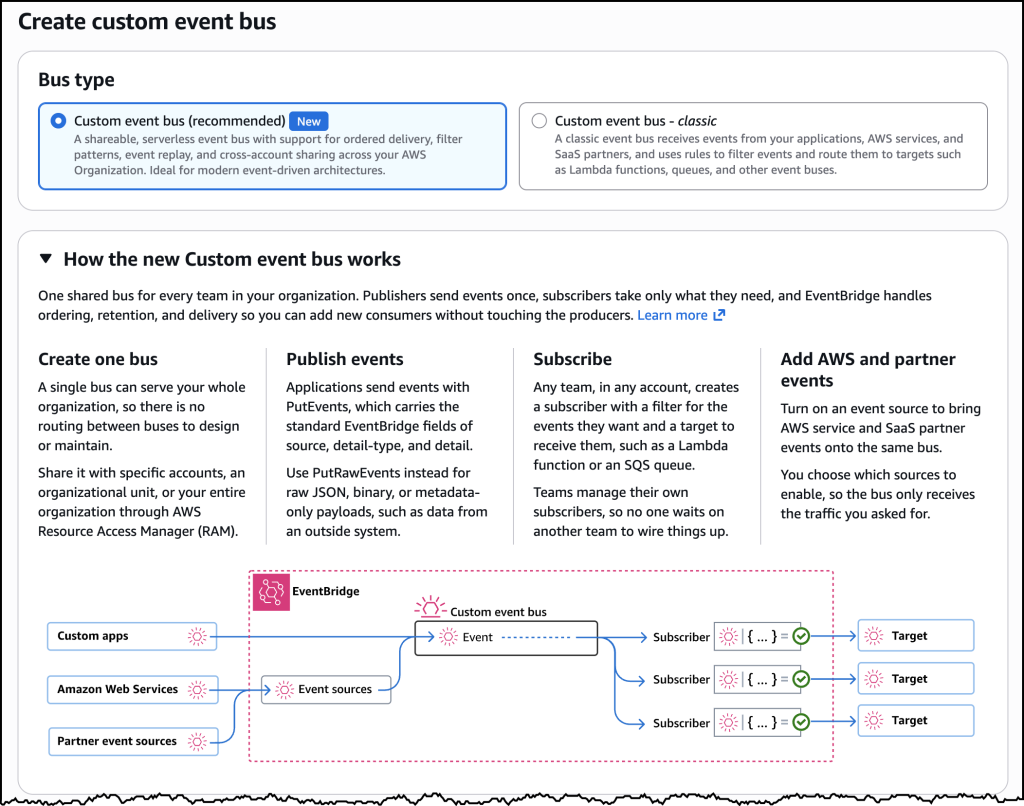
The enhanced custom event bus solves these friction points by allowing platform teams to deploy a single, centralized event bus shared natively across all AWS accounts within an enterprise organization.
Key technical capabilities of the enhanced bus include:

- Organization-Wide Resource Sharing: Integrated natively with AWS Resource Access Manager (AWS RAM), allowing platform administrators to share a single bus across specific accounts, organizational units, or the entire enterprise without manual cross-account permission management.
- Native Event Ordering and Synchronous Invocation: Introduces
EventGroupIdparameters to guarantee sequential delivery for dependent events, paired with synchronous invocation modes for targets like AWS Lambda, removing the need for intermediary queues. - Consolidated Subscriber Resources: Combines filtering, target configuration, retry policies, and dead-letter queues into a single managed entity supporting up to 10,000 subscribers per bus by default.
- Advanced Event Evaluation: Features content-based deduplication to achieve exactly-once semantics, JSONata-powered payload transformation, and native deserialization of Apache Avro and Protocol Buffers formats.
- Ingress-Egress Pricing Model: Aligns costs directly with usage by charging publishers for data ingested and subscribers for data delivered, eliminating compound multi-bus routing fees.
Chronology: The Evolution of Event-Driven Routing on AWS
The journey toward the enhanced custom event bus reflects the maturation of enterprise serverless adoption over the past decade.
Phase 1: The Single-Bus Era
When Amazon EventBridge (originally launched as Amazon CloudWatch Events) evolved into a full-featured event broker, organizations typically began their journey with a single custom event bus residing within one AWS account. This architecture proved exceptionally efficient when applications were small and managed by a single cohesive team. Publishers dropped events onto the bus, and local rules routed them directly to Lambda functions, SNS topics, or SQS queues.
Phase 2: The Multi-Account Explosion
As enterprise adoption scaled, organizational growth necessitated multi-account strategies governed by AWS Organizations. To facilitate communication between teams, developers began establishing sprawling networks of custom event buses. Cross-account IAM policies, resource-based permissions, and bus-to-bus routing rules proliferated. While functional, this network introduced blind spots for central platform teams, making it exceedingly difficult to audit who was consuming what data and driving up cloud operational expenditure.
Phase 3: The Search for Workarounds
Faced with architectural limitations—such as the lack of native ordering on standard event buses or strict limits on cross-account targets—engineers resorted to building custom scaffolding. It became common practice to place Amazon Simple Queue Service (Amazon SQS) FIFO queues between event buses and downstream compute engines to preserve message ordering, or to write custom deduplication logic to handle network retries.
Phase 4: The Centralized Future
Recognizing these operational bottlenecks, AWS engineering teams went back to the drawing board. The result is the enhanced custom event bus, launched today. By baking multi-account governance, ordering guarantees, and advanced payload manipulation directly into the service tier, AWS has unified the flexibility of event-driven design with the robust controls required by enterprise platform teams.
Supporting Data: Scale, Quotas, and Economics
The architecture of the enhanced custom event bus is underpinned by rigorous performance parameters and an overhauled financial model designed to scale cost-effectively.

Capacity and Limits
- Subscriber Quota: The new bus ships with a default quota of 10,000 Subscribers per bus, a massive leap that drastically reduces the need to fragment workloads across artificial boundaries simply to bypass scaling limits. Higher quotas are available upon request through AWS support channels.
- Deduplication Window: The content-based deduplication engine analyzes event payloads and hashes meaningful attributes, automatically collapsing duplicate transmissions arriving within a 5-minute window to ensure true exactly-once delivery semantics for erratic sources.
Financial Structure
Under legacy multi-bus configurations, organizations often incurred compound charges—paying for events when published, when routed across buses, and when delivered to final targets. The enhanced custom event bus introduces a clean ingress and egress throughput pricing model:
- Publishers pay strictly for the volume of events successfully ingested into the bus.
- Subscribers pay for the events actually delivered to their designated targets.
This separation of financial responsibility makes accurate cost allocation straightforward in multi-tenant corporate environments, allowing finance and platform teams to attribute serverless infrastructure costs directly to the business units consuming the data streams.
Official Responses and Perspectives from AWS Leadership
While AWS has integrated the new feature quietly into its management console and documentation ecosystem, cloud architects and early preview participants have shared profound insights into the structural impact of the release.
"For years, platform teams faced an impossible compromise," notes an internal AWS architectural briefing document regarding the launch. "They could either grant teams total autonomy by letting them spin up their own buses—sacrificing central visibility and driving up costs—or they could build rigid, heavily gated pipelines that choked developer velocity. The enhanced custom event bus eliminates that dichotomy entirely. It provides the governance and visibility platform engineers demand, alongside the self-service agility that application developers require."
Early feedback from enterprise beta testers highlights the elimination of intermediate infrastructure as a primary win. By supporting synchronous target invocation and native ordering via EventGroupId, teams running high-throughput logistics and financial transaction processing pipelines reported retiring dozens of auxiliary SQS FIFO queues previously required to maintain message sequence integrity.
Implications: What This Means for Developers, Architects, and Enterprises
The release of the enhanced custom event bus carries far-reaching consequences for how modern cloud-native applications are designed, deployed, and governed.
1. Empowerment of Platform Engineering Teams
Platform engineering is no longer reduced to acting as a gatekeeper for event routing configurations. Utilizing AWS RAM integration, platform teams can provision a single organizational event backbone once, define enterprise-wide security guardrails, and step back. Application teams can subsequently provision their own Subscriber resources independently, drastically reducing lead times for cross-team integrations.
2. Simplification of Microservices Topologies
By consolidating filtering, retry policies, transformation (via JSONata), and dead-letter queues into a unified Subscriber resource, AWS has radically simplified the cognitive load placed on developers. Engineers no longer need to chain disparate EventBridge rules, IAM roles, and CloudWatch log groups together to achieve reliable, fault-tolerant event delivery.
3. Broadened Scope for Event-Driven Architectures
Historically, event-driven architectures were discouraged for workloads requiring strict sequencing—such as inventory management, order fulfillment, or telemetry tracking—due to the asynchronous, out-of-order nature of traditional pub-sub systems. With native EventGroupId sequencing and synchronous invocation options, developers can now confidently migrate sequential workloads to serverless event-driven models without sacrificing data integrity.
4. Availability and Getting Started
The enhanced custom event bus is available immediately across a broad footprint of global AWS Regions, including US East (N. Virginia, Ohio), US West (Oregon), Europe (Ireland, Frankfurt, Stockholm, Spain), and Asia Pacific (Hong Kong, Malaysia, Mumbai, Singapore, Sydney, Thailand, Tokyo).
Organizations can begin adopting the new architecture today through the AWS Management Console, the AWS Command Line Interface (CLI), or programmatic API calls. For existing workloads, classic event buses remain fully operational, ensuring that migration can occur at an organization’s own pace without disruptive refactoring.