










By Tech & Engineering Desk
Published: April 2026
Looking for the underlying code for this project? You can find the complete implementation repository on GitHub.
Main Facts: The Rise of Agentic AI and the Crisis of Non-Determinism
The modern workplace is undergoing a seismic, unprecedented transformation. Over the course of 2025, the integration of Artificial Intelligence into software engineering, data science, and business analytics shifted from a novelty to a ubiquitous paradigm. By early 2026, this shift evolved into a full-scale operational revolution driven by widespread adoption of advanced coding harnesses—such as Claude Code, Codex, and Antigravity.
These are not the simple chatbot assistants of the early 2020s. They are sophisticated, agentic ecosystems capable of making multiple Large Language Model (LLM) calls per single user request. They reason through labyrinthine programming puzzles, write and execute complex SQL queries, and formulate polished, multi-faceted business intelligence reports complete with analytical figures and strategic recommendations.
Yet, this monumental leap forward comes with a catch: the underlying engines of these tools are fundamentally non-deterministic.
Powered by token-predicting LLMs, these agents thrive on probability distributions. While this non-determinism fuels the creativity and adaptive reasoning required to solve open-ended problems, it introduces a terrifying variable for enterprise deployment—unpredictability. When a business executive asks an analytics agent for a customer lifetime value (LTV) distribution, they do not just want a creative response; they require mathematically identical, auditable figures every single time.
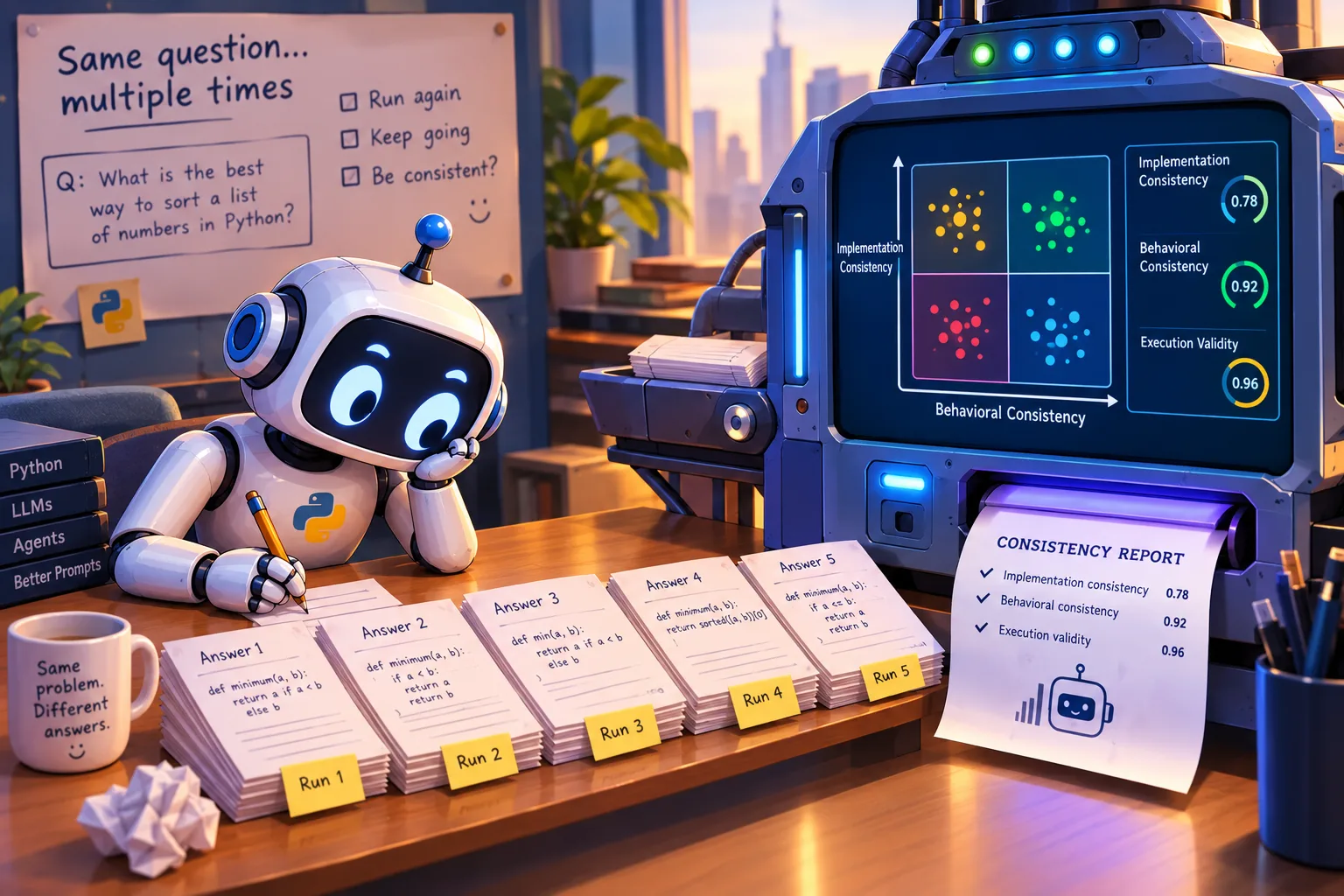
To bridge this gap, engineers are turning to a novel metric: multi-sample consistency. By building automated command-line evaluation tools like Coding Agent Consistency (cca), developers are attempting to measure and map the reliability of AI models when ground-truth answers are entirely unknown.
Chronology: How the Tech Industry Grappled with AI Consistency
The journey toward understanding and quantifying AI non-determinism did not happen overnight. It is the result of a multi-year evolutionary timeline:
- Pre-2025 (The Era of Single Prompts): Developers interacted with LLMs in isolated silos, feeding single prompts and manually inspecting outputs. Non-determinism was managed largely through trial-and-error prompt engineering or by dialing the temperature parameter down to zero.
- The 2025 Shift (Agentic Workflows): As workflows grew more complex, multi-step agentic frameworks emerged. Systems began executing long chains of reasoning, rendering traditional debugging methods obsolete.
- Early 2026 (The Black Box Explosion): The industry saw the mass deployment of advanced coding harnesses (Claude Code, Codex, Antigravity) and next-generation reasoning models (such as GPT-5+ variants and Claude Opus). Crucially, many of these cutting-edge models ceased exposing temperature or sampling controls to developers, hiding internal determinism controls behind proprietary APIs.
- The Present (Empirical Consistency Measurement): Recognizing that traditional unit testing cannot keep pace with dynamic AI agents, researchers and engineers began developing experimental open-source frameworks—such as the
ccatoolkit—to systematically bombard models with identical prompts and map their behavioral distribution.
Supporting Data: The Two-Dimensional Consistency Space
To evaluate an AI model’s reliability without knowing the correct answer ahead of time, developers must analyze its behavior across two distinct axes: Syntax Consistency and Output Consistency.
1. Syntax Consistency
This metric evaluates the structural sequence of tokens produced by a model, independent of what the code or query actually accomplishes. In a Python environment, this is measured by canonicalizing code snippets (stripping comments, docstrings, and extraneous whitespace) and calculating the Levenshtein (edit) distance across multiple iterations. High syntax consistency means the model generates virtually identical code structures every time.
2. Output Consistency
This measures the functional reality of the generated artifact. By running generated code against a robust suite of test inputs, developers create a functional "fingerprint." Output consistency assesses the distribution of those fingerprints using normalized Shannon entropy.
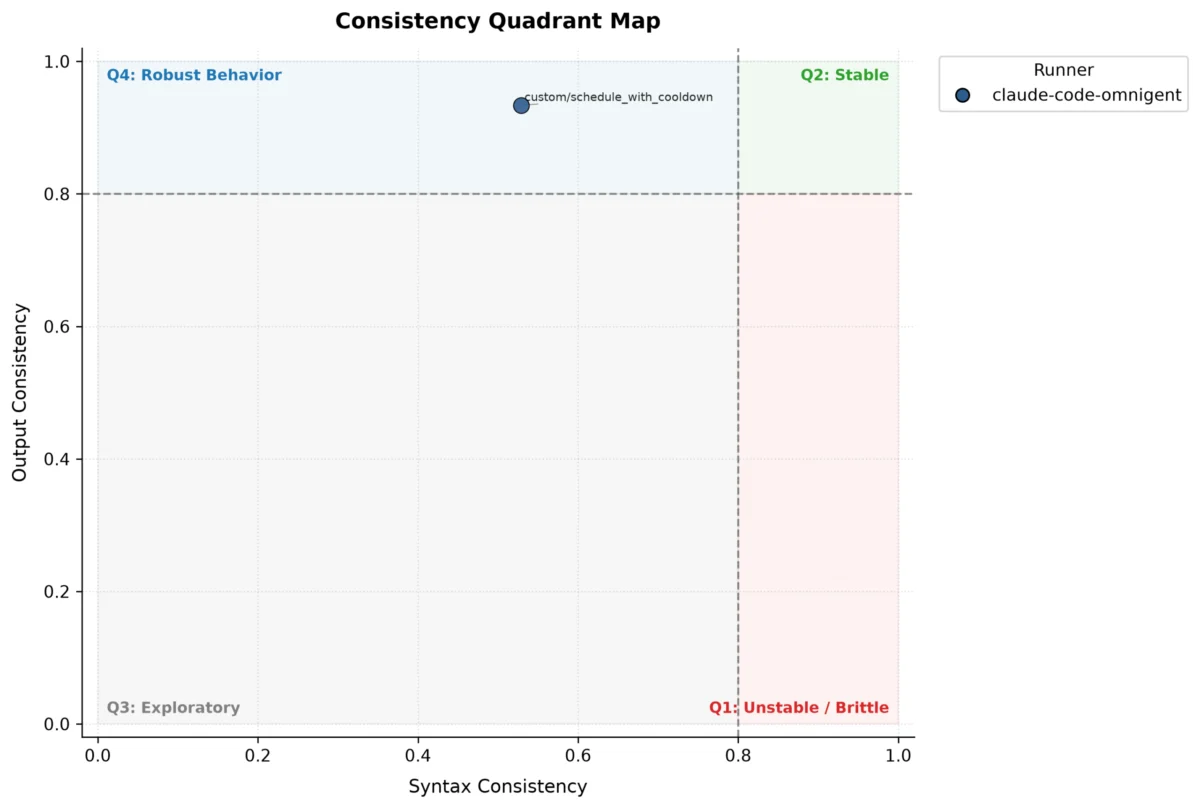
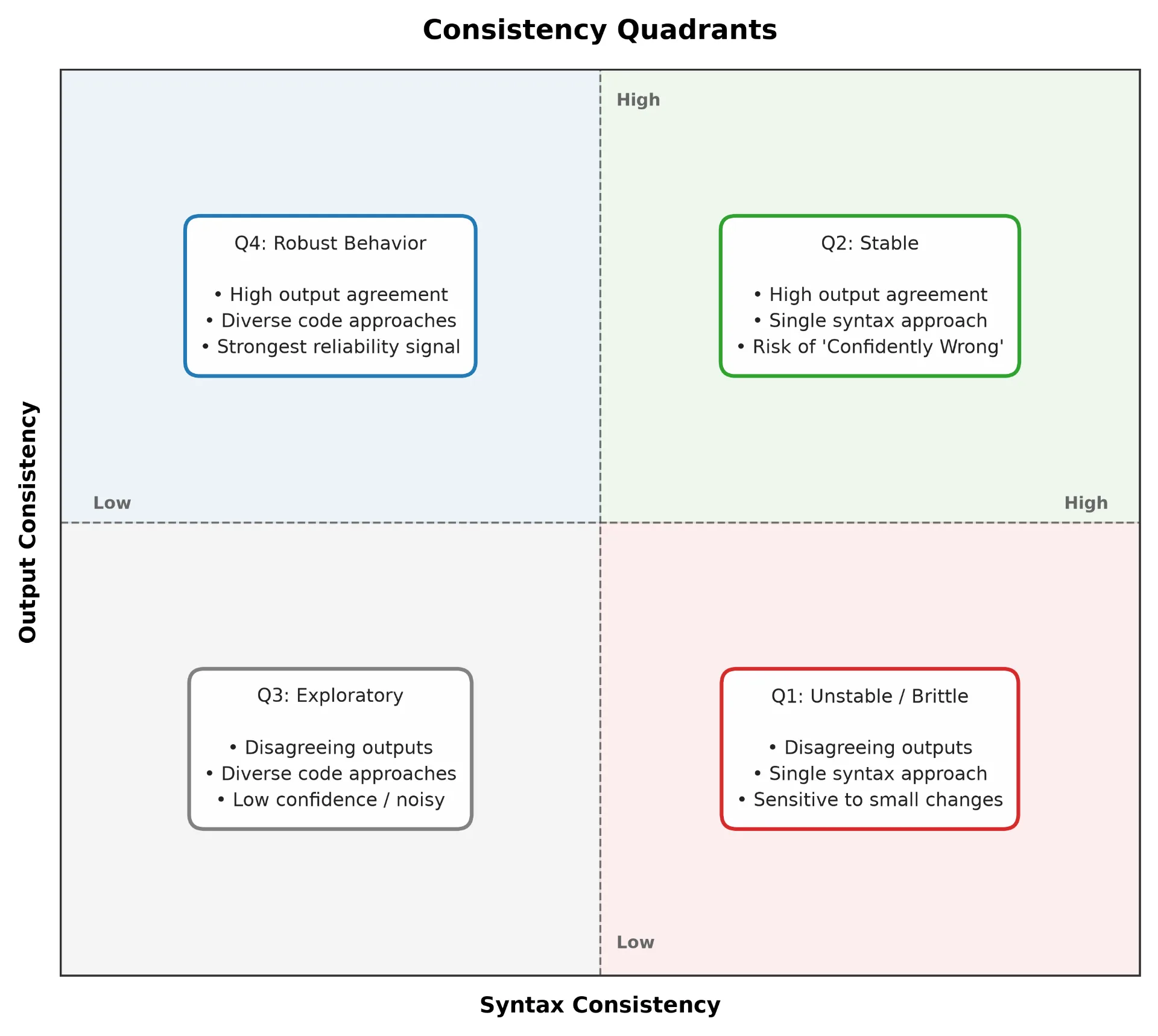
By mapping these two metrics against one another, researchers have established a four-quadrant consistency grid:
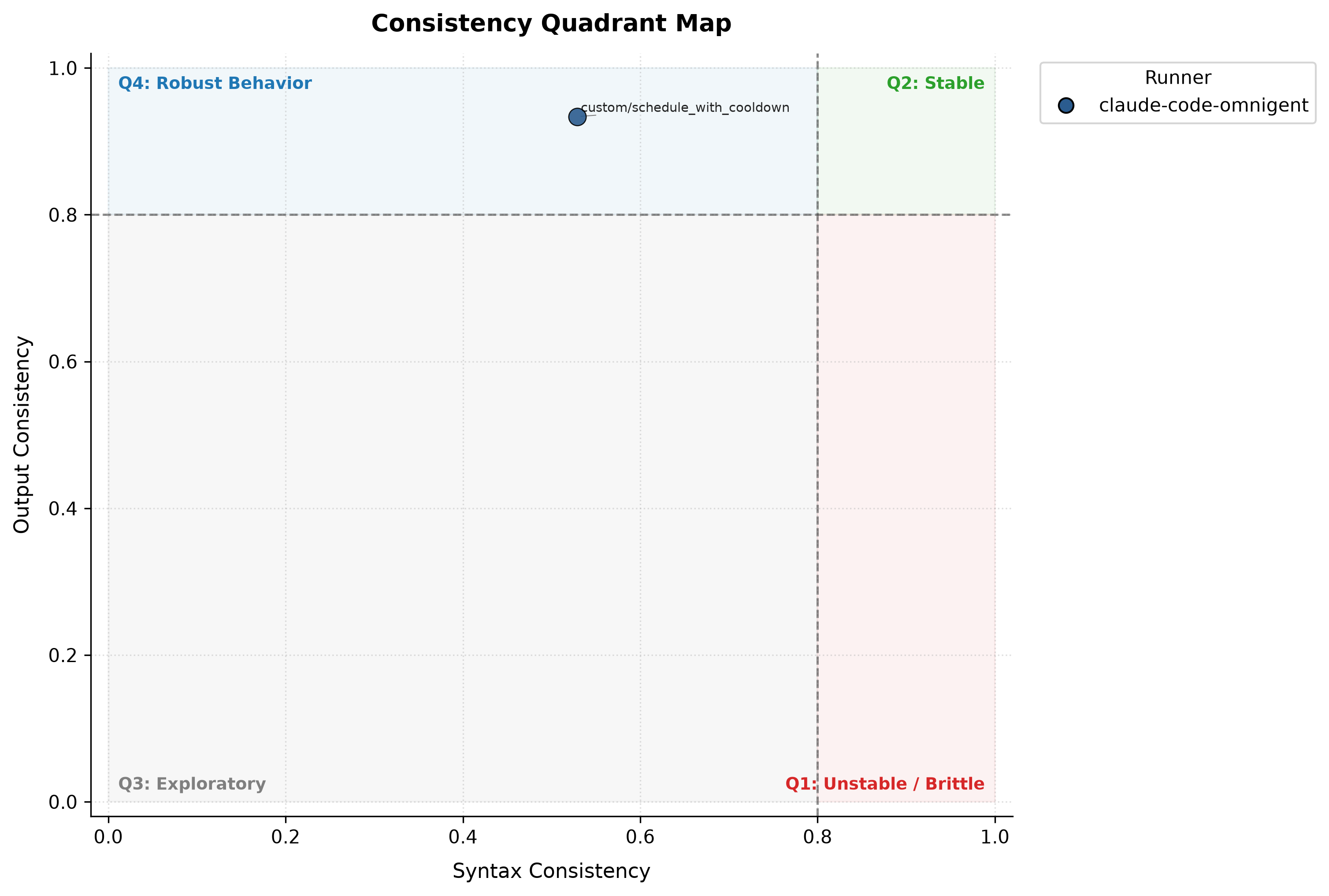
- Quadrant 1 (Low Syntax, Low Output): Chaotic and unreliable. The model struggles to find a coherent path to a solution.
- Quadrant 2 (High Syntax, Low Output): Rigidly repetitive, yet consistently wrong. The model doggedly repeats the exact same flawed logic.
- Quadrant 3 (Low Syntax, High Output): Creative execution. The model uses diverse structural approaches to arrive at the exact same correct functional outcome.
- Quadrant 4 (High Syntax, High Output): Maximum reliability. The model produces uniform, correct, and predictable code.
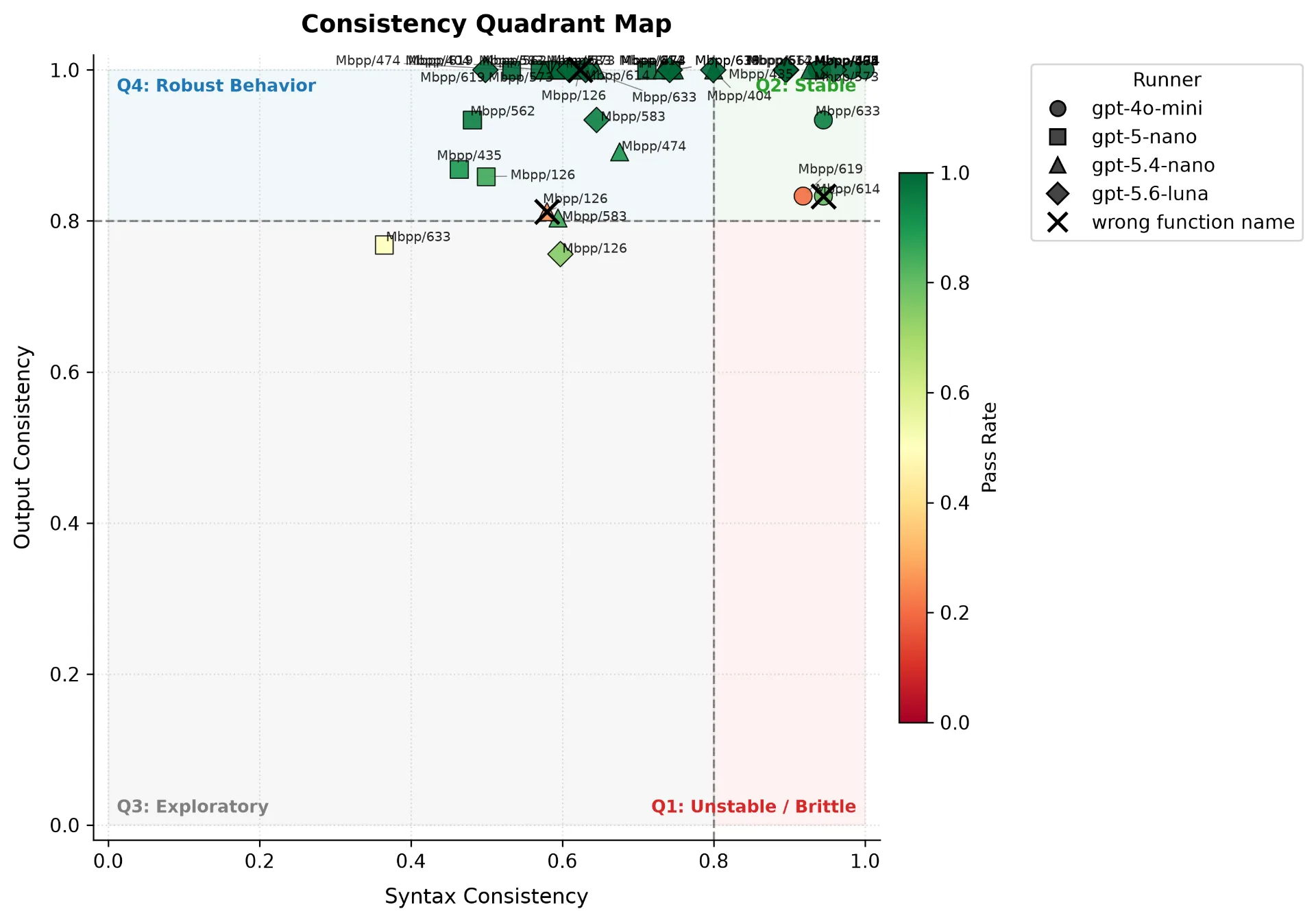
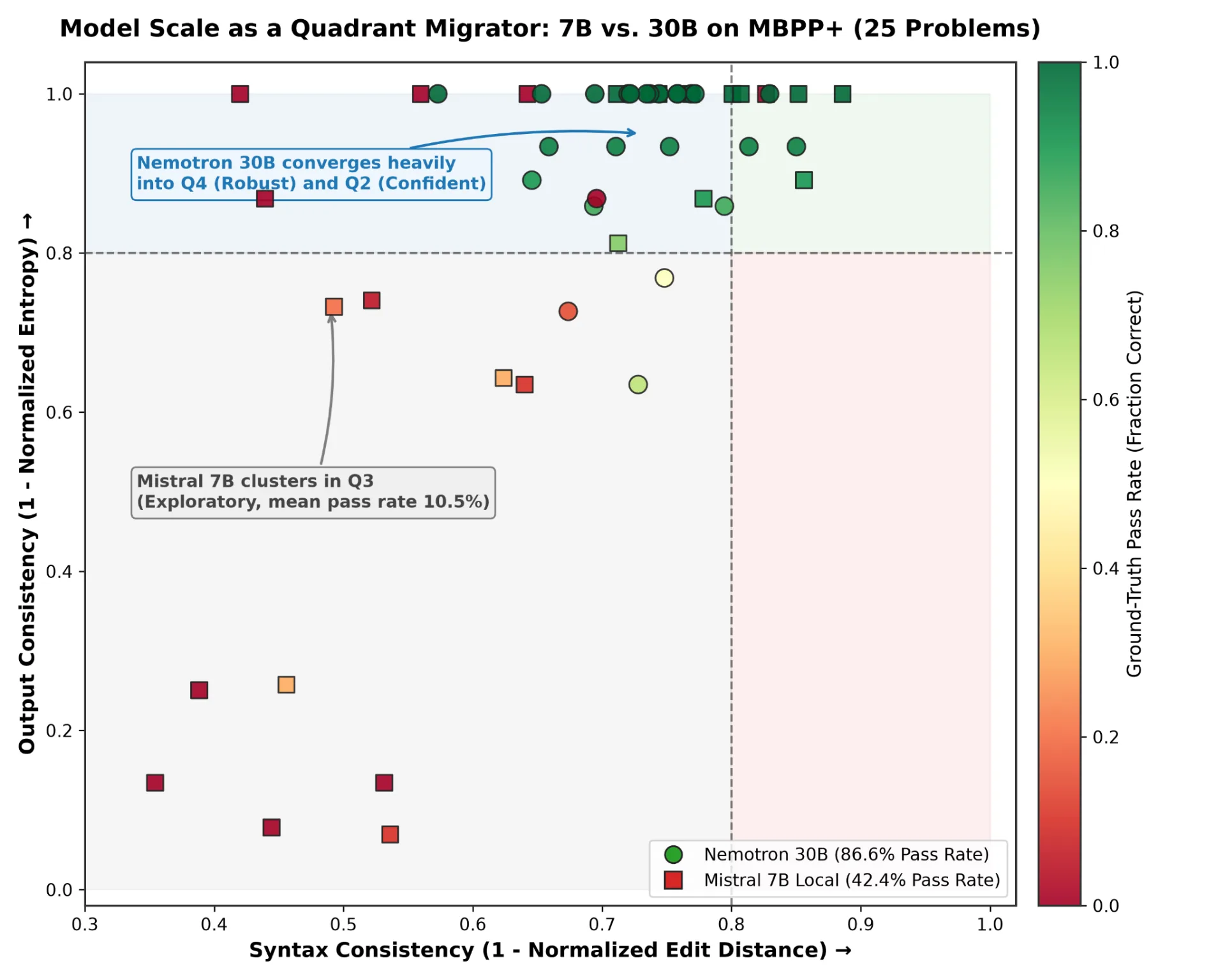
Empirical experiments run on standard datasets—such as variations of the Mostly Basic Python Problems (MBPP) dataset—reveal fascinating anomalies. For instance, when testing powerful models like GPT-4o-mini, GPT-5.4-nano, and Mistral-7b at higher temperatures, pass rates rarely hit 100%, even on trivial logic problems.
Furthermore, temperature sweep experiments demonstrate a complex, non-linear relationship between temperature, syntax variability, and pass rates. While low temperatures reduce syntax variation, they can trap models in suboptimal local minima. Conversely, increasing temperature introduces beneficial problem-solving variability up to a threshold, beyond which syntax errors cause sudden spikes in artificial output consistency due to unrunnable code.
Official Responses and Industry Perspectives
The engineering community remains sharply divided on how to handle the erosion of deterministic control in modern AI development.
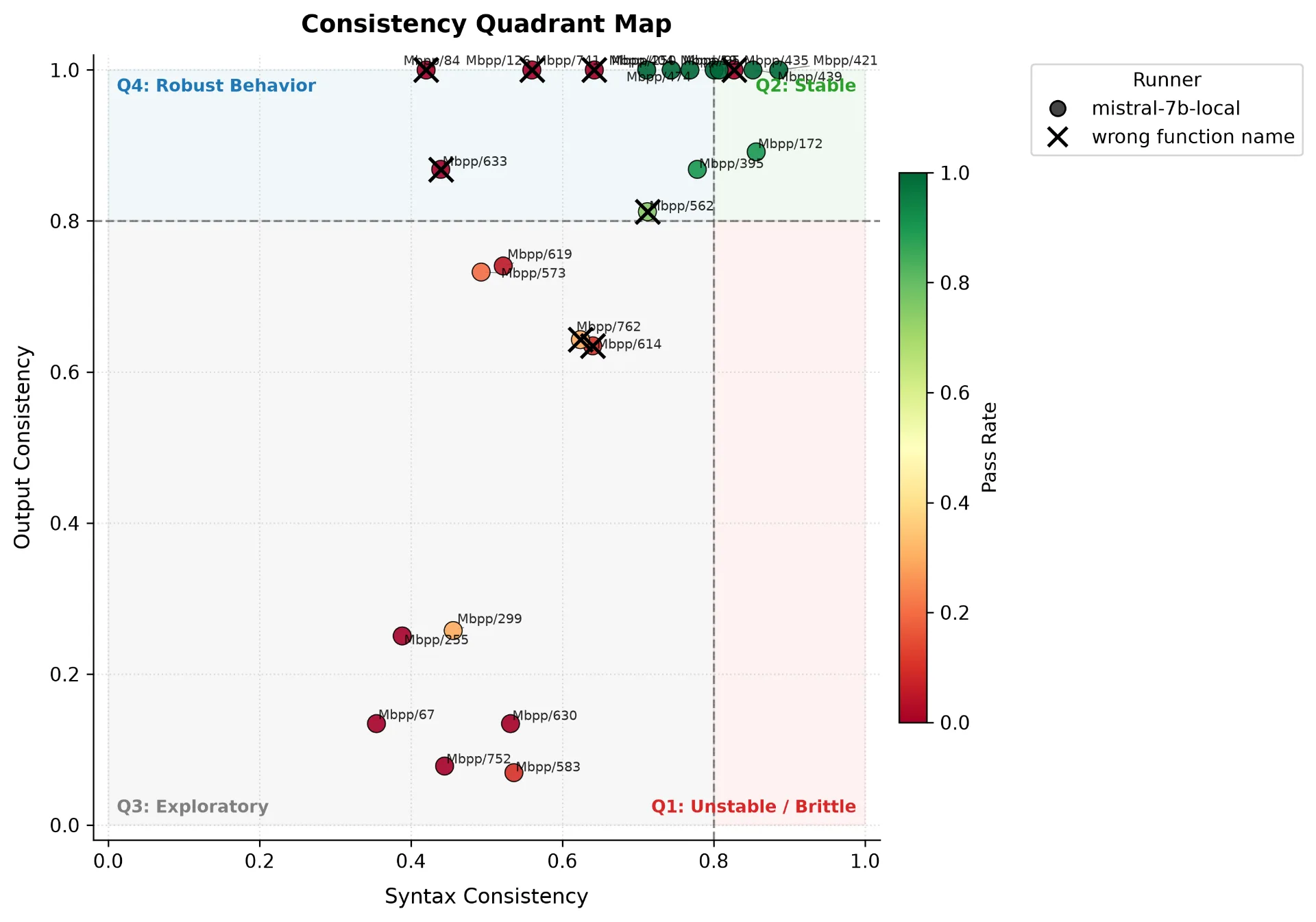
Proponents of advanced coding harnesses argue that strict determinism is an outdated paradigm. They maintain that modern agentic systems are designed to operate more like human software engineering teams—where two developers given the same problem will write different code (low syntax consistency) that ultimately passes the same enterprise integration tests (high output consistency).
Conversely, systems architects and data compliance officers express deep concern over auditability. In human-led analytics, a flawed procedure that is saved and recorded remains an auditable procedure. In contrast, querying an AI agent ten times can yield ten semi-independent analytical paths, turning compliance auditing into a moving target.
Industry researchers point to the recent rise of "System One" architectures—such as newly minted decision models like Jev—as a sign that the industry is actively searching for a middle ground. While these models do not generate code token-by-token, their classification consistency far surpasses traditional LLMs, offering a potential glimpse into how future coding harnesses will maintain predictable control boundaries.
Implications: What This Means for the Future of Software Engineering
The formalization of consistency frameworks like the cca package signals a maturing ecosystem. As AI transitions from a productivity-enhancing add-on to an indispensable, autonomous core of the technology workplace, several critical implications emerge:
- The Death of "Single-Shot" Confidence: Relying on a single API call to build critical software infrastructure is becoming professionally untenable. Enterprise development workflows must adapt to multi-sample validation, treating AI outputs not as definitive answers, but as statistical distributions that must be measured.
- The Cost of Rigorous Evaluation: Running consistency experiments across dozens of models, multi-step agents, and extensive test suites is computationally expensive and resource-intensive. Organizations will need to balance the cost of rigorous consistency auditing against the risk of unverified AI hallucinations.
- Redefining Developer Roles: As AI tools shoulder the burden of mechanical code generation, software engineers are stepping further away from the inner workings of syntax. Success in the industry will no longer be defined by how fast a developer can write a function, but by their ability to design comprehensive test suites, validate multi-sample outputs, and architect robust guardrails around non-deterministic systems.
Ultimately, non-determinism is not an inherent flaw in generative AI; it is the biological-inspired engine of its creativity. The challenge for the next generation of engineers is not eliminating that chaos, but successfully building the tools required to measure, manage, and master it.



