










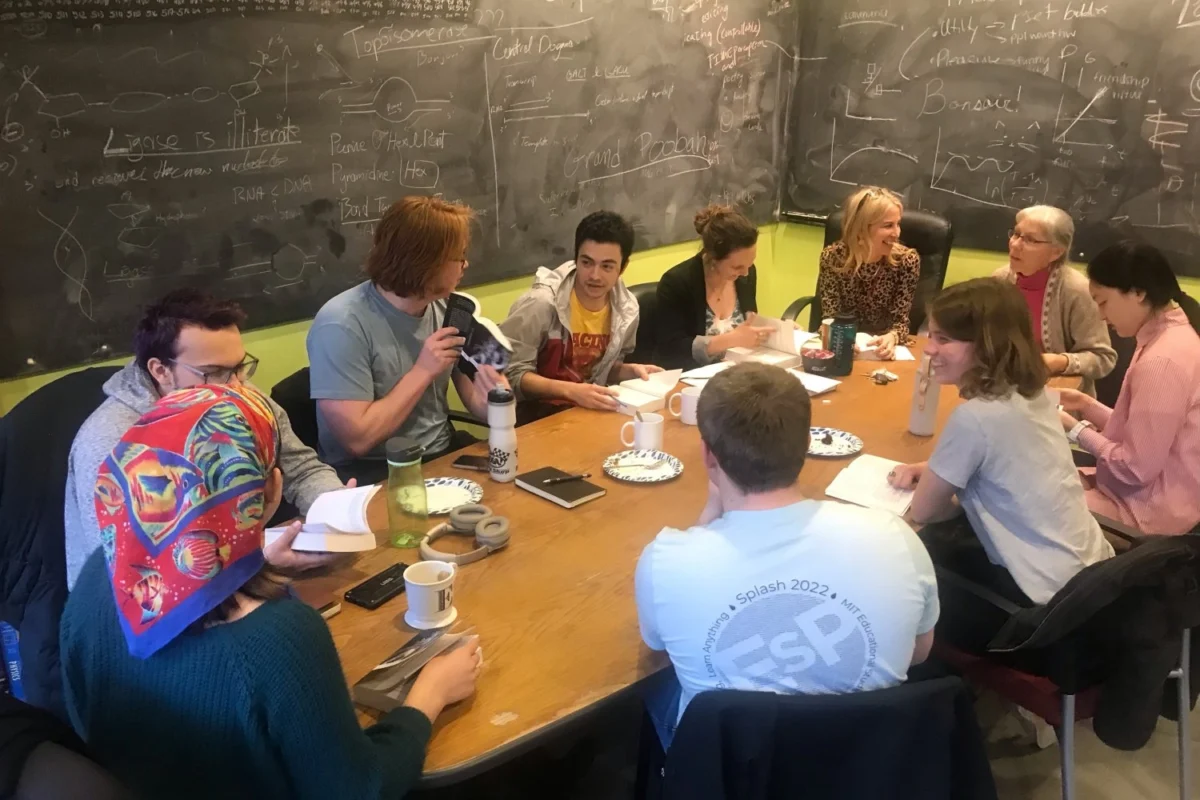
In an era defined by the rapid ascent of generative artificial intelligence and the increasing automation of cognitive labor, the halls of the Massachusetts Institute of Technology (MIT) are fostering a counter-intuitive sanctuary. While the world debates the technical limitations and potential dangers of large language models, a select group of first-year students is engaging in a project far older than the silicon chip: the rigorous examination of what it means to be human.
At the center of this pedagogical effort is Concourse, one of MIT’s most storied first-year learning communities. Founded over 50 years ago, Concourse serves as a "mini-liberal arts college" embedded within the world’s premier institute for science and technology. Here, students who have arrived to build the future of robotics, biotechnology, and computer science are tasked with something equally daunting: reading the great books and learning how to think critically about the moral, political, and philosophical challenges that technology alone cannot solve.
The Chronology of a Humanistic Legacy
The roots of Concourse trace back to 1970, a decade marked by social upheaval and a growing realization that the technical specialization of the post-war era required a stronger ethical framework. Faculty from the humanities, engineering, and science departments sought to bridge the widening chasm between their respective disciplines. They envisioned a "concourse"—a meeting place—where ideas could flow freely between the laboratory and the library.
For over half a century, the program has evolved while maintaining its core mission. Throughout the 1980s and 90s, as the digital revolution began in earnest, Concourse became a vital hub for students who refused to compartmentalize their intellectual interests. By the early 2000s, the program had solidified its reputation as a transformative space, attracting a diverse cohort of 50 students annually—individuals who were as likely to be found debating Aristotle in a seminar room as they were to be solving complex partial differential equations in a lab.
In 2010, Senior Lecturer Linda Rabieh joined the faculty, bringing a renewed focus on the integration of humanistic inquiry with the realities of modern life. Under the long-standing stewardship of scholars like Anne McCants, the Ann F. Friedlaender Professor of History, the program expanded its collaborative advising model, creating a "whole-student" approach that supported pupils through their entire four-year undergraduate career.
Today, as the program enters its next chapter, Ford Professor of Political Science Lily Tsai has taken the helm as director. Her appointment signals a strategic alignment between Concourse and broader institutional initiatives, such as the Compass Initiative and the MIT Human Insight Collaborative, which aim to weave humanistic wisdom into the fabric of the Schwarzman College of Computing.
The Architecture of Community: Why "Magic Happens"
The success of Concourse is not found in a textbook, but in its physical and social architecture. Located in Building 16, the program provides a dedicated ecosystem—a classroom, a seminar room, a lounge, and a kitchen. This space acts as an intellectual incubator where the barriers between academic subjects dissolve.
"There is a lot of cross-pollination of conversation and ideas," explains Rabieh. This is literalized during the weekly Friday advising seminars, where students gather over shared meals to dissect texts by Wordsworth, Coleridge, Plato, and Homer. In the fall, the curriculum focuses on the broad arc of the human condition, while the spring semester shifts toward contemporary dilemmas: gene therapy, immigration, and the ethics of digital privacy.
The program’s "magic," as described by senior mathematics student and teaching assistant Johnnie Jones VI, lies in its self-selection. Despite being an intense, rigorous program, it attracts a microcosm of the entire MIT student body. "Athletes, people who are interested in humanities, people who have no experience in humanities—somehow, 50 people every year self-select into this space, and magic happens," Jones observes.
This "magic" is built on a foundation of trust. By taking multiple courses together and sharing the rhythms of daily life, students develop the vulnerability required for deep, uncomfortable, and necessary conversations.
Supporting Data: The Case for Liberal Arts in STEM
The necessity of programs like Concourse is supported by the changing nature of the workforce. As AI begins to automate routine technical tasks, the value of "human-in-the-loop" decision-making is rising.
Assistant Director Sasha Rickard, an alumna of the program, notes a recurring pattern in the maturity of the students. Incoming freshmen often arrive with one of two default positions: either they are hyper-confident in their political and moral certainties, or they are paralyzed by the belief that there are no objective truths to be found.
"Some students come to understand that they need to learn from others," says Rickard, "and others learn that they really can think for themselves, and they do have something to say."
This is the "non-quantitative" skill set that Rabieh argues is essential for the modern leader. While MIT students are world-class at quantitative reasoning, they often lack a framework for navigating issues where there is no "correct" answer—issues of policy, morality, and justice. Concourse teaches them that these questions, while not solvable by an algorithm, are still subject to rigorous, logical, and disciplined thought.
Official Responses: Navigating the Future
The transition of leadership from Anne McCants to Lily Tsai represents a critical juncture for Concourse. McCants, who led the program for 14 years, emphasizes that the greatest loss for a faculty member is the professional siloing that occurs in traditional departments. "Having a group of committed educators from different disciplines in sustained conversation is a remarkable feature of Concourse," she says.
Her successor, Lily Tsai, views the program as a vital tool for the future of technological governance. "At a time when the whole world is seeking to ground our use of powerful technologies in thoughtful, principled judgment, Concourse seems all the more vital," Tsai notes.
Tsai’s vision for the program is to serve as a beacon for the broader university, demonstrating that technical prowess and humanistic sensitivity are not mutually exclusive. By integrating Concourse into the wider efforts of the School of Humanities, Arts, and Social Sciences (SHASS), she intends to ensure that the "ethos of Concourse"—the commitment to deliberation and the refusal to accept easy answers—is scaled to meet the challenges of the AI age.
Implications: The Humanistic Edge in an Age of Algorithms
What are the long-term implications of training the next generation of engineers to think like philosophers? The primary benefit is the cultivation of "principled judgment."
In the development of artificial intelligence, the most pressing questions are not technical—they are moral. How do we ensure that algorithms respect privacy? How do we mitigate the bias inherent in training data? How do we define "intelligence" when it exists in a machine?
Concourse students are uniquely equipped to interrogate these questions. As Johnnie Jones VI points out, the program’s greatest gift is not a specific set of facts, but the ability to "work through ideas myself." This habit of mind—the ability to sit down with a complex, potentially 300-year-old text and find relevance for a modern technical challenge—is the ultimate "soft skill."
It is the difference between a coder who simply executes a task and a leader who understands the societal impact of their work. As the boundaries between the digital and physical worlds blur, the need for individuals who can navigate the ambiguity of the human experience becomes paramount.
For the 50 students who enter the Concourse program each year, MIT is not just a place to learn the laws of physics; it is a place to examine the laws of human existence. By fostering a community that values debate, reflection, and the "great books," Concourse ensures that the technological progress of tomorrow will be guided by the enduring wisdom of yesterday. In the face of a rapidly changing zeitgeist, this humanistic foundation is not just a relic of the past—it is the most important asset for the future.



