










By the Tech & Marketing Editorial Desk
Published: October 2026
Main Facts: The Shift from Traditional PR to AI Visibility
The foundational purpose of digital public relations has always remained steadfast: earning credible third-party media coverage to influence audiences that paid advertising channels cannot organically reach. However, the definition of "showing up" in the modern media landscape has undergone a radical, technology-driven transformation.
Today, when modern buyers and consumers research a product category, evaluate software, or look for service recommendations, they increasingly turn to AI-powered answer engines rather than traditional search engine results pages. Appearing directly within these conversational AI answers represents a powerful form of modern earned media—one that traditional press releases and standard media outreach strategies were never originally designed to capture.
As a result, forward-thinking PR and marketing teams are pulling ahead of the competition by treating AI visibility not as a secondary, downstream byproduct of traditional metrics, but as a primary, measurable outcome of their daily work.

Chronology: How Digital PR Met Artificial Intelligence
To understand where the public relations industry stands today, it is helpful to trace the rapid evolution of how brands build authority and how audiences consume information:
- The Pre-Digital Era: PR success was almost entirely defined by print circulation numbers, television broadcast segments, share-of-voice counts, and physical column inches.
- The Rise of Digital PR (2010–2020): As media shifted online, the industry pivoted. Success began to be measured through backlink acquisition, domain authority (DA), organic referral traffic, and estimated media reach. Press releases and digital pitching targeted high-authority news sites to boost SEO rankings.
- The Generative AI Disruption (2023–2025): The mass adoption of conversational AI search tools and answer engines fundamentally altered user behavior. Instead of clicking through ten blue links, users began asking AI models complex, multi-layered questions and receiving synthesized, direct answers. Traditional SEO and digital PR strategies struggled to track how brands were being cited within these closed-loop AI responses.
- The AEO Integration (Present Day): The introduction of dedicated Answer Engine Optimization (AEO) toolsets—such as HubSpot’s pioneering AEO solutions—has allowed marketing and PR departments to formally bridge the gap between earned media placements and AI citation tracking, establishing a new operational standard for brand visibility.
Supporting Data: The Metrics That Matter in an AI-First World
The relationship between traditional earned media placements and AI visibility is real, yet it is far from uniform. Industry data reveals a critical disconnect: securing a high-profile feature in a top-tier media outlet does not automatically translate into a citation within an AI answer engine.
The Uneven Distribution of AI Citations
Research into citation mechanics indicates that certain types of publications and specific content formats generate AI citations at exponentially higher rates than others. For example:
- Comparison and Round-up Articles: Data from HubSpot’s internal marketing team illustrates the magnitude of this shift. Following a strategic pivot toward optimizing content types, HubSpot recorded an astounding 642% increase in citations for comparison articles and a corresponding 58% increase in overall brand mentions across major answer engines.
- The Pitfall of Volume-Based Metrics: Teams that continue to measure PR success solely by the sheer volume of placements, domain authority scores, or estimated audience reach are often optimizing for legacy metrics that no longer capture true market influence.
Bridging the Accountability Gap
To solve this visibility puzzle, modern marketers are leveraging specialized toolsets to audit their media strategies:

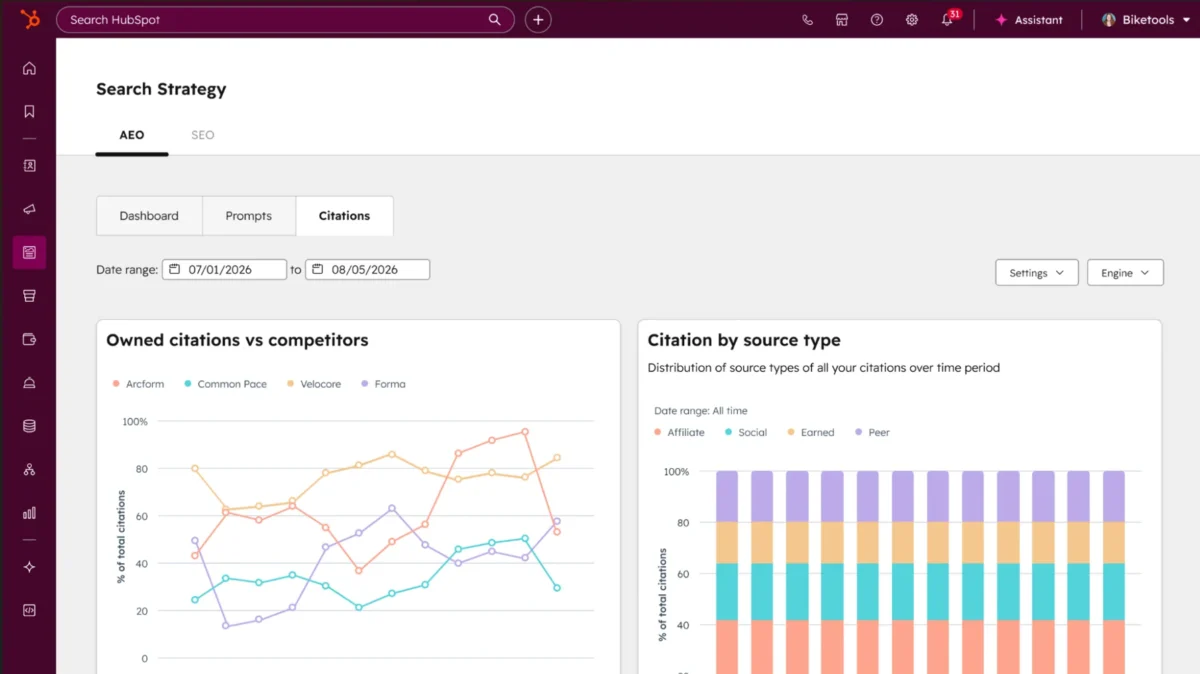
- Citation Analysis: Platforms like HubSpot AEO’s Citation Analysis feature surface the exact publications and content categories that successfully generate citations in answer engines. This allows PR professionals to immediately identify which third-party outlets actively contribute to brand visibility and which fail to move the needle.
- Targeted Recommendations: AEO recommendation engines automatically analyze a brand’s citation profile to flag structural gaps, highlighting the specific source types and content angles required to boost a brand’s overall AI visibility score.
- Comprehensive Visibility Dashboards: Brand visibility dashboards track key indicators—including composite visibility scores, direct citations, and dynamic share of voice—over the lifespan of a campaign, providing hard data to prove campaign ROI.
Official Responses and Industry Perspectives
As the line between search engine optimization, content marketing, and public relations continues to blur, industry leaders are weighing in on the necessary adaptation of agency and in-house workflows.
"Digital PR has always been about earning coverage that influences the audience you can’t reach through paid channels," notes leading marketing analysts. "While the core value proposition hasn’t changed, the battlefield has shifted entirely to conversational AI interfaces. If your brand isn’t cited when an AI engine answers a buyer’s question, your traditional media wins are missing half their modern value."
Agency executives emphasize that while the media outlets influencing AI answers are largely the same trusted publications PR professionals have pitched for decades, the internal execution must change.
"It is no longer enough to land a great story and walk away with a clipping and a backlink," explains a corporate communications director. "We must now analyze how that story is structured, whether it answers buyer intent queries, and if it features the comparative framing that AI engines look for when synthesizing market recommendations. PR is now an algorithmic science just as much as it is an art of relationship-building."

Implications: What This Means for Brands and PR Professionals
The rise of Answer Engine Optimization carries profound strategic implications for marketing departments, public relations agencies, and corporate communications leaders worldwide.
1. The Redefinition of Media Outreach Priorities
Media lists can no longer be built solely on an outlet’s global prestige or massive readership numbers. PR teams must cross-reference target publications with AI citation data. If a prestigious publication rarely appears in answer engine responses for key category queries, pitching resources may be better allocated toward niche, high-citation industry publications or specialized review formats.
2. Closer Alignment Between SEO, Content, and PR
Silos within marketing organizations must fall away. Public relations teams, content creators, and SEO/AEO specialists must operate as a unified unit. PR professionals secure the foundational third-party validation and media placements, while content teams ensure that owned assets (like comparison guides and product roundups) are optimized to capture AI citations.
3. Demonstrating Quantifiable Business Impact
Historically, PR has struggled to prove direct attribution to revenue and pipeline growth, often relying on "Advertising Value Equivalency" (AVE) metrics that modern executives view with skepticism. AEO changes this dynamic by providing cleaner, more direct signals. Changes in AI visibility scores, citation frequencies, and generative share of voice are directly attributable to specific PR campaigns and content investments.

4. Future-Proofing Brand Authority
As conversational AI becomes the default starting point for consumer research and enterprise software evaluation, brands that fail to optimize for answer engines risk becoming invisible—regardless of how many traditional press releases they distribute. By embracing AEO-driven PR strategies today, organizations can secure their digital legacy, ensuring they remain top-of-mind not just for human readers, but for the artificial intelligence systems guiding modern commerce.



