










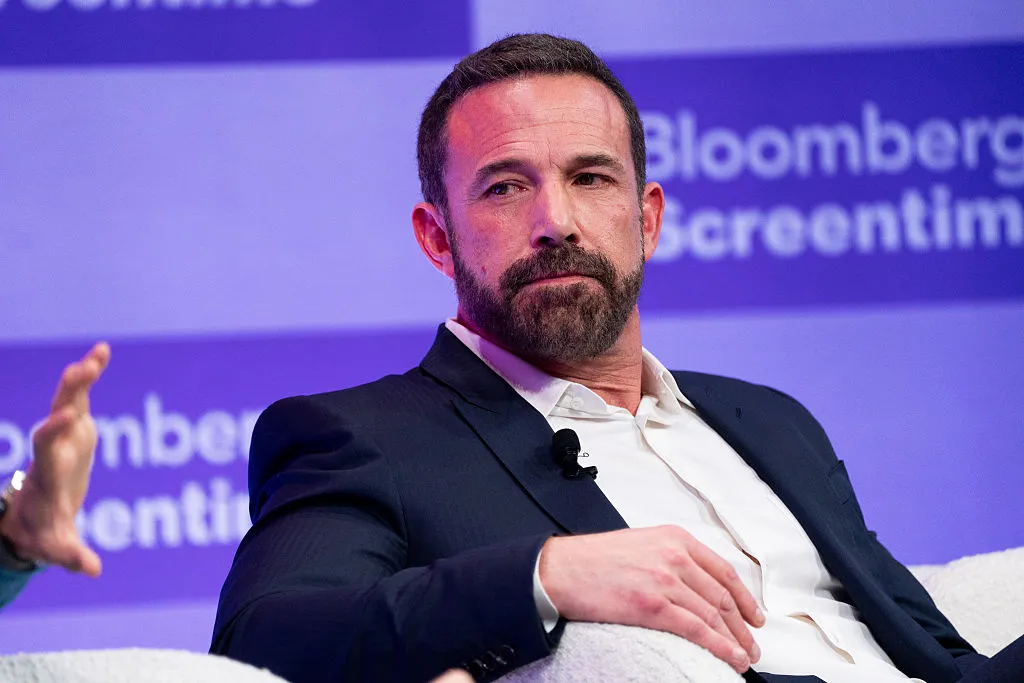
It turns out the genius behind Good Will Hunting wasn’t just a character on the page—he was the man holding the pen. In a turn of events that has captivated both Silicon Valley and the entertainment industry, Ben Affleck has emerged not merely as a Hollywood A-lister, but as a sophisticated architect of artificial intelligence. Following the blockbuster sale of his AI-driven filmmaking startup to Netflix earlier this year for a reported $587 million, Affleck has spent the last week dominating social media feeds, not for his latest blockbuster performance, but for his surprisingly granular, expert-level fluency in neural networks, tensor mathematics, and machine learning architectures.
For years, the public perceived Affleck as a traditionalist—a director and actor deeply rooted in the craft of analog film and studio storytelling. Yet, recent interviews, most notably on GQ’s One More Question series and Bloomberg’s Screentime 2026 conference, have unveiled a dual identity: a filmmaker who has spent years quietly mastering the complexities of the digital frontier.
The Technical Deep Dive: Beyond the Hollywood Veneer
When Affleck sat down with GQ’s Zach Baron, he began with a humble admission: "I’ve always been kind of into computers since I was young." However, the ensuing conversation was anything but casual. Affleck pivoted effortlessly into a technical breakdown of how AI is reshaping the cinematic workflow.
He didn’t speak in the vague, high-level platitudes often adopted by celebrities dabbling in tech. Instead, he spoke the language of a data scientist. Explaining his early interest in the transition from analog to digital film, Affleck detailed the evolution of visual effects, noting, "The visual effects workflow for many years has included machine learning."
Perhaps the most viral moment of the interview arrived when Affleck described the internal mechanics of deep learning. "I can write, like, pretty shitty Python scripts and stuff like that," he joked before launching into a precise explanation of convolutional neural networks (CNNs). He described the shift from older CNNs to modern transformer architectures, emphasizing the increase in simultaneous computation.
He didn’t stop there. Affleck demystified the concept of "tensors," describing them as the numerical translation of visual images—a matrix containing frame numbers, batch sizes, and the precise RGB values for every pixel. To the uninitiated, it sounded like a lecture from a computer science department head. To the internet, it was a revelation: the man behind Argo was explaining backpropagation and feature extraction with the ease of a seasoned engineer.
A Chronology of Innovation: From Cinephile to Code
The narrative of Affleck’s technical evolution is one of sustained curiosity rather than a sudden pivot.
- 2022: Affleck founds InterPositive, a boutique, 16-person startup focused on the intersection of generative AI and professional film production.
- 2023–2024: During this period, Affleck leveraged his industry connections to gain behind-the-scenes access to organizations like OpenAI. He began treating these visits not as tourist excursions, but as opportunities to understand the "inference code" and dataset architecture required to build meaningful, industry-specific AI tools.
- 2025: Affleck embarks on an ambitious eight-month data collection project. Recognizing that off-the-shelf generative AI models often struggled with the nuances of professional cinematography, he utilized custom camera setups and proprietary equipment to generate a unique, high-fidelity dataset.
- 2026 (Mid-Year): The acquisition of InterPositive by Netflix is announced. While Affleck has publicly challenged the $587 million valuation—noting that his equity stake was not total—the deal signaled a massive vote of confidence from the streaming giant in his vision for AI-integrated production.
- October 2026: Affleck makes waves at the Screentime conference, publicly discussing the fine-tuning of open-source models by "unfreezing weights" to meet exacting cinematic standards.
The Philosophical Framework: AI as an "Additive" Tool
Affleck’s approach to AI is rooted in a philosophy of augmentation rather than replacement. In his view, the hysteria surrounding AI—particularly the "Skynet" narrative—is misplaced.
"When I worry about AI, I worry about my kids in school," he remarked during his Screentime appearance. "I worry about the 30% rise in the number of A’s given out at colleges over the last three years. I worry about learned helplessness."
Affleck’s concern is not that machines will develop sentience and overthrow human civilization, but that the ubiquity of generative tools will stifle human critical thinking and craftsmanship. Within the context of filmmaking, he views AI as a way to handle the "drudgery" of production—tasks like rotoscoping, edge detection, and complex compositing—so that artists can spend more time on creative decision-making.
He is particularly vocal about the ethical dimensions of data. "I gambled on this notion that in order to do this in an ethical way… we had to create our own dataset," he explained. By prioritizing the creation of proprietary, ethically sourced training data, he aims to ensure that filmmakers retain ownership of their work, creating a "hand-in-glove" relationship between the artist and the algorithm.
Supporting Data: The Mechanics of the "Animals" Workflow
The practical application of Affleck’s theory was put to the test in his recent project, Animals. During the post-production process, his team utilized AI models that were fine-tuned specifically for the movie’s unique visual language.
The process, as described by Affleck, involves taking open-source foundational models and training only the "last cinematic layer." This allows the crew to maintain the stylistic integrity of their film while benefiting from the massive computational power of the underlying AI. By unfreezing the weights of these models and retraining them on proprietary cinematic datasets, the production team could ensure that the AI-generated elements matched the lighting, grain, and color science of the live-action footage perfectly.
This approach addresses one of the primary critiques of AI in film: the "uncanny valley" or the generic, sterile look that often accompanies early-stage generative video. By focusing on "discrete tasks," Affleck’s models generate value by solving specific production hurdles rather than attempting to "generate" a movie from a text prompt.
Implications for the Entertainment Industry
The implications of Affleck’s work extend far beyond the technical. He represents a new breed of "techno-creative"—an artist who speaks the language of the coder and the director with equal fluency.
1. The Death of the "Black Box" Studio
If Affleck’s model becomes the industry standard, studios will move away from generic, outsourced AI solutions. Instead, they will follow his lead: creating proprietary datasets that reflect the unique aesthetic of their individual studios or directors. This allows for the retention of intellectual property and the protection of an artist’s specific visual "DNA."
2. A Shift in Labor Dynamics
Affleck’s warnings about "learned helplessness" suggest that he is hyper-aware of how these tools could change the film industry workforce. By framing AI as "additive," he is attempting to carve out a future where the role of the editor, VFX artist, and cinematographer evolves rather than disappears. However, this creates an industry-wide imperative: the next generation of filmmakers must be as comfortable with Python as they are with a Panavision lens.
3. The Valuation of "Human-in-the-Loop" Systems
The massive interest from Netflix in InterPositive suggests that the industry is moving away from purely generative models toward "controlled" AI systems. Investors are no longer looking for "AI that can make a movie"; they are looking for systems that can integrate into a $200 million production schedule without disrupting the delicate balance of relationships and union agreements that define Hollywood.
Conclusion: The New Maverick
Ben Affleck’s transition from a movie star to a tech visionary serves as a case study for the future of professional creative work. By grounding his interest in hard science and ethical data practices, he has bypassed the superficial "AI influencer" stage to become a legitimate force in the evolution of cinema.
As he continues to balance his roles as a producer, director, and tech entrepreneur, one thing is clear: the man who once wrote about a janitor with a secret genius is now the one proving that in the modern era, the greatest power is not in the fame you hold, but in the models you build. Whether or not his "shitty Python scripts" eventually power the next generation of blockbuster cinema, Affleck has successfully forced Hollywood to confront a new reality—one where the gap between the film set and the server room is closing faster than anyone anticipated.



