










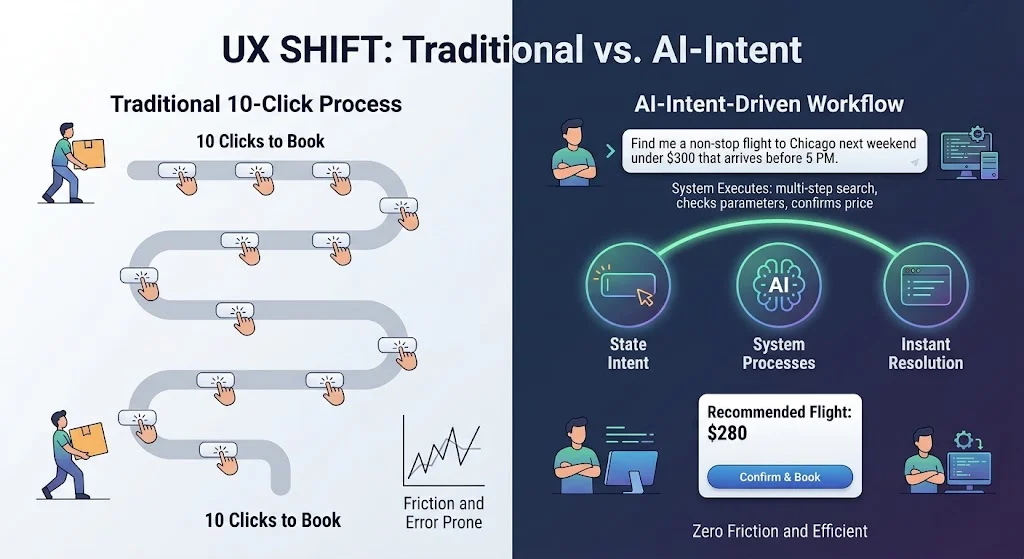
For over four decades, the digital landscape has been defined by the Graphical User Interface (GUI). From the Xerox Star to the original Apple Macintosh, we have been conditioned to view software as a labyrinth: a series of menus, range sliders, multi-step forms, and endless browser tabs. We have accepted the "ten-click process" as the standard cost of doing business online. However, a seismic shift is underway. As Artificial Intelligence and Large Language Models (LLMs) mature, the web is evolving beyond the point-and-click paradigm toward a new philosophy: Intent-Driven Design.
The ultimate goal of modern web development is no longer to build prettier buttons or more engaging animations; it is, quite simply, to eliminate the interface entirely.
The Chronology of Control: From Command-Line to Intent
The history of computing has been a gradual move toward abstraction. In the early days, users were forced to learn syntax to communicate with machines. The GUI arrived as a revolution, replacing arcane commands with visual metaphors—folders, desktops, and trash cans.

For years, UX designers focused on perfecting these visual metaphors. We obsessed over "conversion funnels," "call-to-action buttons," and "user paths." We built software that demanded constant attention, turning users into data entry clerks who had to manually orchestrate every micro-step of a task.
Today, we are witnessing the third major epoch of human-computer interaction (HCI). After the Command-Line Era and the GUI Era, we have entered the Agentic Era. In this phase, the computer ceases to be a passive container of data and becomes an active partner. Instead of navigating a website to perform a task, the user expresses a high-level goal, and the AI agent executes the necessary operations in the background.
The "10-Click" Friction: A Quantifiable Problem
To understand the necessity of this shift, consider the traditional workflow of booking a flight. Currently, the user is the orchestrator:
- Open a browser tab.
- Navigate to a travel aggregator.
- Input origin and destination.
- Select dates from a calendar widget.
- Filter by price, duration, and stops.
- Interpret the results.
- Open multiple tabs to cross-reference options.
- Fill out passenger details.
- Manage cookies and pop-ups.
- Finally, execute the transaction.
This is a classic "point-and-click" paradigm. It is labor-intensive, prone to error, and cognitively draining. Intent-driven design flips this. A user simply states: "Find me a non-stop flight to Chicago next weekend under $300 that arrives before 5 PM." The software consumes this intent, runs the search, compares the data, and presents a single, actionable resolution. The friction of ten clicks dissolves into one clear outcome.
Case Studies: Pioneers of the Invisible Interface
The transition to intent-driven systems is not theoretical; it is already happening across three primary domains:
1. Perplexity AI: The End of Search Tab-Fatigue
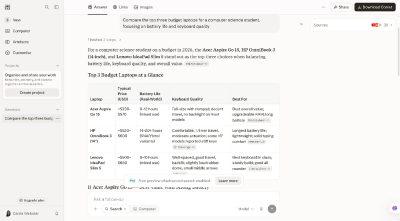
Traditional search engines like Google were built as directories. You typed a keyword, and the interface rewarded you with a list of "ten blue links." The user was then tasked with the manual labor of opening multiple tabs, skimming articles, and synthesizing information. Perplexity AI has effectively bypassed this by synthesizing answers directly. It acts as an intelligence layer that removes the need for the user to navigate the directory, providing a curated, context-aware resolution to the user’s query.
2. Vercel v0: Generative UI
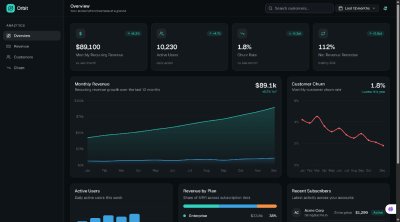
Web design has historically been a manual craft involving drag-and-drop builders, hexadecimal codes, and padding adjustments. Vercel’s v0 platform changes this by enabling users to describe a functional interface and having the AI render the code and layout instantly. By moving from manual construction to outcome-specification, Vercel demonstrates that the UI itself can be ephemeral, generated on the fly to meet the specific requirements of the moment.
3. Goblin.tools: Cognitive Offloading
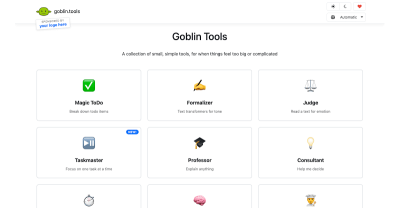
Productivity software has traditionally been burdened by complex Kanban boards and rigid task-management hierarchies. Goblin.tools provides a suite of AI-driven, single-task utilities that prioritize accessibility and simplicity. For neurodivergent users or those experiencing cognitive overload, the tool breaks down massive goals into manageable micro-tasks without the overhead of administrative setup. It is a prime example of an interface that prioritizes function over form.
The Pillars of Intent-Driven UX
When removing menus and forms, designers must rely on a new set of principles to maintain usability:
- High-Level Goals: Systems must leverage context (device state, location, past behavior) to anticipate needs. Rather than waiting for a command, the system acts proactively.
- Generative UI: Interfaces should be dynamic. If a user needs a calculator, the system generates a calculator widget that appears for the duration of the task and vanishes when the goal is achieved.
- Autonomous Execution: AI agents take the burden of "execution" off the user. This necessitates a shift in error management—moving from "prevention-based" pop-ups (e.g., "Are you sure?") to "recovery-based" mechanisms (e.g., a prominent "Undo" button).
Ethical Implications and the "Black Box"
The shift to agentic systems introduces significant risks. When software acts on inferred intent, it can quickly feel patronizing or invasive. Designers must walk a fine line between helpful automation and loss of agency.
The Stanford HCI Group and the Center for Humane Technology warn that automation must have clear, transparent boundaries. Furthermore, there is the "Black Box" problem. In a traditional UI, if something goes wrong, a user can trace their steps through the buttons they clicked. In an AI-driven system, if the machine arrives at an incorrect conclusion, the user may not know why. As advocated by the Google PAIR (People + AI Research) Guidebook, systems must include transparent feedback loops, stating clearly: "I am searching for X because you said Y." This allows users to calibrate trust and correct the AI’s path in real-time.
The Role of the Designer: Re-evaluating the Craft
For UX professionals, this transition is both a challenge and an opportunity. The role of the designer is shifting from "architect of buttons" to "curator of outcomes."
We must move away from designing static, rigid forms and toward mapping dynamic, generative components. The skills of the future will involve:
- Ambient Feedback: Designing subtle indicators that keep users informed of what the AI is doing in the background.
- Inline Prompting: Providing contextual guidance that allows users to refine AI outputs without leaving their workflow.
- Trust Design: Building systems that are inherently transparent about their decision-making processes.
Conclusion: The Best Interface is No Interface
For decades, the digital industry has used vanity metrics like "time spent in app" and "page views per session" as indicators of success. These metrics encouraged the creation of addictive, interaction-heavy designs.
The philosophy popularized by Golden Krishna’s The Best Interface Is No Interface and the "Time Well Spent" movement represents a radical departure. The true measure of a digital product in the coming decade will be its ability to solve a problem with the least amount of user effort.
We are entering an era where applications will no longer be measured by the beauty of their interfaces, but by their ability to render those interfaces obsolete. The future of the web is not more interaction; it is seamless, invisible completion. As we refine these agent-driven tools, our ultimate success will be marked by the degree to which our software becomes a silent, indispensable, and nearly invisible extension of human intent.



