For years, the Indian startup ecosystem was often described as a "nascent" landscape—an ambitious, high-growth sector characterized by venture capital backing, burn rates, and a relentless pursuit of scale. Today, that narrative has shifted irrevocably. The transition from private venture-backed entities to publicly traded corporations is no longer a distant aspiration; it is the definitive hallmark of an ecosystem that has officially come of age.
As of September 2026, over 70 Indian new-age tech companies have successfully crossed the IPO milestone, marking a transformative era for the country’s capital markets. With a cumulative market capitalization exceeding $192 billion, these companies have moved beyond the "growth-at-all-costs" philosophy, embracing the rigors of transparency, operational efficiency, and long-term viability required by public shareholders.
The 2026 IPO Wave: A New Benchmark for Maturity
The momentum of public listings in India has accelerated significantly over the past two years. While 2025 served as a landmark year—witnessing 18 startups make their debut—the trend has shown no signs of slowing down in 2026. Already, 13 companies have tapped the public markets this year, reflecting a robust pipeline and a resilient investor appetite for technology-led growth stories.
The list of 2026 debutants includes a diverse array of industry leaders, underscoring the broad-based nature of this evolution:
- Logistics: Shiprocket, LEAP India, Shadowfax
- Fintech: Turtlemint, Kissht, Aye Finance
- Enterprise Tech: Fractal Analytics, Amagi, SEDEMAC
- Edtech: Klassroom
- Ecommerce: Rentomojo, Purple Style Labs
- Infrastructure: ESDS
This influx of companies is not merely a quantitative increase; it represents a qualitative shift in how Indian startups approach their business models. The pressure to meet quarterly earnings calls and maintain public-market disclosure standards has forced a "maturation" that many observers believe will strengthen the long-term foundations of the Indian economy.

Chronology of an Evolution: From "Kid" to "Adult"
To understand the current IPO climate, one must look at the historical trajectory of the Indian startup ecosystem. The "startup" label, once synonymous with perpetual losses and massive cash-burn, is being replaced by a focus on sustainable profitability.
The Funding Winter Reality Check (2022)
The 2022 funding winter acted as a critical catalyst. As cheap capital dried up, the ecosystem faced a stark reality: the runway was shortening. This forced a strategic pivot across the board. Startups that were once solely focused on customer acquisition costs (CAC) and gross merchandise value (GMV) were suddenly forced to prioritize Unit Economics and EBITDA margins.
The Path to the Bourse
The average time taken for an Indian startup to reach a public listing currently stands at 11 years. While legacy players like Info Edge (listed in 2006) paved the way, modern entrants are finding diverse pathways to the market. For example, while companies like ixigo and Fino Payments Bank took nearly two decades to reach the public stage, newer, high-velocity firms like ArisInfra have managed to list within four years of operations.
This timeline indicates that while the market is welcoming younger companies, the prerequisite for entry—a clear, proven path to profitability—has become non-negotiable.
Supporting Data: The Profitability Pivot
One of the most compelling aspects of the current "Listed Tech" landscape is the transition from red to green on the balance sheet. According to data tracked by the Indian Listed New-Age Tech Company Tracker, roughly 59 out of the 72 listed companies are currently profitable.

Leading the Charge
- Groww: Leading the pack in terms of profitability, Groww reported a net profit of ₹2,083 Cr in FY26.
- Paytm: Despite a volatile history on the bourses, Paytm has consolidated its position with a profit of ₹553 Cr in FY26.
- Eternal: A major player in the foodtech space, Eternal posted a profit of ₹366 Cr, backed by a massive 169% YoY growth.
The Turnaround Strategy
For companies like Lenskart, the transition has been nothing short of impressive. After reporting a loss of ₹10 Cr in FY24, the company turned the tide, reporting a profit of ₹297 Cr in FY25 and sustaining that growth with a Profit After Tax (PAT) of ₹494 Cr in FY26.
However, the journey is rarely linear. Urban Company, for instance, reported a profit of ₹240 Cr in FY25 but slipped back into a loss of ₹234.8 Cr in FY26, highlighting the inherent volatility of new-age business models as they scale.
Sectoral Dominance and Regional Hubs
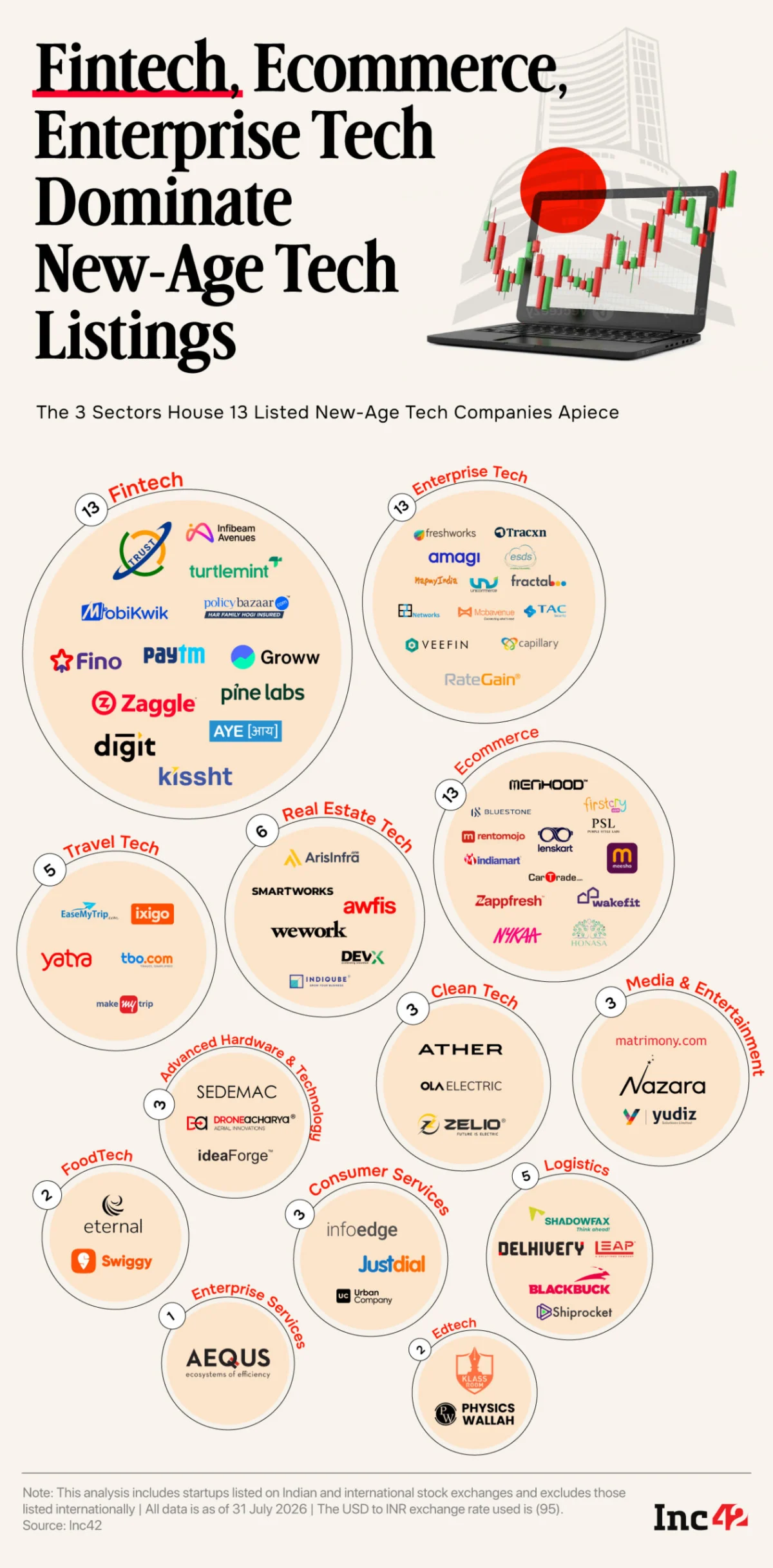
The sectors that dominate the IPO list are a mirror image of the private funding trends from the last decade. Fintech, Ecommerce, and Enterprise Tech account for the majority of the market cap, proving that these sectors have reached a level of maturity that public market investors find "investable."
Delhi NCR: The IPO Powerhouse
While Bengaluru is often hailed as the "Silicon Valley of India," the data paints a different picture regarding public listings. The Delhi NCR region—comprising Delhi, Gurugram, and Noida—has emerged as the undisputed leader.
- Delhi NCR: Home to 25 listed new-age tech companies, contributing a staggering $113.3 billion to the total $190 billion cumulative market cap.
- Bengaluru: Accounts for 15 listed companies.
- Mumbai: Accounts for 11 listed companies.
The concentration of corporate headquarters in the national capital region, particularly in Gurugram, suggests that the "listing infrastructure"—legal, financial, and regulatory advisory—is deeply entrenched in the NCR region.

Implications for the Future: What Lies Ahead?
The rise of the "Indian Listed New-Age Tech" cohort has profound implications for both domestic and international investors.
1. Wealth Creation and Investor Exits
The IPO wave provides a crucial liquidity event for early-stage investors, employees holding ESOPs, and founders. This recycling of capital back into the ecosystem is expected to fuel the next generation of startups, creating a virtuous cycle of investment.
2. Market Sentiment and Valuation
The volatility of some recently listed tech stocks, such as Ola Electric or Delhivery, serves as a reminder that the public market is a harsh taskmaster. Investors are no longer willing to pay a premium for "potential" alone; they demand consistent, predictable growth.
3. The Upcoming Pipeline
The appetite for tech IPOs remains strong. With major names like PhonePe, Zepto, and OYO currently in the wings, the list of public tech companies is set to expand further. The success or failure of these future offerings will likely dictate the IPO "window" for the rest of the market.
Conclusion
The Indian tech startup ecosystem has shed its "childhood" skin. The transition from private, opaque, and cash-burning entities to public, transparent, and profit-conscious corporations is a significant milestone in India’s economic narrative.

As we look toward the remainder of 2026 and beyond, the focus will undoubtedly shift from how many companies are listing to how well they are performing post-listing. The Indian Listed New-Age Tech Company Tracker will continue to serve as the definitive lens through which to view this historic transition, offering the data, transparency, and analysis required to navigate the complex, rewarding, and high-stakes world of Dalal Street’s new-age tech titans.
Data Source: Inc42 Indian Listed New-Age Tech Company Tracker, as of September 19, 2026.