










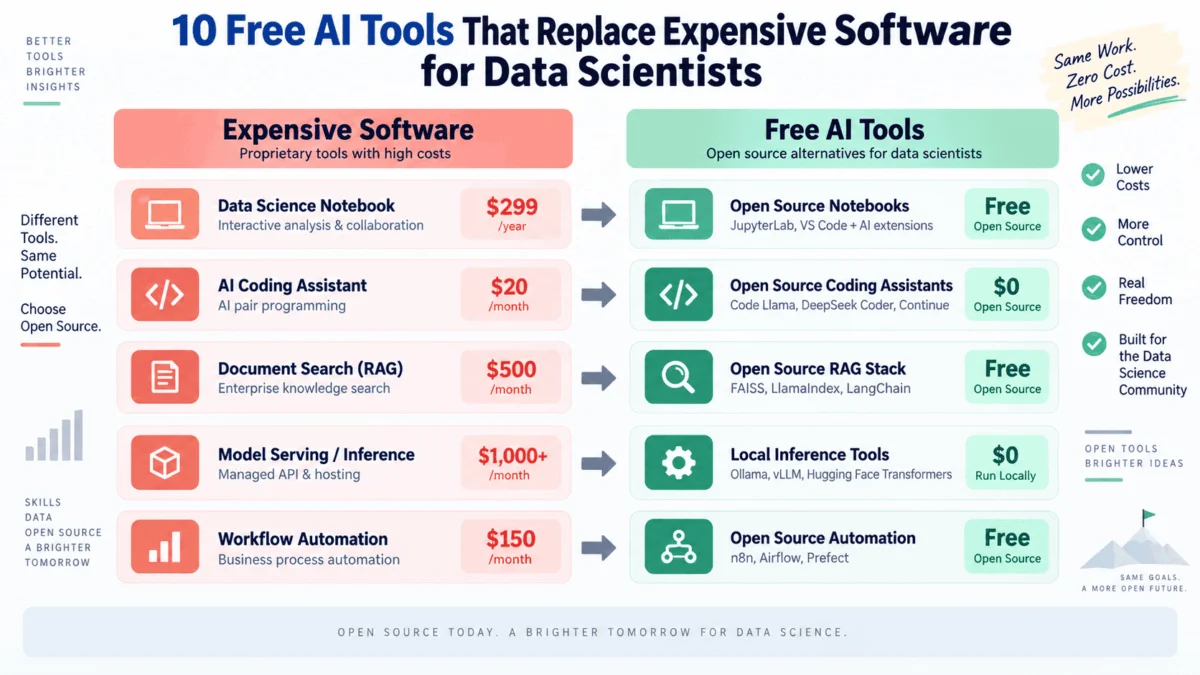
In the rapidly evolving landscape of artificial intelligence and data science, a quiet revolution is underway. For the past decade, the industry has been defined by the "SaaSification" of the data stack—a model where enterprises pay heavy premiums for managed platforms that handle everything from machine learning pipelines to LLM observability. However, the economic reality of these subscriptions is becoming increasingly unsustainable. With enterprise data science seats often costing upwards of $50,000 annually and LLM API inference fees scaling uncontrollably with data volume, organizations are reaching a breaking point.
The paradigm is shifting. A new generation of open-source, local-first tools has reached a level of maturity where the "gap" between proprietary software and free alternatives has effectively closed. Today, teams can replicate the functionality of industry titans like DataRobot, Tableau, and Snowflake without incurring a single dollar in licensing fees.
The Economic Imperative: Why the Enterprise Model Is Faltering
The primary driver of this shift is the "per-token" and "per-seat" tax. As organizations integrate Large Language Models (LLMs) into their core workflows—such as continuous document extraction or real-time summarization—the costs associated with commercial APIs like OpenAI or Anthropic can spiral into thousands of dollars per month with no visible ceiling.
Furthermore, data privacy has become a paramount concern. When sensitive, proprietary code or confidential client data is sent to external cloud servers, it triggers intensive compliance reviews and security risks. By moving to a local-first architecture, teams reclaim sovereignty over their data, ensuring that proprietary assets never leave their secure internal environment.
10 Strategic Replacements for the Modern Data Stack
The following breakdown maps the most expensive categories in the modern data stack to their high-performance, open-source counterparts.
1. The Inference Layer: Ollama + Open WebUI
Replacing: OpenAI and Anthropic APIs
The reliance on external LLM APIs creates a massive variable cost that makes long-term budgeting impossible. Ollama allows developers to run state-of-the-art open-weight models—such as Llama 3.3, DeepSeek-R1, and Mistral—locally on internal hardware. When paired with Open WebUI, teams gain a sophisticated, ChatGPT-like interface that supports multi-turn conversations and document uploads. This combination eliminates API costs while ensuring that sensitive data remains air-gapped from the public internet.
2. The AI Coding Assistant: Tabby
Replacing: GitHub Copilot and Tabnine
For developers, context is king. While GitHub Copilot is a market leader, its reliance on Microsoft’s cloud infrastructure presents a compliance hurdle for many regulated industries. Tabby provides a self-hosted alternative that integrates seamlessly with VS Code and JetBrains. Its superpower is its ability to perform repository-level indexing, allowing the AI to understand internal libraries and proprietary conventions far more effectively than generic, cloud-based competitors.
3. The AutoML Engine: AutoGluon
Replacing: DataRobot and H2O Driverless AI
Enterprise AutoML platforms command six-figure annual contracts. AutoGluon, developed by the team at AWS, offers an open-source alternative that frequently outperforms its commercial counterparts on tabular and multimodal benchmarks. Because it operates entirely within a local Python environment, it removes the need for data egress to cloud platforms, allowing for infinite iteration and hyperparameter tuning without budget anxiety.
4. Natural Language Data Exploration: PandasAI
Replacing: ThoughtSpot and Alteryx
PandasAI introduces a conversational interface to the standard Python Pandas library. Instead of writing complex filtering or aggregation code, users can query data in plain English. This effectively democratizes data access, allowing non-technical stakeholders to perform self-service analytics. By pairing this with local Ollama models, organizations can maintain a completely private, offline data exploration pipeline.
5. Knowledge Management: AnythingLLM
Replacing: Enterprise RAG Platforms
Retrieval-Augmented Generation (RAG) is the backbone of modern enterprise knowledge bases. AnythingLLM simplifies the entire RAG pipeline, from document chunking and vector storage to final retrieval. It turns disparate PDFs, codebases, and websites into an interactive queryable library, providing source citations that make AI-generated answers verifiable and trustworthy.
6. Computer Vision Annotation: Autodistill
Replacing: Scale AI and Labelbox
The cost of human-labeled datasets is a massive barrier to entry for computer vision projects. Autodistill disrupts this by using large foundation models (like Segment Anything) to automatically label images based on natural language prompts. This "distillation" process allows teams to build highly accurate, domain-specific models without paying for manual annotation services, reducing a project’s timeline from months to days.
7. Visual Analytics: PyGWalker
Replacing: Tableau and Power BI
PyGWalker transforms Jupyter notebooks into an interactive BI environment. It replicates the "shelf-based" drag-and-drop interface of Tableau directly inside the data scientist’s workspace. This eliminates the "export-to-BI-tool" bottleneck, allowing for seamless transitions between data processing and visual storytelling without requiring a separate, costly enterprise license.
8. Experiment Tracking: MLflow
Replacing: Weights & Biases Enterprise
MLflow has become the industry standard for experiment tracking and model registry management. It allows teams to log parameters, metrics, and artifacts across training runs. Its recent expansion into LLM-specific observability—tracking prompts, token usage, and response quality—makes it an essential, cost-free alternative to proprietary tracking platforms that gate-keep their features behind high-tier subscriptions.
9. Analytical SQL Processing: DuckDB
Replacing: Snowflake and BigQuery
For analytical workloads, DuckDB is a game-changer. It is an in-process analytical database that allows for high-performance SQL queries directly on local files (Parquet, CSV, JSON). By removing the need to upload data into a managed warehouse, it eliminates the "compute tax" and network latency associated with cloud-based SQL engines. For most data science workflows, DuckDB is faster, cheaper, and more convenient.
10. LLM Observability: Langfuse
Replacing: LangSmith
For teams building production-grade LLM applications, monitoring is non-negotiable. Langfuse offers a comprehensive, open-source platform for tracing LLM calls, evaluating prompt performance, and managing cost metrics. It provides the visibility required to debug complex AI pipelines without the per-trace pricing model found in commercial alternatives.
Chronology of the Shift: From Proprietary to Open
The progression of this movement has occurred in three distinct phases:
- The Infrastructure Foundation (2018–2021): The rise of frameworks like MLflow and PyTorch created the baseline for open-source reproducibility.
- The LLM Explosion (2022–2023): The release of Llama and subsequent open-weight models broke the monopoly of the "Big Three" AI providers.
- The Integration Era (2024–Present): Tools like Ollama and AnythingLLM have made these powerful models accessible to non-engineers, finalizing the transition to a local-first enterprise stack.
Supporting Data and Implications
According to recent industry benchmarks, transitioning from a fully commercial cloud stack to an open-source, local-first stack can result in a 60% to 80% reduction in infrastructure costs over a 24-month period. Beyond the direct financial impact, the shift has profound implications for data strategy.
Organizations are moving away from "vendor lock-in," where their intellectual property becomes tethered to the pricing whims of a third-party provider. Instead, they are building modular systems where individual components—be it the inference model or the database—can be swapped out as technology advances.
The Human Factor: Skills and Adaptation
The primary trade-off for these savings is an increase in technical configuration. While commercial platforms offer "out-of-the-box" ease, open-source tools require a more hands-on approach to deployment and maintenance. However, for most professional data teams, this investment is measured in hours of initial setup rather than the thousands of dollars in monthly recurring costs.
As Vinod Chugani, an AI educator and mentor, notes: "The goal is to bridge the gap between emerging AI technologies and practical application. By mastering these open-source tools, data professionals gain not only budget flexibility but also a deeper, more granular understanding of how their systems function."
Final Considerations for Implementation
For organizations looking to begin this transition, the best strategy is incremental.
- Audit your spending: Identify the single largest line item in your current software budget.
- Pilot a replacement: Replace that specific tool with an open-source counterpart.
- Scale the stack: Once the team is comfortable with the local deployment workflow, expand to other areas of the stack.
The era of "blindly subscribing" to expensive enterprise data tools is coming to an end. By leveraging these ten tools, data science teams can achieve a state-of-the-art workflow that is not only more cost-effective but significantly more secure and resilient. The future of data science is local, and it is open.



