For as long as Anshita Mehrotra can remember, the air in her childhood home was thick with the scent of cosmetic formulations and the hum of industry discourse. Born into a family where beauty was not merely a vanity but a rigorous science of ingredients and consumer behavior, she was naturally expected to take the mantle at her mother Shailey Malhotra’s powerhouse, Fixderma.
Fixderma had already established itself as a cornerstone of the Indian skincare market, serving millions. The path for Mehrotra was clear, paved, and prestigious. Yet, she chose a divergent trajectory—one defined by the specific, unmet needs of her own reflection.
In 2018, upon returning to India after completing her studies in Canada, Mehrotra identified a glaring void in the Indian beauty landscape. As a person with naturally curly hair, she lived the daily frustration of trying to manage textured hair in a market dominated by heavy oils and salon-grade products that were either ineffective for daily styling or prohibitively expensive. This was the genesis of Fix My Curls.
The Genesis: Identifying the Unmet Need
The Indian haircare market at the time was binary: either you used traditional, heavy oils that left hair greasy, or you invested in luxury imported brands that were unsustainable for everyday use. There was no middle ground—no accessible, science-backed hydration system for the curly-haired consumer.
“There was no curl cream or shampoo for hair like mine,” Mehrotra recalls. “The market simply didn’t exist. There was a huge unmet need staring us in the face, and I knew I could build in that space.”

Leveraging her background in the family business, she possessed a rare advantage: an intimate understanding of the product development lifecycle and access to high-tier manufacturing facilities. She spent eight months collaborating with hair care specialists to engineer the first leave-in curl cream and hair gel specifically formulated for the Indian climate and hair texture. Crucially, these products were free from sulfates, silicones, parabens, and mineral oils, setting a new standard for clean, daily-use styling.
Chronology: A Trajectory of Resilience and Adaptation
- 2019: The brand officially launches on its D2C website, followed by a strategic entry into Amazon.
- 2020: The COVID-19 pandemic strikes. With supply chains shattered, Mehrotra pivots to content-led growth. She utilizes the lockdown period to educate consumers on Instagram, amassing 12,000 active followers and building a loyal community.
- 2021: Fix My Curls decouples from Fixderma to operate as an independent entity, expanding into beauty marketplaces like Nykaa and Vanity Wagon.
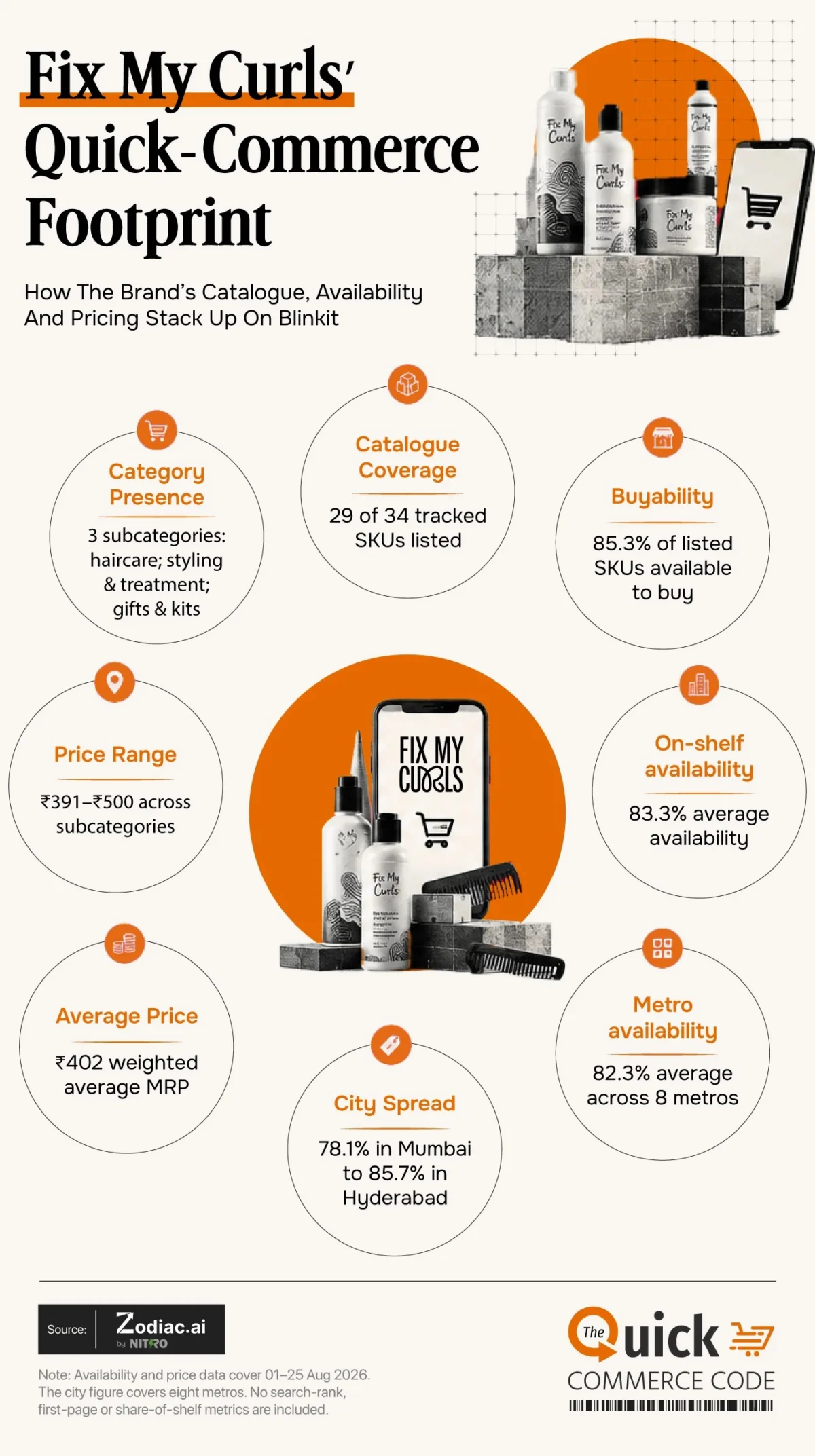
- 2023: The brand makes a bold, experimental entry into the nascent quick commerce (Q-comm) space, beginning with a limited rollout on Blinkit.
- 2024: Blinkit expands the brand’s reach nationwide. The “Quick Commerce Engine” officially shifts into high gear, with the channel becoming a primary revenue driver.
- 2025-2027: The company eyes EBITDA profitability (2-5% target) by FY27, transitioning from a startup phase to a scale-up phase.
Building the Quick Commerce Playbook
When Fix My Curls entered the quick commerce space in late 2023, there was no established "playbook." The industry was in its infancy, and brands were essentially conducting real-time experiments.
The Challenge of Cart Behavior
Mehrotra quickly realized that the Q-comm consumer is a different breed. Unlike on Instagram, where discovery is high, or a website, where intent is focused, Q-comm is a high-velocity, grocery-adjacent environment.
"We realized that if somebody is adding groceries worth ₹1,000 to ₹1,500, our product needs to feel like an easy addition to that cart," she explains. To optimize for this "impulse-plus-utility" behavior, the brand introduced travel-sized packs priced between ₹150 and ₹300. This lowered the barrier to entry, allowing the brand to maintain high turnover and frequent purchase orders (POs).
Mastering the Replenishment Rhythm
The operational intensity of quick commerce is vastly different from traditional e-commerce. While traditional channels allow for predictable inventory cycles, Q-comm demands replenishment windows of four to seven days.

To bridge this gap, Mehrotra instituted a dedicated Q-comm function within her team. This unit is tasked with monitoring SKU-level demand in real-time, maintaining a 15-20% inventory buffer, and coordinating with smaller, more agile logistics partners who are capable of keeping up with the platform’s hyper-fast delivery cycles. When the "Milky Leave-In Serum" launched, demand spiked so sharply that the company had to place three separate purchase orders in quick succession—a feat that would have been impossible under a traditional supply chain model.
Search Intent and Discovery
A pivotal realization for the brand was that shoppers were not searching for "Fix My Curls" by name; they were searching for category solutions like "shampoo" or "hair gel." By collaborating with Q-comm platforms, the brand adjusted its packaging—specifically for its dry shampoo—to be more compact and travel-friendly. This alignment with search intent, combined with strategic pricing, turned the brand into a discovery engine rather than a destination store.
Supporting Data and Financial Outlook
The financial shift has been stark. Today, marketplaces and quick commerce account for roughly 70% of the brand’s total sales. The D2C website contributes 25%, while exports to international markets like Switzerland, Malaysia, and Romania make up the remaining 5%.
Despite reporting revenue exceeding ₹21.42 Cr in FY25, the company is currently focused on growth and market penetration rather than immediate bottom-line profits. Mehrotra is pragmatic about the path to profitability, targeting an EBITDA margin of 2-5% by FY27. Her confidence lies in the fact that as scale increases, the operational efficiencies gained through her refined Q-comm playbook will translate directly into better margins.
Implications: The Future of the Beauty Industry
The rise of Fix My Curls offers several critical implications for the Indian D2C sector:

- Tier-III Penetration: Quick commerce has enabled the brand to reach consumers in Tier-III cities that were previously unreachable due to logistics costs and lack of distribution channels. This level of penetration is a game-changer for niche categories.
- The "Survival of the Fittest" Phase: Mehrotra predicts a "clean-out" of the Q-comm space in the next two years. She believes that the platforms will eventually prioritize brands that can master the complex logistics of replenishment. "It’s not just about being on the platform," she notes. "It’s about who can move products, keep them in stock, and build genuine demand."
- Data-Driven Product Development: The success of the brand proves that Q-comm is not just a delivery channel—it is a feedback loop. Brands that use Q-comm data to iterate on packaging and product size will outperform those that simply treat it as another digital storefront.
Conclusion: A New Chapter of Scale
Anshita Mehrotra’s journey from a family business legacy to the pioneer of a specific, underserved hair care category is a masterclass in modern entrepreneurship. By treating quick commerce as a strategic partner rather than just a sales channel, she has successfully bridged the gap between niche demand and mass-market accessibility.
As Fix My Curls moves into its next phase, the focus shifts from "building the engine" to "fueling the machine." With a robust logistical framework, a loyal community built on educational content, and a proven model for quick-commerce success, the brand is poised to not only reach profitability but to redefine the standard for personal care in the digital-first era. The "road less trodden" has, it seems, led directly to the center of the Indian consumer’s basket.