








The AWS Builder Center, the cloud giant’s dedicated hub for developers, architects, and technical enthusiasts, officially celebrated its first anniversary last week. Launched on July 9, 2025, the platform has rapidly evolved from a modest community portal into a comprehensive ecosystem that bridges the gap between theoretical learning and hands-on cloud engineering.
In just 365 days, the platform has transformed the way the AWS community interacts, learns, and builds. By integrating sophisticated features like sandbox environments, structured workshops, and a collaborative "Builders’ Library," AWS has successfully cultivated a space that feels less like a corporate documentation site and more like a vibrant, living laboratory for innovation.
The Chronology of Growth: From Beta to Ecosystem
To mark the occasion, Rick Suttles, a key figure in the platform’s development, released a comprehensive timeline documenting the meteoric rise of the Builder Center. The progression reflects a strategic roadmap designed to reduce friction for developers at every skill level.
- Q3 2025 (Launch Phase): The platform debuted with basic community engagement tools, including Wishlist voting, community profiles, and an initial set of technical toolboxes.
- Q4 2025 (Feature Expansion): AWS began scaling the platform’s utility by introducing "Spaces"—dedicated areas for community-created groups—and implementing advanced filtering for workshops based on category and complexity.
- Q1 2026 (Gamification & Engagement): The introduction of badges and streaks transformed passive consumption into active participation, encouraging users to contribute more frequently.
- Q2 2026 (Refinement): The platform added "student status" verification, availability notifications for popular services, and seamless sign-in integration with GitHub and Amazon accounts.
- July 2026 (The Anniversary Milestone): The launch of frictionless Sandbox Environments marks the current pinnacle of the platform’s utility.
Supporting Data: By the Numbers
Jeff Barr, a cornerstone of AWS’s communication strategy, provided a retrospective analysis that highlights the sheer scale of the community’s output. The metrics are staggering for a platform only one year old:
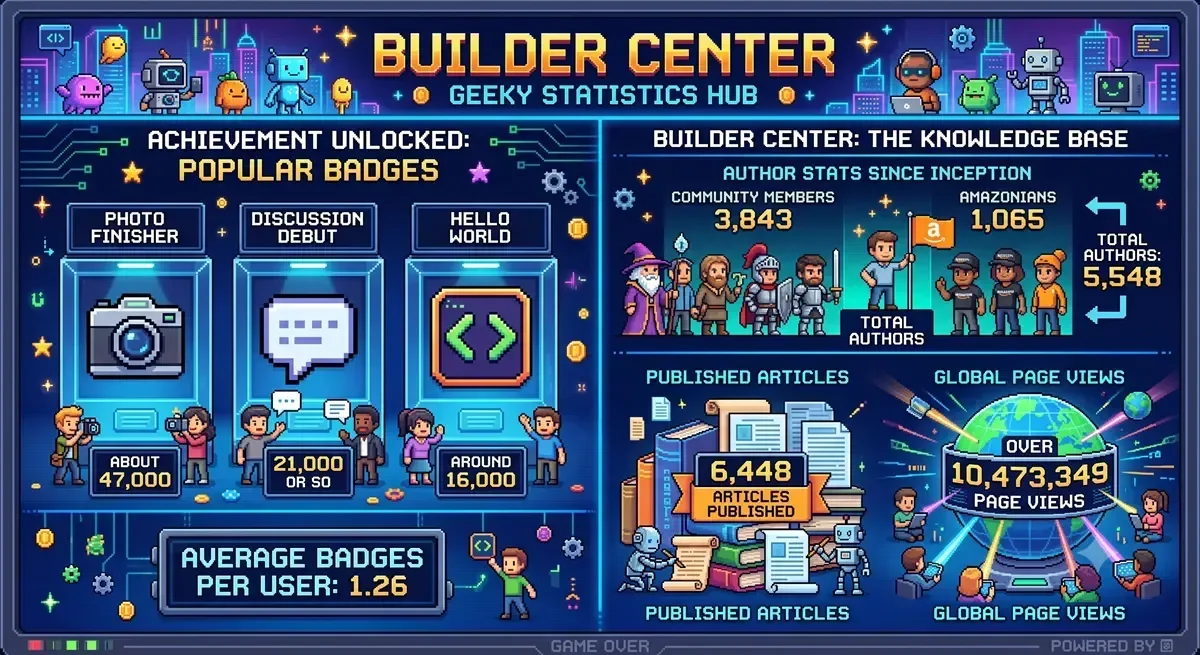
- Content Production: 5,548 unique authors have contributed a total of 6,448 articles.
- Reach: These articles have collectively garnered over 10.4 million page views, underscoring the platform’s status as a primary knowledge source.
- Gamification Success: Since the introduction of the badge system in March 2026, users have earned 99,226 badges, signaling high levels of community engagement.
- Community Influence: The "Wishlist" feature has become a direct pipeline to the AWS engineering teams. Of the 565 user-submitted wishes, 10 have already been shipped, with another 20 confirmed to be on the near-term development roadmap.
The Most Impactful Contributions
The community has shown a distinct preference for high-utility, project-based content. The top three articles of the year illustrate a trend toward practical, real-world application:
- "Building an AWS Study Buddy with MCP + Strands Agents SDK" by Dineshraj Dhanapathy: With over 50,000 views, this article demonstrates the high interest in integrating Large Language Models (LLMs) with AWS-native agentic workflows.
- "Migrating an EOL Linux Server to AWS in 8 Hours with Kiro" by Chris Miller: Garnering 45,000+ views, this piece highlights the enduring demand for reliable, time-efficient migration strategies for legacy infrastructure.
- "AIdeas: NeuroVoice – Multimodal AI for Early Screening of Neurological Diseases" by Yash Aggarwal: Reaching 38,000+ views, this article showcases the potential of AWS cloud services to solve critical challenges in the healthcare and biotech sectors.
Official Response: The "Sandbox" Revolution
The most significant announcement accompanying the anniversary is the introduction of Sandbox Environments. Addressing the "cold start" problem for developers—where the barrier to testing a new service is the overhead of account creation and cleanup—AWS has streamlined the entire process.
According to Rick Suttles, these sandboxes provide a free, pre-provisioned AWS account specifically designed to execute workshop exercises. The technical implementation is elegant:
- Duration: Each environment remains active for a standard 8-hour window.
- Lifecycle Management: Once the time expires, the account and all associated resources are automatically de-provisioned, ensuring no lingering costs or security risks for the user.
- Accessibility: Users are currently entitled to one active sandbox at a time, with a limit of one per week.
- Frictionless Experience: Perhaps most importantly, the system requires no personal credit card, no complex account setup, and absolutely no manual cleanup.
This initiative is a clear signal from AWS that they are moving toward a "learn-by-doing" pedagogy, prioritizing developer time and lowering the technical debt associated with experimentation.
Implications: The Future of Cloud Learning
The first year of the AWS Builder Center suggests a shift in how cloud providers interact with their ecosystems. Traditionally, documentation was static and disconnected from the development environment. The Builder Center breaks this mold by placing the learning materials, the community feedback, and the actual infrastructure in a single, unified UI.
1. The Democratization of Expertise
By facilitating peer-to-peer knowledge sharing, AWS is effectively crowdsourcing the creation of technical tutorials. This allows AWS engineers to focus on core platform development while community experts fill the gaps in documentation with specialized, edge-case use cases.
2. Lowering the Barrier to Entry
The sandbox environments are likely to have the most profound impact on the AWS ecosystem. By providing a safe, ephemeral space for beginners to experiment, AWS is lowering the "fear of cost" that prevents many developers from diving into new services. This, in turn, will likely accelerate the adoption rate of emerging technologies like Generative AI and Serverless architectures.
3. A Data-Driven Roadmap
The "Wishlist" mechanism serves as a powerful feedback loop. By allowing the community to vote on features, AWS is ensuring that their development priorities remain aligned with user demand. The fact that 10 requested features have already been integrated into the platform in under 12 months proves that the feedback loop is both active and responsive.

Looking Ahead: Beyond the First Year
As the platform enters its second year, the focus will likely shift toward personalization. With the foundation of content and infrastructure established, the next logical step involves AI-driven content recommendations, personalized learning paths based on skill gaps, and deeper integration with existing enterprise CI/CD pipelines.
The AWS Builder Center is no longer just a project; it is an essential component of the global cloud infrastructure. For builders, it represents a transition from being a consumer of services to an active participant in the ecosystem. As the community continues to grow, the Builder Center will remain the central nervous system for those looking to master the complexities of the AWS cloud.
For those eager to contribute or learn, the official portal remains open. Whether you are looking to deploy your first container or optimize a global-scale serverless architecture, the resources available now reflect a level of maturity that is rare for a platform in its infancy. As the summer continues, the community expects further enhancements, particularly in the realm of automated troubleshooting and community-led workshop templates.
The lesson from the first year is clear: when you provide the tools, the community will provide the innovation. AWS has successfully built the stage; it is now up to the builders to define what comes next.