For the past two years, the technology sector has been locked in an arms race to infuse Artificial Intelligence into every conceivable digital touchpoint. From email clients and word processors to household appliances and CRM platforms, the mandate from corporate boardrooms is clear: pivot to AI or perish. Yet, as the initial novelty of generative AI begins to wane, a uncomfortable truth is emerging from the data: consumers and employees are not just indifferent to this tidal wave of new features—they are actively resistant.
The assumption driving this industry-wide obsession is that users are suffering from a lack of AI in their lives and that "intelligent" automation will be the panacea for all professional and personal friction. However, evidence suggests that most people do not want more AI in the way leaders currently envision it. Instead, they are finding themselves caught in a cycle of fragmented workflows, high-maintenance tools, and a growing sense of professional alienation.
The Myth of the AI Value Proposition
The fundamental mistake being made by product leaders is the conflation of technology with value. "Powered by AI" is not a value proposition; it is a technical attribute. When companies bolt AI features onto existing workflows as separate, clunky modules, they inadvertently remove the user from their established, efficient processes.
In most professional environments, work is already characterized by "context switching"—the act of jumping between dozens of disconnected systems to complete a single task. By introducing yet another standalone AI tool, companies are not reducing the burden; they are compounding it. The user now has to navigate a new system, learn its unique quirks, and, crucially, act as a supervisor for the AI’s output.
The Hidden Costs of "Intelligent" Tools
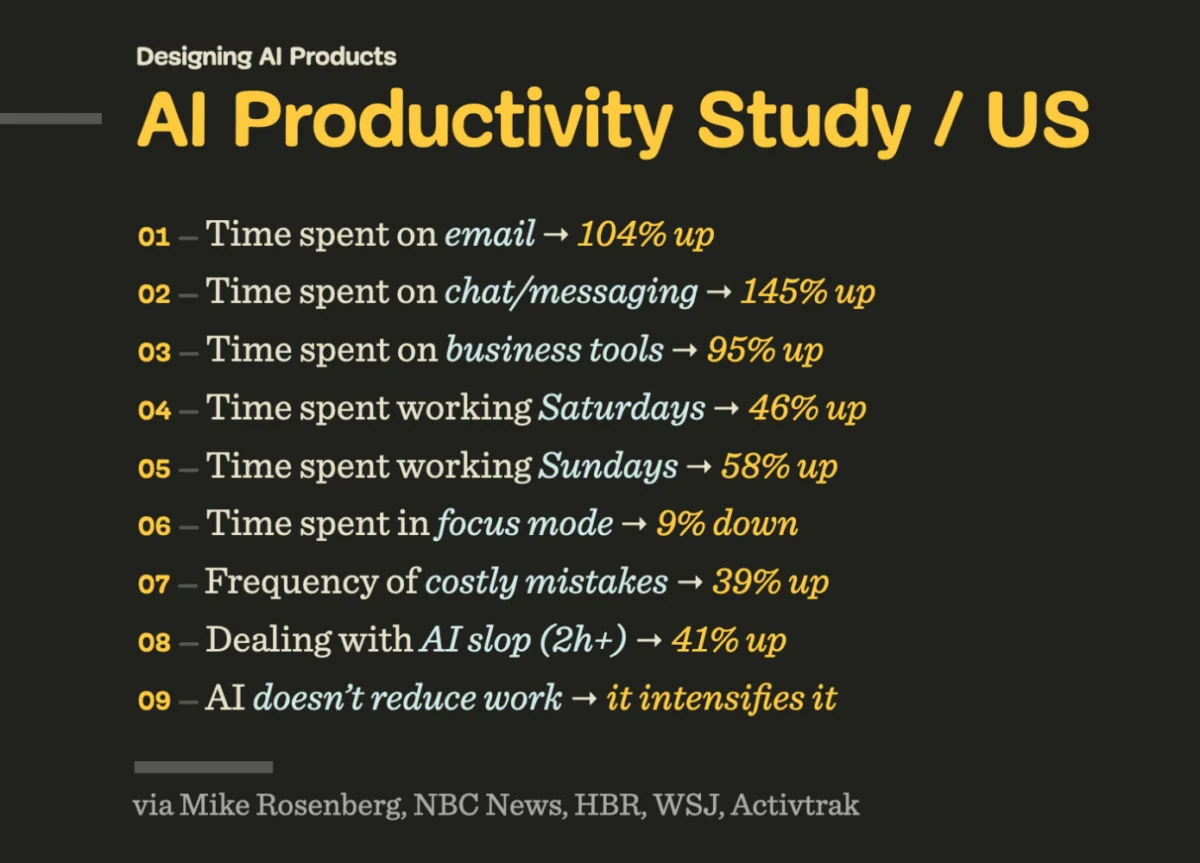
The narrative surrounding AI often highlights speed and productivity. However, reality tells a different story. Research, including findings from the AI Productivity Study (cited via Harvard Business Review and The Wall Street Journal), paints a grim picture:
- Increased Workload: Email time has surged by 104%, while time spent in messaging tools has ballooned by 145%.
- The "Slop" Tax: Users are spending upwards of 41% more time dealing with "AI slop"—correcting hallucinations, verifying data, and formatting outputs.
- Cognitive Decline: Focus mode metrics are down, as employees spend less time on deep work and more time acting as editors for unreliable machine-generated content.
AI, in its current implementation, is proving to be an intensifier of labor rather than a reducer. It cannot fix deep-seated organizational issues like poor data quality, broken communication cultures, or conflicting internal priorities. If anything, AI acts as a magnifying glass, exposing these structural weaknesses and forcing the end-user to bear the brunt of the dysfunction.

Chronology of the Adoption Gap
The trajectory of AI integration has followed a predictable, if unsustainable, path:
- The Gold Rush (2022–2023): Following the public release of major LLMs, companies scrambled to integrate "chat" interfaces into everything. The primary goal was marketing—the inclusion of the word "AI" in pitch decks and press releases.
- The Integration Phase (2023–2024): Organizations began forcing AI agents into workflows. This was the period where the "bolt-on" strategy dominated, resulting in the current UI fragmentation.
- The Resistance Phase (Late 2024–Present): User metrics began to reflect low adoption and poor retention rates. Employees began viewing AI tools as a source of anxiety rather than a benefit, leading to the current pushback against "AI-first" design.
The User Perspective: Why Resistance is Rational
Resistance to AI is often mischaracterized by leadership as a "change management" issue. In reality, it is a rational response to a product that fails to deliver on its promises. When users compare features, they don’t look at the underlying tech stack; they look for reliability, predictability, and utility.
If a human assistant is reliable, they are valued. If an AI assistant is unreliable, it is seen as a liability. Unlike traditional software, which behaves deterministically, AI is probabilistic. This lack of predictability creates a profound sense of instability. Users are increasingly wary of "agents" acting on their behalf in high-stakes environments, such as banking or medical decision-making, where the cost of an error is too high to justify the convenience of automation.

The Fear of Obsolescence
Beyond the functional failures, there is a deep, existential anxiety. When companies market AI as a tool for "replacing" tasks—or worse, replacing people—they foster a culture of fear. This is not just a resistance to new software; it is a defense mechanism against a world that feels as though it is being reconfigured without human input or agency.
Redefining the Role of AI: The "AI-Second" Philosophy
If the industry is to move past this impasse, the strategy must shift from "AI-first" to "AI-second." The most successful implementations of the future will be those that are subtle, humble, and ambient.
True utility lies in the automation of the "boring stuff." Humans have little desire for AI-generated art, AI-narrated children’s books, or synthetic therapists. What they do want is the elimination of the mundane, repetitive mental and physical labor that taxes their cognitive capacity.

Core Principles for Human-Centric AI
- Deep Integration, Not Bolt-Ons: AI must operate within the tools people already use, matching their existing mental models. It should adapt to the human, not force the human to adapt to it.
- Predictability Over "Magic": Users prefer a tool that works the same way every time over a "magical" tool that performs poorly 20% of the time.
- Augmentation, Not Replacement: The focus should be on the parts of a job that are truly tedious. By stripping away the administrative drudgery, AI can allow humans to focus on the unique creative, intuitive, and empathetic aspects of their work that machines cannot replicate.
Implications for Future Product Design
The market is signaling that it has reached a saturation point for "AI gimmicks." Companies that continue to force generative chat interfaces into every product will likely see their churn rates rise as users migrate toward tools that prioritize clarity, reliability, and human-centered design.
As noted by Bo Young Lee in her widely shared sentiment on the subject, there is a clear distinction between wanting labor-saving automation and wanting a digital surrogate. People want to read books written by humans, attend galleries with art created by humans, and engage with human professionals. They want AI to clear the brush so they can engage with the world more meaningfully, not to replace the world itself.
Conclusion: The Human-in-the-Loop Imperative
Ultimately, the most successful products will be those that recognize that users value their own time, their own autonomy, and, above all, their own connections with other people. AI should be a background service, a quiet utility that enables us to spend more time on the things that make us human.

For product designers, the challenge is no longer about how to "fit AI into the UI." It is about understanding the human workflow so deeply that the automation feels invisible. The goal is not to create a smarter machine; the goal is to create a more empowered human.
As we look toward the future, the companies that thrive will be those that stop trying to sell "AI" and start selling time—time for people to be, to think, and to interact with one another. Because, regardless of how advanced our models become, the most valuable interaction in any business remains, and will likely always be, the one between two people.