By Josh Gallant
Updated: August 1, 2025 • 12-minute read
For decades, the standard playbook for digital marketing optimization has followed a familiar, high-stakes pattern. A marketing team spends weeks—sometimes months—crafting a massive, overhauled campaign. They deploy a single A/B test, watch the data trickle in, celebrate a winning variant or mourn a costly flop, and then declare the project "finished" before moving on to the next major launch.
In an era of hyper-competitive digital landscapes and shifting consumer expectations, however, this traditional, all-or-nothing approach is rapidly losing ground.
Enter iterative testing: a cyclical, evidence-based methodology where small, targeted experiments continuously build upon the insights of the last. Rather than swinging for the fences with expensive, complete overhauls, iterative testing champions the power of consistent, incremental improvements. By treating optimization as an ongoing loop rather than a finite event, growth-focused teams are discovering they can adapt to erratic user behavior, slash wasted ad spend, and compound their conversion rates much faster than their competitors.
Main Facts: The Shift to Continuous Optimization
The core premise of iterative testing is simple: instead of changing an entire landing page, email sequence, or ad creative all at once, marketers isolate individual elements—such as a headline, a call-to-action (CTA) button, or a hero image—and test minor variations in rapid succession.
While product development and software engineering teams have relied on agile, iterative cycles for decades, marketing departments are only recently applying these same foundational principles. The primary catalyst for this shift is the realization that most marketing failures are not catastrophic, fiery crashes; rather, they are slow, silent leaks draining budgets day after day.

By shrinking feedback loops from quarters down to mere days, iterative testing plugs those financial leaks. It allows marketers to experiment based on real-time observations, industry benchmarks, and behavioral data, transforming guessing games into disciplined, data-backed strategies.
Chronology: The Evolution from Static Campaigns to Agile Experimentation
Understanding the necessity of iterative testing requires looking at how digital marketing has matured over the years.
- The Era of Static Design (Early 2000s): Campaigns were built based on gut feelings and executive intuition. Websites and landing pages remained unchanged for months or even years, and success was measured primarily by raw traffic rather than user behavior or conversion efficiency.
- The Advent of Traditional A/B Testing (2010s): Marketers gained access to sophisticated testing tools, allowing them to pit Version A against Version B. However, tests were often treated as isolated events. Teams would test a grand hypothesis, implement the winner, and rest on their laurels, assuming the optimization work was complete.
- The Modern Agile Marketing Movement (Present Day): With shortening attention spans and volatile market trends, static strategies became liabilities. Forward-thinking teams began adopting an iterative framework, moving away from massive, infrequent product launches and toward continuous, micro-experimentation where every test informs the next.
Supporting Data: What the Numbers Tell Us
Data-backed benchmarks reveal why incremental, iterative changes often outperform sweeping design overhauls. According to insights from recent industry studies—such as the Unbounce Conversion Benchmark Report—consumer behavior online is nuanced, counterintuitive, and constantly evolving:
- The Clarity Factor: Pages written at a 5th-to-7th-grade reading level convert at an average of 11.1%—more than double the conversion rate of professional, highly complex writing. Iterative testing allows marketers to test simplified language on a small scale before rewriting entire site architectures.
- The Device Disparity: While 83% of landing page visits now occur on mobile devices, desktop traffic still converts roughly 8% better on average. Iterative testing gives teams the agility to experiment with device-specific messaging rather than relying on blanket assumptions.
- The Danger of Complexity: Landing pages featuring high word complexity show a -24.3% negative correlation with conversion rates, reinforcing the idea that audiences value immediate comprehension over dense industry jargon.
Official Perspectives and Industry Insights
Leading growth strategists and optimization experts emphasize that the greatest barrier to successful marketing is not a lack of creativity, but a lack of structural agility.
When discussing the integration of rapid optimization tools—such as automated traffic allocation software that begins optimizing campaigns after just 50 visits—industry analysts note that sample size requirements should no longer hold teams back. Modern iterative frameworks enable even low-traffic campaigns to extract valuable behavioral insights quickly.
Furthermore, digital marketing leaders point out that a "failed" test is never a waste of resources. A rejected hypothesis provides critical context regarding what does not resonate with an audience, thereby narrowing the path toward high-performing messaging. In an iterative environment, negative data is still actionable data.

Implications for Modern Marketing Teams
Embracing an iterative testing model fundamentally changes how marketing departments operate, budgeting is allocated, and interdepartmental collaboration is structured.
1. Accelerated Growth Through Rapid Feedback Loops
Waiting months to measure the success of a campaign is no longer viable. Iterative testing shrinks feedback cycles, letting teams identify winning messaging before committing a full quarter’s budget. By leveraging tools that optimize after minimal visitor engagement, marketers stay steps ahead of shifting market trends.
2. Radical Reduction of Wasted Spend
With marketing budgets tightening across industries, every dollar must prove its worth. Incremental testing ensures that capital is deployed prudently. Instead of betting an entire ad budget on an unproven concept, marketers test variations on small audience segments, scaling up only when empirical data justifies the investment.
3. Cultivating Cross-Departmental Synergy
Iterative testing breaks down organizational silos. When marketing, sales, customer support, and product development teams pool their insights, test hypotheses become deeply rooted in actual customer pain points rather than internal assumptions. For instance, if customer support reports frequent user confusion over pricing tiers, marketing can immediately formulate an iterative test addressing price transparency early in the user journey.
A Step-by-Step Guide to Implementing Iterative Testing
Transitioning to a continuous improvement model does not require an overhaul of your entire marketing department. Organizations can follow this practical, six-step framework:
Step 1: Define a Focused Hypothesis
Never test everything at once. Changing headlines, hero images, and CTA buttons simultaneously obscures what actually drove the results. Formulate laser-focused hypotheses tied to a single element (e.g., "Changing the hero CTA from ‘Learn More’ to ‘Start Free Trial’ will increase form submissions by 5%").
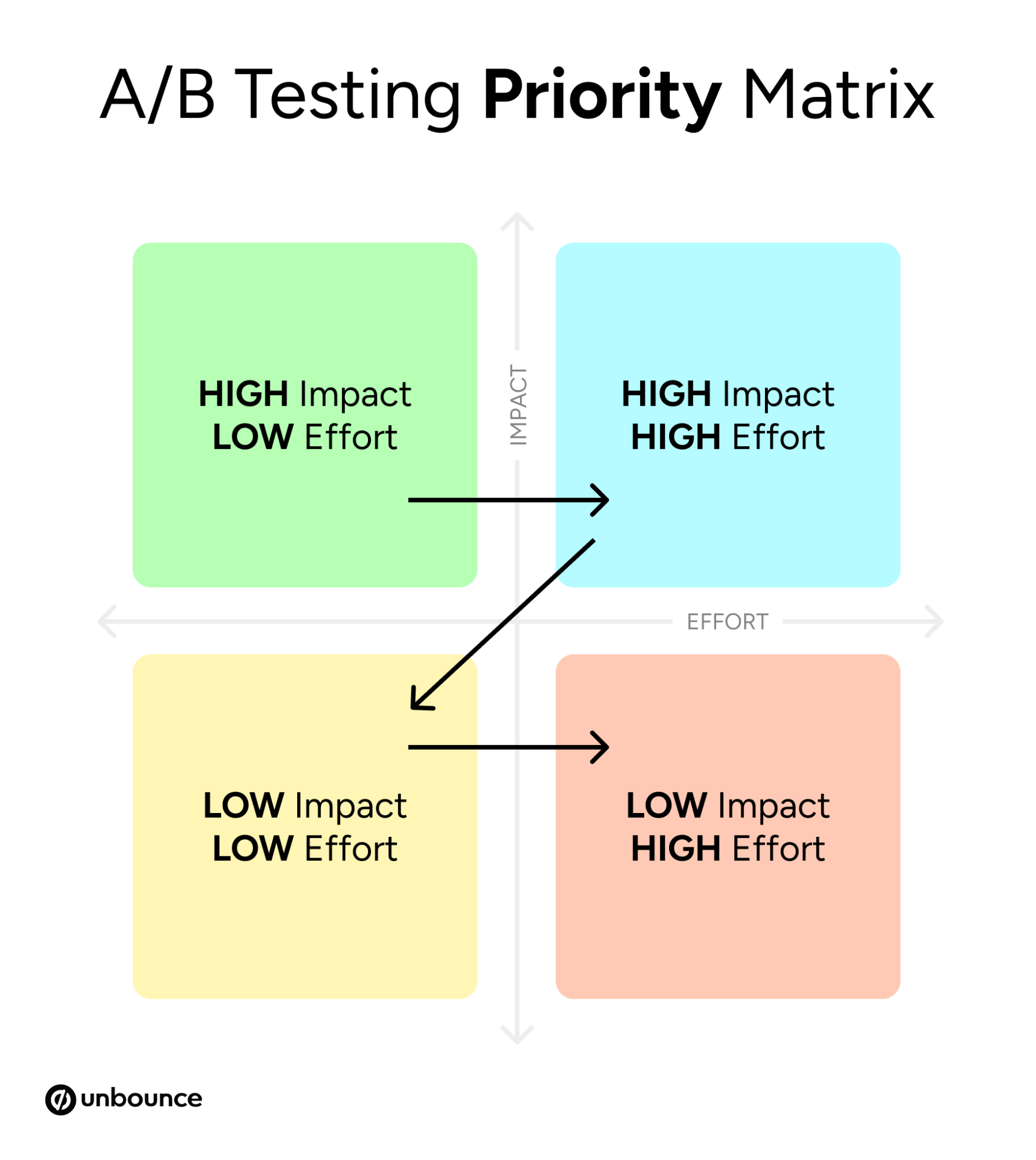
Step 2: Prioritize via Impact and Effort
Use a prioritization matrix to evaluate test ideas based on potential impact versus implementation effort. Start with low-effort, high-impact "quick wins" to build internal momentum and executive buy-in for more ambitious experiments down the road.
Step 3: Build Minimal, Testable Variations
Avoid overcomplicating test variants. Create clean, isolated alterations of your control page. Utilizing dedicated A/B testing platforms allows marketers to duplicate landing pages and deploy targeted variations without requiring constant developer support.
Step 4: Launch and Gather Statistical Significance
Resist the temptation to pull the plug on tests prematurely. Ensure your sample sizes reach statistical significance so that your decisions are driven by reliable user behavior rather than random statistical flukes.
Step 5: Extract Actionable Insights
Raw data is just numbers until interpreted correctly. When a variant wins, ask why. If a simplified headline boosted conversions, the takeaway isn’t just a surface-level trick—it’s a deeper insight into your audience’s preference for clarity over cleverness.
Step 6: Scale and Iterate Again
Once a winning variation is identified, scale it across broader campaigns, update brand guidelines, or use the insight as a stepping stone for the next hypothesis. Every test feeds the next cycle of improvement.
Best Practices for Long-Term Success
- Prioritize Speed: Ship simple tests quickly. The best test is always the one you actually run, rather than the one trapped in endless planning meetings.
- Keep Metrics Simple: Focus on core performance indicators—such as conversion rates, bounce rates, and cost-per-acquisition—rather than drowning in vanity metrics.
- Embrace a Culture of Experimentation: Encourage team members across all departments to submit testing ideas. When the whole organization contributes to the testing backlog, the collective commitment to optimization multiplies.
Conclusion
Iterative testing is ultimately about progress over perfection. By abandoning the trap of the one-and-done campaign and adopting a cyclical mindset of continuous learning, marketers can future-proof their strategies, delight their audiences with experiences tailored to their exact needs, and build a resilient engine for sustainable business growth.