







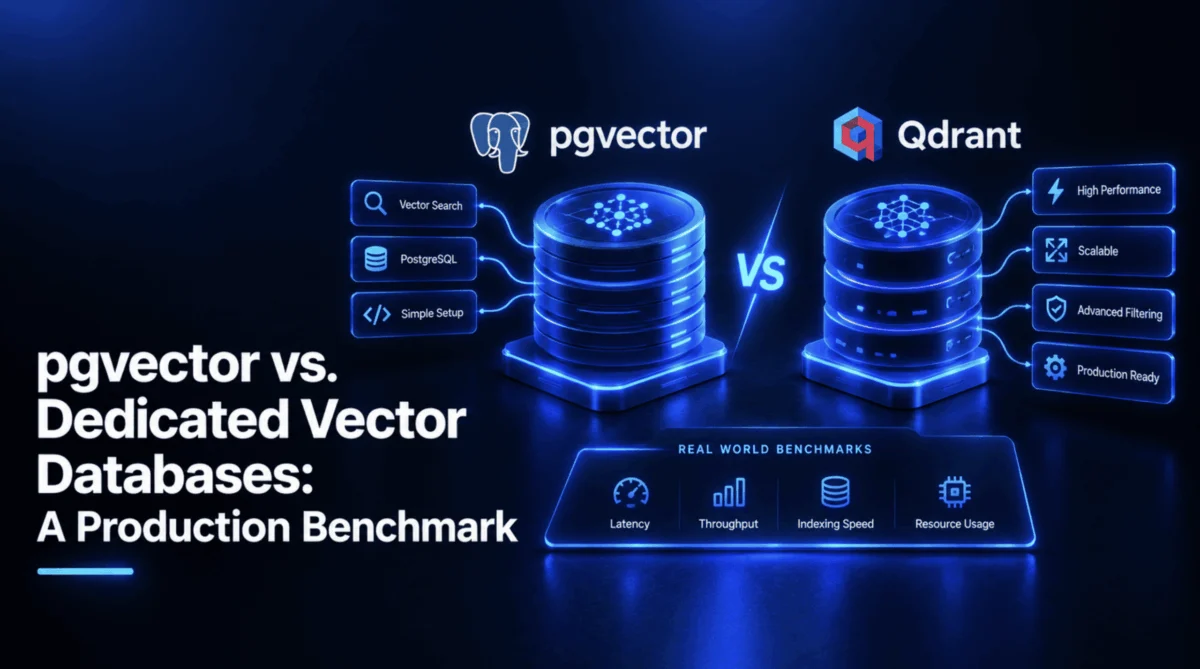
For engineering teams building AI-powered applications, the architectural choice between extending an existing relational database with vector capabilities and deploying a purpose-built vector database is often fraught with conflicting advice. On one hand, the "Postgres-first" movement argues that adding pgvector to a familiar stack is the most efficient path forward. On the other, vendors of dedicated vector databases—such as Pinecone, Qdrant, and Milvus—insist that general-purpose databases will eventually hit a "scaling wall" that only specialized infrastructure can overcome.
Historically, this debate has been dominated by marketing narratives rather than empirical data. To move beyond opinion, this analysis examines the performance realities, architectural tradeoffs, and production implications of both approaches, providing a framework for choosing the right tool for your specific workload.
The Evolution of the Vector Landscape
The rise of Large Language Models (LLMs) necessitated a new way of handling data: vector embeddings. These high-dimensional numerical representations of text, images, and audio require specialized search mechanisms—specifically, Approximate Nearest Neighbor (ANN) algorithms—to perform similarity searches at scale.
In the early days of the generative AI boom, developers often defaulted to dedicated vector databases because they were the first tools to hit the market with specialized indexing for embeddings. However, as pgvector matured, it transformed from a niche experiment into a robust, enterprise-grade solution. By integrating vector similarity search directly into PostgreSQL, pgvector allows teams to store, index, and query embeddings alongside their relational source-of-truth data.
Architectural Foundations: Two Philosophies
Understanding the performance difference begins with the architectural divide.
The pgvector Philosophy: Convergence
pgvector operates as a native extension to PostgreSQL. It leverages the database’s existing storage engine, transaction management, and query optimizer. For a developer, this means the vector data is "first-class" data. You can perform a JOIN between a user table and an embedding table, or filter results using standard WHERE clauses alongside similarity metrics. The primary advantage here is transactional integrity. If you delete a user record, the associated embedding is handled within the same atomic transaction, ensuring no "orphaned" data remains.
The Dedicated Database Philosophy: Specialization
Dedicated vector databases like Qdrant, Milvus, or Weaviate are purpose-built from the ground up for high-dimensional data. They often utilize different memory management techniques, specialized index structures (like HNSW or DiskANN), and distributed architectures designed for horizontal scaling. These systems prioritize query speed and massive throughput for vector-specific tasks, often at the expense of needing to synchronize data between the "source of truth" database and the "vector search" database.
Benchmarking at Scale: What the Data Says
To understand when the "scaling wall" actually appears, we must look at controlled benchmarks. Recent data comparing pgvector (specifically when augmented with pgvectorscale) against Qdrant on AWS r6id.4xlarge instances reveals a nuanced reality.
When testing 50 million Cohere embeddings at 768 dimensions, the results show that neither system is a universal victor. At 99% recall accuracy:
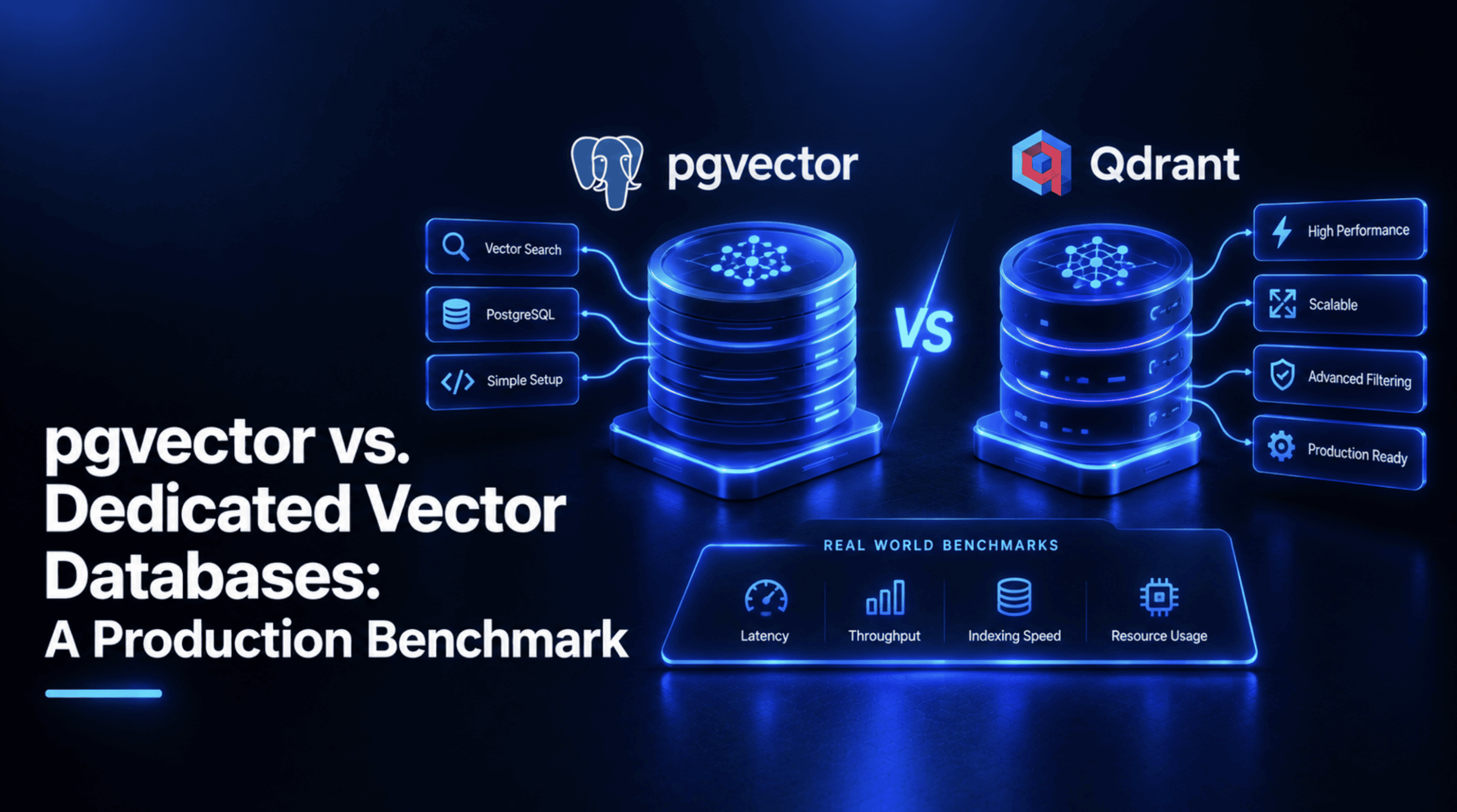
- Throughput: The
pgvectorstack demonstrated a massive advantage, delivering over 470 Queries Per Second (QPS), compared to approximately 41 QPS for the dedicated system. - Tail Latency: Qdrant showcased superior stability in tail latency, with a p99 of 38.71ms compared to 74.60ms for the Postgres-based approach.
This data suggests that if your application requires high-frequency, low-latency lookups (e.g., real-time recommendation engines), the tail-latency profile of a dedicated database may be preferable. Conversely, for applications that value high throughput and complex filtering of relational data alongside vectors, the pgvector ecosystem is exceptionally performant.
Chronology of Adoption
- Phase 1 (Prototyping): Teams start with local development, often using
pgvectoror local-first databases like ChromaDB. The simplicity of a single Docker container wins over complex distributed systems. - Phase 2 (Growth): As datasets grow from thousands to hundreds of thousands of records,
pgvectorcontinues to perform well. Most teams find they do not need a secondary system until they cross the 5–10 million record threshold. - Phase 3 (Enterprise Scale): At the 50-million-plus vector mark, operational costs change. Teams must choose between tuning Postgres (which requires significant expertise) or adopting a managed vector database (which shifts the operational burden to a third party).
Implications for Production Workloads
When to Stick with pgvector
You should prioritize pgvector if:
- Data Integrity is Paramount: You need ACID compliance between your vectors and your relational metadata.
- You Have Existing Postgres Expertise: Your team is already comfortable with vacuuming, index tuning, and replication in PostgreSQL. Adding another system increases your "operational surface area."
- Complex Filtering is Required: If your queries frequently rely on combined relational filters (e.g., "Find the most similar vector where the
regionis ‘EMEA’ and theuser_tieris ‘Premium’"), PostgreSQL’s query optimizer is often superior to the metadata filtering capabilities of many vector databases.
When to Migrate to a Dedicated Vector Database
You should consider a dedicated vector database if:
- Massive Scale: You are dealing with hundreds of millions or billions of vectors where a single-node database—even a highly tuned one—would become a bottleneck.
- Strict Tail-Latency SLAs: If your product requires consistent, sub-40ms responses regardless of system load, the architectural design of dedicated systems like Qdrant or Milvus provides a more predictable performance floor.
- Zero-Ops Preference: If your team lacks database engineers, a fully managed service (like Pinecone) removes the burden of managing index rebuilds, node scaling, and backups.
Official Industry Stance
While vendors naturally favor their own products, the engineering community at large is trending toward "Postgres-first" for the vast majority of use cases. Leaders at companies like Timescale (the creators of pgvectorscale) argue that most applications overestimate their scale. By pushing the boundaries of what Postgres can handle, developers avoid the "distributed systems tax"—the complexity of managing two separate databases that must be kept in sync.
However, the dedicated vector database vendors correctly point out that specialized hardware (like GPU-accelerated indexing in Milvus) is not yet a native capability in standard relational databases. For teams working in fields like image recognition or high-speed genomic sequencing, these specialized features are not just "nice to have"—they are prerequisites.
Final Analysis
The "Great Vector Debate" is ultimately a question of operational trade-offs.
If you are a startup or a mid-sized enterprise, the overhead of maintaining a separate vector database is rarely justified by the performance gains until you reach substantial scale. pgvector provides a level of simplicity and transactional safety that is difficult to replicate in a two-database architecture.
However, do not ignore the "tail latency" factor. If your application’s core value proposition relies on sub-50ms similarity search latency for a massive, concurrent user base, the specialized engineering inside Qdrant, Milvus, or Weaviate is a legitimate competitive advantage.
In conclusion, do not base your architectural decision on vendor marketing or "industry standard" claims. Base it on your current data volume, your team’s existing operational expertise, and your specific latency SLAs. For 90% of production workloads, pgvector is not just "good enough"—it is the optimal choice. For the remaining 10% operating at extreme scale or with unique hardware requirements, dedicated vector databases provide the specialized power necessary to move the needle.