The digital marketing landscape is undergoing a structural paradigm shift. For decades, search engine optimization (SEO) has focused on optimizing web pages for keyword-matching algorithms and blue links. Today, that framework is rapidly being augmented—and in some sectors replaced—by Answer Engine Optimization (AEO). As modern consumers increasingly turn to generative AI platforms like ChatGPT, Google Gemini, Perplexity, and Microsoft Copilot to make purchasing decisions, brands are forced to confront a new reality: visibility is no longer just about ranking on a search engine results page (SERP). It is about whether an AI model chooses to cite your brand when formulating a conversational answer.
To navigate this emerging frontier, a new class of specialized software platforms has materialized. Among the frontrunners in the enterprise AEO software space are Profound and Scrunch. While both platforms measure how AI answer engines perceive and cite corporate brands, they are engineered for fundamentally different operational workflows. Profound leans heavily into market intelligence, audience analysis, and automated content creation, whereas Scrunch focuses primarily on technical optimization, crawlability, and developer-centric interventions.
To provide a holistic view of the market, this report examines the core capabilities of Profound and Scrunch, evaluates their technical frameworks, details their pricing and agency models, and introduces HubSpot AEO as an integrated CRM-connected alternative for modern marketing teams.

Main Facts: Decoding the AEO Tooling Ecosystem
At its core, AEO software addresses a critical blind spot in modern analytics: traditional web analytics platforms like Google Analytics 4 (GA4) cannot fully capture or interpret the nuances of generative AI retrieval traffic. AI crawlers rarely execute client-side JavaScript, meaning traditional tracking snippets often fail to register bot interactions accurately.
Profound and Scrunch bridge this gap by monitoring brand visibility across multiple answer engines, analyzing prompt performance, and tracking agent traffic at the server or CDN layer. However, their underlying philosophies dictate vastly different workflows:
- Profound functions primarily through a market-and-audience lens. It models AI search demand via licensed answer-engine conversations, offering deep visibility into buyer personas and automated content drafting that pushes directly into popular content management systems (CMS) like WordPress, Contentful, and Sanity.
- Scrunch operates through an execution and technical lens. It evaluates content gaps across the buyer’s journey, provides granular tagging by funnel stage, and—via its Agent Experience Platform (AXP)—actively intervenes at the CDN edge to serve crawler-optimized versions of web pages directly to AI bots while human visitors experience the standard UI.
- HubSpot AEO serves as an integrated alternative. Designed for organizations already operating their content publishing and customer relationship management (CRM) systems within a unified ecosystem, HubSpot bridges the gap between visibility data and pipeline attribution.
Chronology: The Emergence of Generative AI Tracking and AEO Platforms
The commercialization of generative AI search engines has triggered a rapid evolution in software tooling over a remarkably short timeline:

- Late 2022 to 2023: The launch of ChatGPT and subsequent conversational AI engines disrupted traditional search behavior. Early adopters relied on manual prompt testing and fragmented web scraping to understand how AI models referenced their brands.
- 2024: The market saw the emergence of dedicated Answer Engine Optimization tools. Early iterations focused purely on visibility tracking—querying popular LLMs to see if a brand appeared in citations.
- 2025: Platforms matured rapidly, introducing agent analytics, crawler log monitoring, and technical diagnostics to distinguish between training crawlers, indexers, and live retrieval bots. User reviews on platforms like G2 began establishing baseline metrics for software reliability, agency scalability, and pricing tiers.
- 2026 and Beyond: The ecosystem has consolidated around specialized execution models. Tools have bifurcated into market-intelligence-heavy suites (such as Profound) and technical-intervention platforms (such as Scrunch), while CRM-integrated ecosystems (such as HubSpot AEO) have entered the market to connect visibility metrics directly to closed-won revenue.
Supporting Data: Comparative Breakdown of Core Criteria
To determine which platform suits a specific organizational bottleneck, buyers must evaluate several critical dimensions, ranging from engine coverage to pricing architecture.
1. Answer Engine Coverage and Prompt Capacity
Engine coverage varies significantly depending on the selected subscription tier. Profound’s self-serve options are heavily restricted, with its free trial sampling ChatGPT, Gemini, and Google AI Overviews for a limited seven-day window, while broader coverage (up to nine engines) is reserved for custom Enterprise quotes. Scrunch initiates coverage with four engines on its entry-level tier, scaling to nine engines under custom contracts. HubSpot AEO consistently tracks ChatGPT, Gemini, and Perplexity across all plans.
Regarding prompt capacity, teams must consider how granularly they wish to slice their tracking across personas, product lines, and geographic regions. Scrunch offers structured daily prompt runs that transition to a 72-hour refresh cadence after the first 14 days, though users can force manual updates. HubSpot AEO allows teams to scale capacity dynamically via Prompt Packs (such as adding blocks of 10 prompts per day) without requiring an immediate tier upgrade.

2. Reporting Lenses: Market Analysis vs. Execution
- Profound’s Reporting Lens: Profound emphasizes macro-level market demand and audience segmentation. Features like Prompt Volumes model AI search demand from licensed conversational datasets, allowing marketers to examine exact user prompts behind high-level keywords. Its Personas feature maps buyer roles onto Answer Engine Insights, revealing discrepancies in how an AI model describes a brand to a technical evaluator versus a corporate executive.
- Scrunch’s Reporting Lens: Scrunch prioritizes micro-level funnel execution. Tracked prompts can be filtered by funnel stage, persona, topic, and custom tags to isolate precisely where competitors capture citations. Its AI Search Trends feature estimates weekly prompt volumes for semantic topic clusters using consumer panel data, offering directional insights into where content strategies are losing momentum.
3. Technical Optimization: Read-Only Diagnostics vs. Edge Intervention
The most profound architectural difference between the two market leaders lies in how they help organizations resolve crawlability barriers:
- Profound (Read-Only Diagnostics): Profound’s Agent Analytics inspects server logs rather than JavaScript tags, flagging
robots.txtblocks and inaccessible pages. Its Technical Analysis suite scores pages on performance, SEO, speed, and semantic phrasing, leaving the remediation process entirely within the user’s internal CMS. - Scrunch (Edge Intervention): Scrunch provides active technical intervention. Its Agent Experience Platform (AXP)—available on Enterprise tiers—sits at the Content Delivery Network (CDN) edge. It detects recognized AI bots and delivers a streamlined, lightweight, highly readable version of web pages specifically tailored for crawlers, while human visitors continue to view the standard site interface.
4. Tracking Agent and Bot Traffic
Because AI crawlers rarely execute client-side JavaScript, traditional analytics packages fail to record their visits accurately. Both Profound and Scrunch bypass this limitation by intercepting traffic at the server or CDN layer.
- Profound reads server logs in real time, validating bot signatures against published IP ranges to filter out spoofed agents and categorizing visits into indexing versus on-demand retrieval crawls.
- Scrunch pulls CDN logs to segment bots into training, indexer, and retrieval categories, treating retrieval traffic as the primary indicator of active buyer intent. Both platforms integrate with GA4 to tie downstream human referral sessions to AI visibility.
Official Responses and Strategic Industry Alignment
Industry analysts and verified user reviews on platforms like G2 (reflecting experiences through 2025 and 2026) highlight distinct points of consensus and divergence between the two tools:

- Where Users Agree: Reviewers from both camps acknowledge that traditional SEO tools are wholly inadequate for measuring generative AI visibility. Both Profound and Scrunch successfully decode the "black box" of LLM citations and provide actionable intelligence regarding bot traffic that standard analytics ignore.
- Where Users Split: Feedback regarding ease of use versus technical depth diverges sharply. Content-focused marketing teams often praise Profound for its seamless automated drafting and CMS integrations. Conversely, technical SEO professionals and developer-heavy teams favor Scrunch for its granular funnel tagging and CDN-level edge intervention capabilities.
Implications for Modern Marketing and Enterprise Strategy
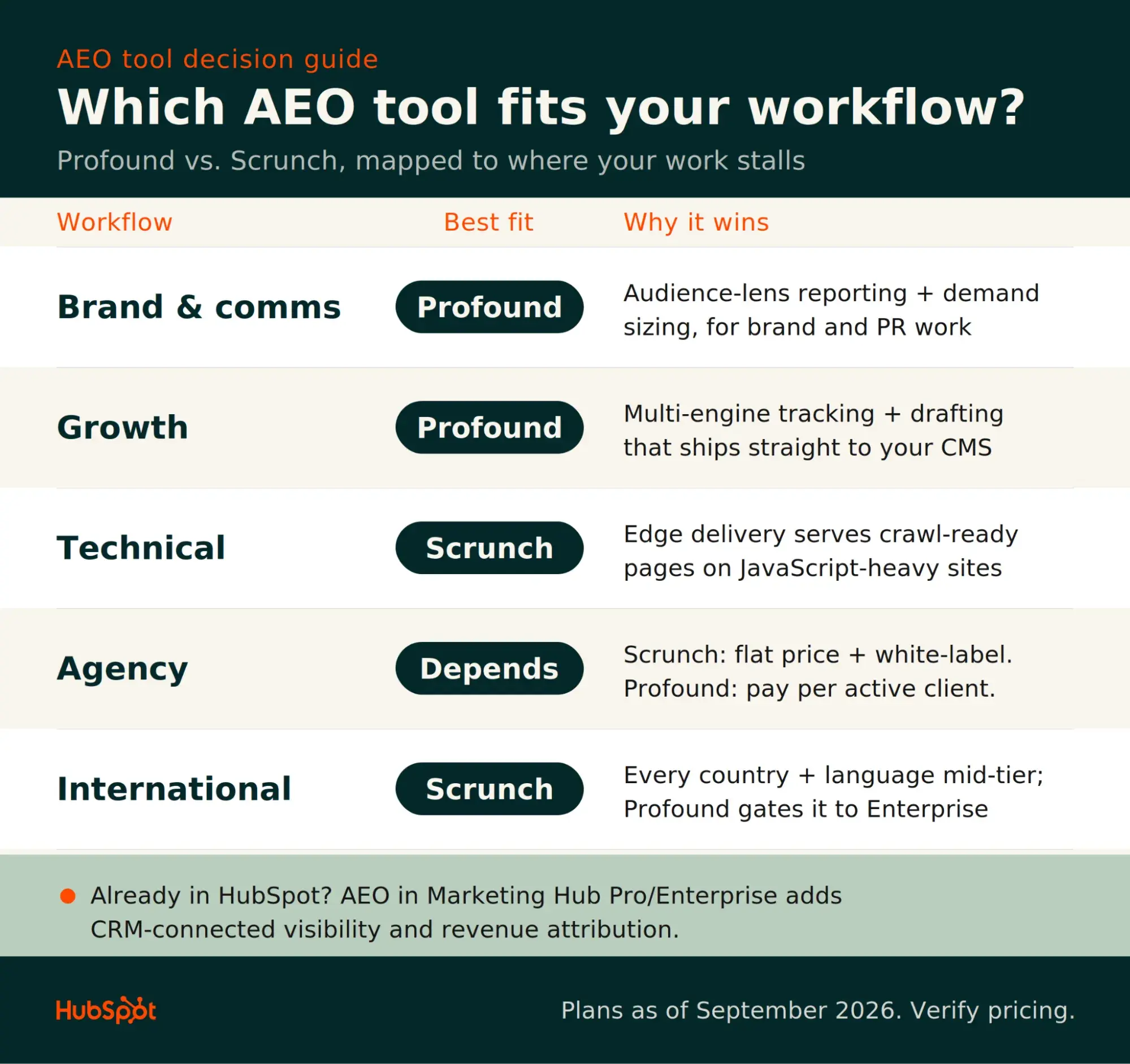
Choosing the right AEO platform ultimately depends on identifying where an organization’s workflow stalls.
- When to Choose Profound: Organizations with strong content creation teams, heavy reliance on multi-engine market analysis, and a need for automated, brand-aligned draft generation that integrates directly into headless or traditional CMS platforms will find Profound to be a natural fit.
- When to Choose Scrunch: Engineering-driven organizations, technical SEO agencies, and enterprises struggling with crawlability bottlenecks, bot management, and precise funnel-stage gap analysis benefit most from Scrunch’s execution-oriented architecture.
- When to Consider HubSpot AEO: Teams seeking to bridge the gap between visibility data and pipeline attribution without managing fragmented tool stacks often turn to CRM-connected solutions. HubSpot AEO integrates tracking, in-app content drafting, and CRM context into a single environment, enabling marketing leaders to tie AI search visibility directly to closed-won revenue.
Strategic Recommendations for Executing an AEO Pilot
Organizations looking to adopt AEO software without overcommitting resources should deploy a low-risk pilot program:
- Establish a Baseline: Run a one-time diagnostic using a free assessment tool, such as HubSpot’s AI Search Grader, to evaluate current brand perception across major generative engines.
- Isolate a Prompt Set: Construct a curated list of approximately 10 high-value buyer prompts spanning core categories, competitor comparisons, and specific buyer personas.
- Maintain a Controlled Cadence: Track performance over a consistent multi-week cycle. Implement targeted optimizations or content updates one at a time to clearly measure correlation between technical changes and subsequent citation shifts.