

SAN FRANCISCO — OpenAI has peeled back the curtain on the engineering mechanics driving its rapidly expanding advertising ecosystem. In a comprehensive technical breakdown, the artificial intelligence pioneer detailed how its proprietary ChatGPT advertising system interprets complex, multi-turn user conversations, selects hyper-relevant commercial placements, and rigorously walls off ad-serving architecture from organic answer generation.
The transparency report arrives alongside explosive growth metrics: OpenAI announced that ChatGPT Ads has crossed the $1 billion annualized revenue run rate threshold in under 200 days since its commercial rollout. More than 100,000 unique advertisers have deployed campaigns on the platform during that timeframe. However, while the technical documentation offers a fascinating look inside the machine-learning pipeline, it also leaves critical questions unanswered regarding true advertiser return on investment (ROI) and performance transparency.
Main Facts
The architectural foundation of ChatGPT Ads relies on a strict operational separation between generative language models and commercial ad-selection engines.
- Complete Separation of Concerns: The neural networks responsible for writing ChatGPT’s responses operate independently from the code and models that evaluate, select, and display ads. OpenAI asserts that an ad can never influence the cognitive trajectory or content of an organic answer.
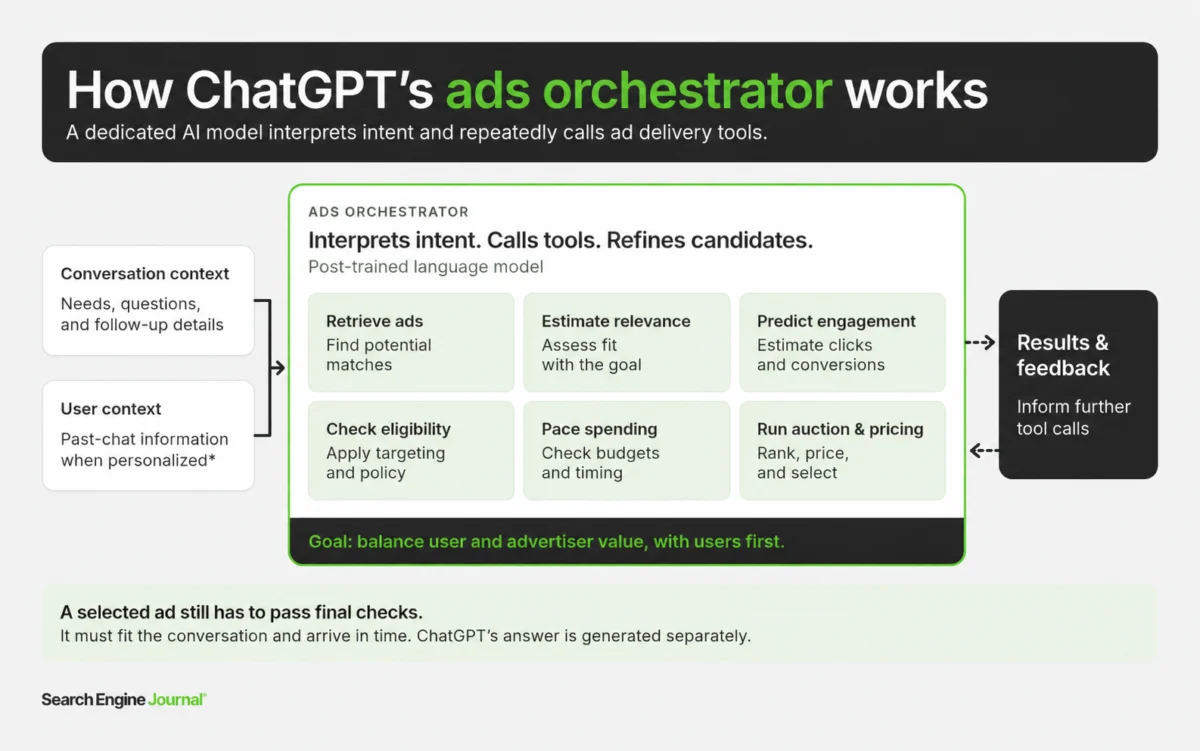
- The "Orchestrator" Model: A specialized language model dubbed the orchestrator monitors the progression of a user’s dialogue, extracts intent through text embeddings, queries an ad index, and submits eligible candidates to an external auction mechanism.
- The Stateful Context Advantage: Unlike traditional search engines that evaluate queries in isolation, ChatGPT’s ad system maintains a "stateful" session. It tracks user needs as they evolve over multiple messages—shifting, for example, from a broad query about business productivity software down to granular concerns regarding client approvals and pricing.
- Explosive Early Monetization: The ad platform has achieved a $1 billion annualized revenue run rate in less than 200 days, attracting over 100,000 distinct advertisers. Despite this scale, OpenAI has not published industry benchmarks, average cost-per-acquisition (CPA) figures, or return on ad spend (ROAS) metrics.
Chronology of OpenAI’s Commercialization
The evolution of monetization within generative artificial intelligence has moved at breakneck speed, transforming experimental chatbots into multi-billion-dollar ad networks.
- Early 2024 to Late 2025 (The Exploration Phase): Following the mainstream explosion of ChatGPT, OpenAI focused primarily on subscription models (ChatGPT Plus, Team, and Enterprise) while facing mounting computational infrastructure costs. Rumors and small-scale interface experiments regarding native monetization began circulating as the company sought sustainable revenue streams to offset training expenses.
- Mid-2025 (The Launch of ChatGPT Ads): OpenAI officially rolled out its native advertising infrastructure. The initial launch prioritized non-intrusive placements clearly delineated from conversational output, focusing on high-intent query matching.
- Late 2025 (Rapid Scaling): Adoption surged past initial projections. Within 200 days of the official rollout, the ecosystem onboarded over 100,000 advertisers, pushing the platform’s annualized revenue run rate past the $1 billion milestone.
- Current Status (The Technical Disclosure): OpenAI published its exhaustive system architecture breakdown. This move aims to assuage privacy concerns, build trust regarding the neutrality of AI-generated answers, and help performance marketers optimize campaigns for stateful conversational contexts.
Supporting Data and Technical Architecture
To understand how ChatGPT Ads functions under the hood, advertisers must look beyond traditional keyword matching and examine OpenAI’s orchestration pipeline.
The Orchestrator and Vector Embeddings
When a user interacts with ChatGPT, the conversation does not pass directly to an ad server. Instead, an internal supervisory model called the orchestrator analyzes the dialogue.
- Query Transformation: The orchestrator converts relevant segments of the dialogue into semantic search queries.
- Embedding Generation: These queries are translated into numerical representations (embeddings) that map conceptual meaning, allowing the system to surface relevant ads even when the user’s phrasing does not match the exact keywords chosen by the advertiser.
- Multi-Query Synthesis: A single, meandering conversation can generate multiple search queries as the user’s intent pivots or refines over time.
Eligibility, Pacing, and Auction Mechanics
Once potential ad candidates are retrieved via vector search, they undergo rigorous filtering:
- Constraint Checks: The system verifies geographical targeting, compliance with strict advertising policies, active campaign budgets, and pacing controls (which dictate how evenly a budget spends throughout a campaign lifecycle).
- Scoring: Surviving ads are scored based on contextual fit, historical performance metrics, and the statistical likelihood of generating a user interaction (view, click, or conversion).
- The Auction: Scored candidates are sent to a separate auction tool responsible for final ranking, pricing, and winner selection. The language model helps curate who enters the auction, but it does not directly determine the winner or set the clearing price.
The "Won Auction, Zero Impression" Phenomenon
One of the most revealing disclosures in OpenAI’s technical breakdown is that winning an ad auction does not guarantee an impression.
- Post-Auction Safety Filters: Even if an ad clears the auction and satisfies general policy guidelines, a secondary contextual filter evaluates whether the ad remains appropriate for the immediate tone and content of the ongoing conversation.
- Delivery Latency Windows: ChatGPT generates organic responses in real time without waiting for the ad system to complete its evaluation. If the ad selection pipeline encounters latency or finishes processing after the primary response has already rendered, the winning ad is dropped. Consequently, an advertiser can win an auction yet miss the delivery window entirely.
Official Responses and Platform Governance
OpenAI has consistently maintained that user trust and answer neutrality are non-negotiable. By architecturally separating the natural language generation (NLG) stack from the advertising stack, the company attempts to neutralize fears of "pay-to-play" answers.
"The system choosing ads runs completely separately from the one writing ChatGPT’s answers. Each uses its own distinct models and codebases," OpenAI stated in its official technical overview. "As ChatGPT writes a response, the ads system independently checks whether there is a relevant ad to show below it. Choosing that ad does not feed back into what ChatGPT writes."
Furthermore, OpenAI emphasizes transparency in labeling. When an advertisement does appear, it features a distinct "sponsored" designation underneath the response. Additionally, a natively generated introductory line—authored by the ad system—explains the logical bridge connecting the user’s conversation to the recommended product or service. This introduction remains strictly segmented from the advertiser’s supplied headlines, descriptions, and calls to action (CTAs).
However, independent digital marketing analysts note that this separation is currently accepted on faith. Because external auditors lack direct access to OpenAI’s proprietary codebase and real-time inference pipelines, advertisers must trust internal safeguards rather than verified external audits.
Implications for Advertisers and the Digital Marketing Industry
While the $1 billion revenue milestone proves that brands are eager to capture intent within generative AI environments, the mechanical realities of the ChatGPT ad stack present both unprecedented opportunities and frustrating opacity for media buyers.
1. Shifting From Keywords to Conversational States
Traditional search engine marketing (SEM) relies heavily on discrete, high-intent keywords (e.g., "project management software pricing"). ChatGPT Ads, by contrast, thrives on stateful sessions.
- The Contextual Opportunity: An advertiser offering a niche feature—such as free guest accounts in a project management tool—can capture high-value prospects earlier in the dialogue lifecycle. If a user spends several turns discussing small-agency workflows, client approval bottlenecks, and administrative overhead, an ad highlighting specific collaborative features can resonate deeply, even if the user’s immediate terminal question is just about cost.
- Strategic Adaptation: Advertisers must shift away from rigid keyword targeting silos. Success on the platform will depend on building rich creative assets and landing pages that address specific problem statements discovered during lengthy, exploratory user dialogues.
2. The Reporting Black Box
Despite detailed engineering disclosures, advertisers face a severe visibility deficit regarding campaign diagnostics.
- Diagnosing Delivery Failures: If a campaign suffers from low impressions, performance marketers cannot easily determine the root cause. Did the ad fail semantic relevance checks? Did it run afoul of post-auction contextual filters? Did it miss the real-time delivery window due to latency? Or did it simply lose the auction on price?
- Internal Logs vs. Advertiser Dashboards: OpenAI notes that its internal logging systems successfully track every stage of this funnel—from queries that yield zero matches to ads disqualified by policy or timing. However, the technical post does not clarify how granularly these diagnostic insights are exposed to external advertisers in their reporting dashboards. Without this transparency, marketers risk inflating bids or rewriting high-performing creative to solve problems caused entirely by backend delivery latency or strict contextual filters.
3. The ROI Question: Revenue vs. Real Returns
Reaching an annualized run rate of $1 billion with over 100,000 participating brands is an undisputed commercial triumph for OpenAI. Yet, volume does not equal profitability for the brands footing the bill.
- The Absence of Benchmarks: OpenAI’s public disclosures currently omit foundational performance benchmarks, including average cost-per-acquisition (CPA), return on ad spend (ROAS), and industry-specific conversion rates.
- Additionality and Incrementality: Crucially, the platform offers no controlled experimental data to prove "additionality"—the measurement of whether ChatGPT ads generate net-new purchases from customers who would not have converted organically anyway. Without transparent cohort analysis or retention tracking showing how many of those 100,000 initial advertisers returned for subsequent budget cycles, brands are essentially operating in an exploratory testing phase.
Looking Ahead
As generative AI continues to cannibalize traditional web traffic and redefine how humans seek information, advertising within chat interfaces is no longer an experiment; it is a permanent pillar of the digital economy.
For brands willing to navigate the complexities of stateful context matching, ChatGPT Ads offers unprecedented access to deep consumer intent. However, for the ecosystem to mature sustainably, OpenAI will eventually need to open its reporting black box—providing marketers with the visibility required to turn speculative ad budgets into predictable, measurable revenue.