Navigating the Era of Answer Engine Optimization: A Comprehensive Comparative Analysis of Profound, Bluefish AI, and HubSpot AEO
The landscape of digital discovery is undergoing a radical structural transformation. For decades, search engine optimization (SEO) served as the definitive playbook for digital visibility, dictating how brands courted algorithms to secure prime real estate on traditional search engine results pages (SERPs). Today, however, consumer behavior has shifted dramatically toward conversational AI discovery. Users increasingly rely on generative platforms—such as OpenAI’s ChatGPT, Google’s Gemini, and Perplexity—to provide synthesized, direct answers rather than a list of blue links.
This paradigm shift has birthed a new discipline: Answer Engine Optimization (AEO). Unlike traditional SEO, which optimizes for keyword rankings and click-through rates, AEO measures and influences how a brand appears, is cited, and is represented within AI-generated responses.
To help marketing teams navigate this complex frontier, this article provides an in-depth analysis of two leading platforms in the space—Profound and Bluefish AI—examining their methodologies, data capture techniques, reporting frameworks, and operational fits. Furthermore, it positions these platforms against HubSpot’s native AEO ecosystem to help enterprises determine the optimal stack for their digital strategy.
The Core Challenge: Understanding AEO Measurement
AEO measurement extends far beyond tracking a simple binary metric of whether a brand appears in an AI-generated answer. The reality of generative AI is inherently volatile; the exact same prompt can yield drastically different mentions, recommendations, and citations depending on the underlying model, geographic market, timing of the query, and real-time contextual variables.
Because of this fluidity, marketing leaders cannot rely on vanity visibility scores alone. A rise in a visibility score could signal a successful content campaign, but it could equally be the result of a competitor temporarily disappearing from a model’s training retrieval window, an uncited brand mention, or a sudden shift in citation patterns.
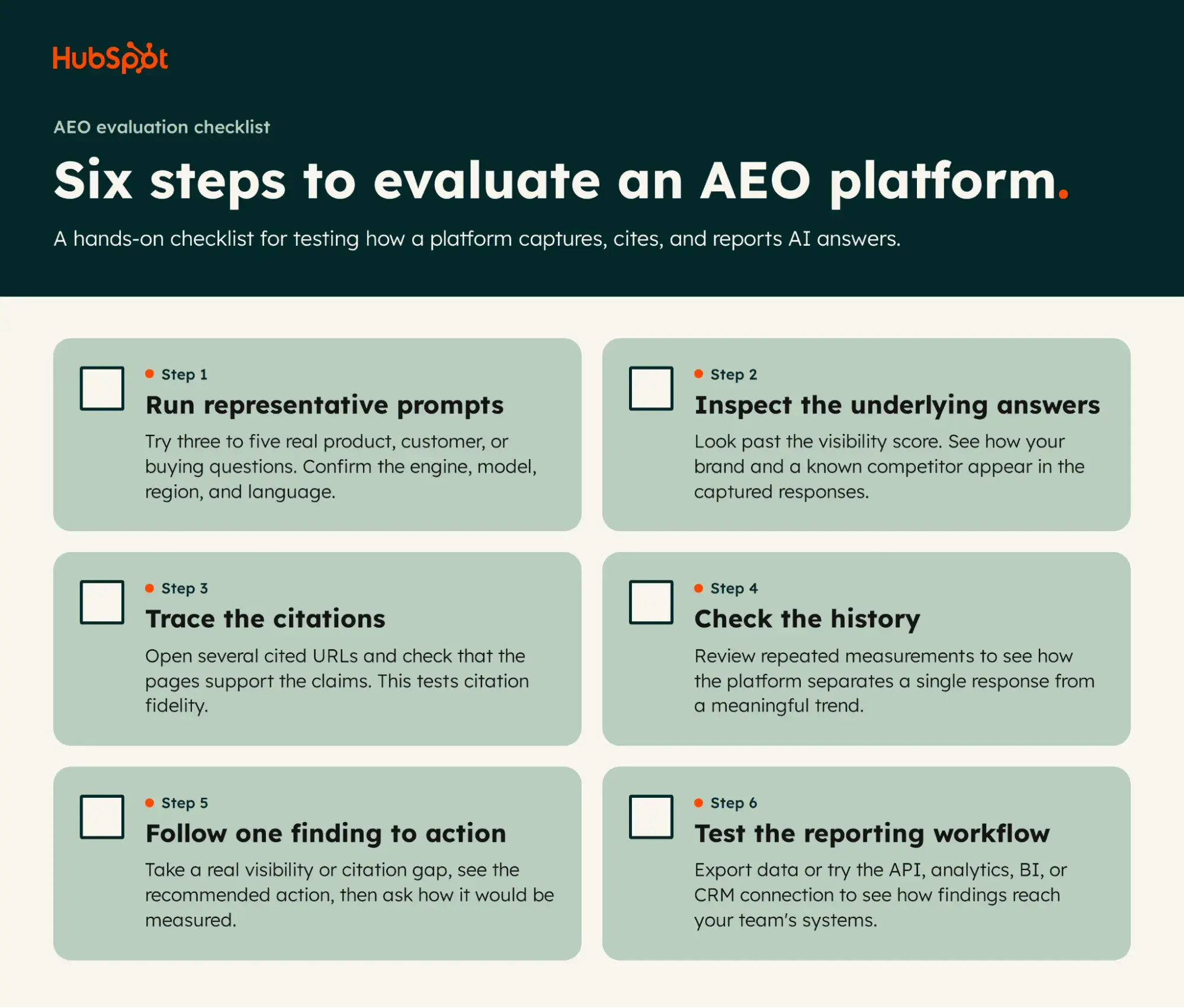
Evaluating platforms like Profound and Bluefish AI requires holding them up to rigorous criteria: engine and model coverage, measurement cadence, prompt controls, citation fidelity, data capture mechanics, reporting depth, governance standards, and organizational team fit.
Chronology and Industry Evolution: From Traditional SERPs to Conversational AI
The evolution of search has accelerated rapidly over the last 36 months, moving from auxiliary features to fully integrated conversational search experiences.
Phase 1: The Emergence of Generative Search (2022–2023). Early iterations of generative search, such as Google’s Search Generative Experience (SGE) pilots, introduced summarized answers at the top of traditional SERPs. During this period, marketers primarily focused on protecting organic traffic as click-through rates began to compress.
Phase 2: Standalone Answer Engines and Specialized Tools (2023–2024). As platforms like ChatGPT, Claude, and Perplexity gained mainstream adoption, consumer discovery bypassed traditional engines entirely. Early software solutions emerged to track brand mentions, prompting the creation of specialized AEO point solutions.
Phase 3: Institutionalization and Enterprise Governance (2024–Present). Today, AEO has matured into a distinct marketing discipline. Enterprise buyers now demand robust governance, SOC 2 compliance, multi-region controls, and closed-loop ROI attribution, forcing tools like Profound and Bluefish AI to evolve from basic tracking dashboards into comprehensive operational suites.
Profound vs. Bluefish AI: Model Coverage and Cadence
Both Profound and Bluefish AI offer daily tracking of AI visibility, yet their underlying architectures and coverage metrics diverge significantly.
Profound: Granular Configuration and Dataset Separation
Profound approaches model coverage by offering high levels of configuration across platforms, regions, and languages. However, buyers must navigate structural nuances within its architecture. For example, Profound’s Prompt Volumes dataset operates with its own distinct regional and platform availability parameters, entirely separate from its Answer Engine Insights. Consequently, marketing teams must audit coverage at a granular level to ensure the tool monitors the exact engines and geographies utilized by their target audience.
Bluefish AI: Commerce Focus and Model-Drift Controls
Bluefish AI documents monitoring across more than 10 distinct models, making it particularly attractive for brands operating within commerce-focused AI ecosystems, such as AI shopping assistants alongside general-purpose engines. Furthermore, Bluefish incorporates static prompt sets and model-drift controls to ensure measurement baselines remain consistent over time, mitigating the risk of false positives caused by underlying algorithmic updates.
Industry Context: HubSpot AEO tracks prompts daily across major general-purpose engines including ChatGPT, Gemini, and Perplexity, offering a streamlined out-of-the-box footprint (typically 25 tracked prompts on standalone plans, with scalable expansions available).
Citation Tracking, Fact-Checking, and Feedback Loops
An AI answer is only as trustworthy as the sources it cites. Both Profound and Bluefish AI trace generative responses back to individual source URLs, enabling marketing and communications teams to investigate inaccurate or weak brand representations. However, their mechanisms for translating these insights into action differ.
Profound’s FactCheck Methodology
Profound’s Answer Engine Insights features dedicated Citations and FactCheck modules. The FactCheck tool compares claims made about a brand against a customer-defined Knowledge Base. When discrepancies are found, it links the inaccurate claim directly to its citation URL, allowing teams to pivot smoothly into remedial workflows—such as updating owned content, publishing new collateral, or initiating digital PR outreach.
Bluefish AI’s Impact and Influence Metrics
Bluefish AI’s AI Monitoring Suite similarly identifies citation URLs and cross-references brand claims against a verified source of truth. It differentiates itself by introducing an Impact Score and an Influence Rank, which estimate the degree to which a specific source shaped the final AI response.
While these metrics provide valuable prioritization layers, enterprise buyers should interpret them with caution. Because these scores are calculated through predictive modeling rather than direct observation, teams must understand the underlying algorithms before allocating budget based on them.
Data Capture Methods: Consumer Interfaces vs. APIs
A foundational consideration in any AEO software evaluation is how the platform captures its data. Platforms generally ingest AI responses using one of three methods: recording direct consumer-facing browser sessions, querying provider APIs, or leveraging a hybrid methodology. Even with identical prompts and engines, different capture methods can yield divergent visibility metrics.
Profound explicitly documents its capture approach: its Answer Engine Insights gathers responses directly from consumer-facing answer-engine experiences. The design philosophy here is fidelity to what the end consumer actually sees in the wild.
Bluefish AI emphasizes a "precisely controlled environment" utilizing static prompt sets, daily monitoring across 10+ models, and various external signals (including Google signals and panel data). However, its public documentation is less explicit regarding whether data is pulled via consumer interfaces or provider APIs.
Evaluation Tip: During vendor demonstrations, explicitly ask how responses are captured, how interface layout changes are handled, and how repeated runs account for platform-side personalization.
Reporting, Attribution, and ROI Integration
The ultimate test of any marketing technology is its ability to tie operational metrics to business outcomes. AEO reporting is most effective when visibility data bridges the gap into CRM and web analytics platforms.
Profound’s Analytics Ecosystem
Profound supports CSV exports, an enterprise-grade API, and direct integrations with major analytics suites, including Google Analytics. By integrating with GA, Profound’s Agent Analytics allows teams to analyze AI-originated traffic alongside downstream conversions, sign-ups, and purchases.
Bluefish AI’s Collections and Attribution Claims
Bluefish AI utilizes Collections to group URLs, products, and topics, establishing clear baselines and recording marketing tactics against them. While Bluefish markets capabilities surrounding conversion contribution and "closed-loop attribution," public documentation provides fewer specifics regarding named CRM and BI integrations, making validation during a live demo essential.
The Attribution Ladder
To avoid misleading ROI claims, organizations should evaluate attribution through a progressive ladder:
$$textAI Visibility longrightarrow textIdentifiable Referral longrightarrow textConversion longrightarrow textKnown Lead/Contact longrightarrow textOpportunity/Pipeline$$
Proving causation—that an increase in AEO visibility directly drove revenue—requires rigorous multi-touch attribution modeling rather than simple correlation.
Security, Governance, and Enterprise Compliance
For enterprise-grade deployment, security and governance are non-negotiable prerequisites. Both Profound and Bluefish AI have matured significantly in this domain.
SOC 2 Compliance: Both platforms document SOC 2 Type II status, satisfying baseline enterprise security audits. Bluefish has also introduced designations such as "HIPAA Ready," which must be rigorously vetted against specific organizational compliance mandates.
Granular Controls: Profound generally publishes more comprehensive documentation detailing role-based access controls (RBAC), audit logging, data encryption at rest and in transit, and backup protocols. Bluefish covers core enterprise necessities, though certain administrative permissions and data retention policies may require direct inquiry during procurement.
Official Responses and Strategic Implications
Industry analysts and platform executives emphasize that AEO is not a temporary trend, but a permanent structural evolution in how human beings interact with information.
As digital real estate shifts from keyword rankings to synthesized conversational answers, organizations face profound strategic implications:
The Death of the Single Keyword: Optimization strategies must pivot toward semantic topics, complex multi-intent prompt structures, and conversational queries.
The Rise of Source Authority: Because AI engines synthesize answers from trusted third-party repositories (such as Wikipedia, Reddit, industry publications, and review sites), digital PR and earned media are now core components of technical search strategy.
Cross-Departmental Ownership: AEO cannot live exclusively within the SEO team. It requires close collaboration between content creators, PR teams, product marketing, and data engineering.
Scalable multi-client and enterprise configurations
Final Verdict and Recommendations
Choosing between Profound and Bluefish AI—or opting for a native solution like HubSpot AEO—depends entirely on your organization’s operational model, resource allocation, and existing technology stack.
Choose Profound if: Your team requires deep configuration control over prompt datasets, highly granular multi-region tracking, rigorous audit logging, and dedicated agency workspaces for managing multiple client brands independently.
Choose Bluefish AI if: Your brand requires broad coverage across specialized commerce AI models, heavy reliance on enterprise-led onboarding services, and sophisticated modeled impact scoring for brand reputation management.
Choose HubSpot AEO if: Your organization is already embedded within the HubSpot ecosystem (such as Marketing Hub Professional or Enterprise). By leveraging CRM context to drive prompt discovery and connecting AEO recommendations directly to existing content workflows, HubSpot offers a streamlined, unified approach to managing organic discovery without the friction of disparate third-party tools.
Ultimately, organizations should run a structured 30-day proof-of-concept using a shared checklist of known brand prompts and visibility challenges to determine which platform yields the most actionable, trustworthy data for their specific strategic goals.