







In the current landscape of artificial intelligence, a fierce arms race is underway. Every major AI laboratory and independent provider claims their latest agent architecture is "state-of-the-art." Weekly, new leaderboards emerge, and marketing departments fill social media feeds with glowing bar charts and soaring percentage points. Yet, for the enterprise engineer or the product manager who has attempted to transition an AI agent from a prototype to a production environment, one fundamental question looms larger than any metric: Does it reliably do the job I hired it for?
This article aims to strip away the marketing noise surrounding AI agent benchmarks. We will explore what these evaluations actually measure, why they serve better as directional signals than performance guarantees, and how to build a robust evaluation strategy that survives the unpredictability of the real world.
The Evolution of Evaluation: From Static Models to Active Agents
To understand the current state of agent evaluation, one must first distinguish between the two eras of AI testing. Traditional benchmarks, such as MMLU (Massive Multitask Language Understanding) or HumanEval, were designed for the "Chatbot Era." They measure a model’s ability to generate a correct, static response in a single turn. You provide a prompt, the model outputs text, and a judge scores the accuracy. While these tests are essential for quantifying raw reasoning and knowledge retention, they are fundamentally ill-equipped to measure agency.
Agent benchmarks represent a paradigm shift. They drop a model into an environment where it must take sequences of actions over multiple steps, utilize external tools, adapt to environmental friction, and pursue a goal that cannot be satisfied by a single block of text. If a chatbot is a student taking a written exam, an agent is an employee attempting to navigate a live work simulation. The agent must browse websites, manipulate files, execute code, and handle the "surprises" that occur when a web element changes or a server returns a 404 error.
The Major Benchmarks: A Technical Breakdown
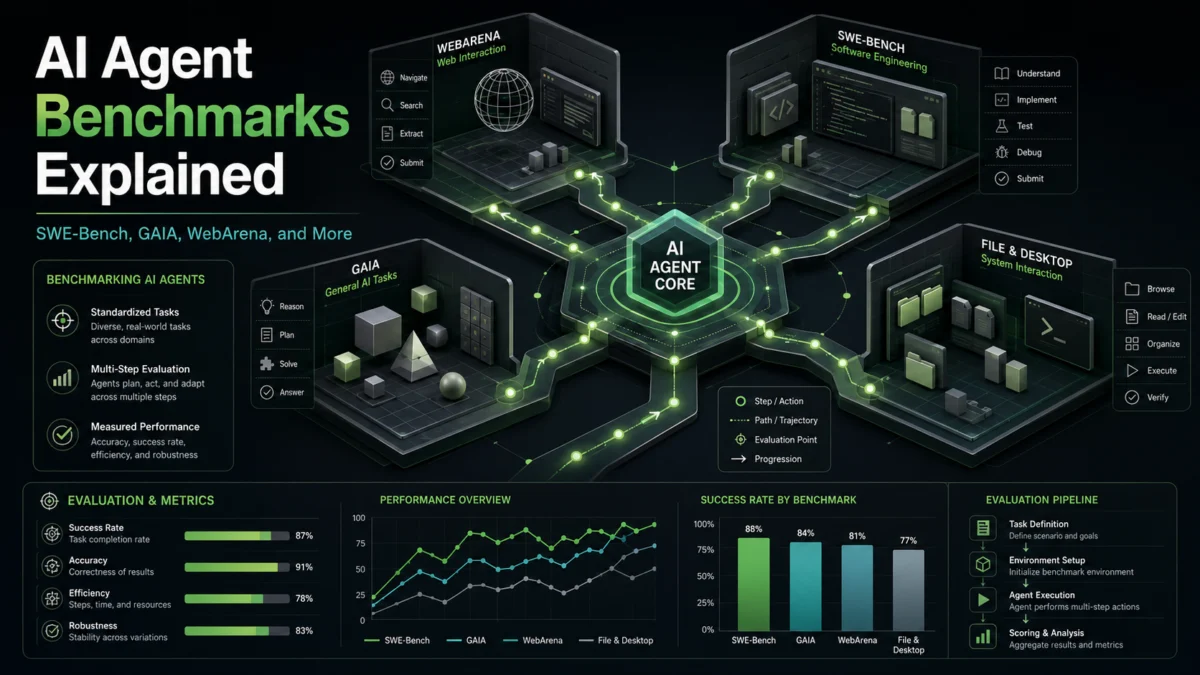
As the field matures, four specific benchmarks have emerged as the primary gauges for autonomous capability. Understanding their methodology is the first step toward informed procurement.
1. SWE-Bench and SWE-Bench Verified
SWE-bench is widely considered the gold standard for software engineering agents. The test presents an agent with a genuine GitHub issue from prominent open-source Python repositories like Django or scikit-learn. The objective is simple: produce a code patch that resolves the issue and passes the repository’s existing suite of unit tests.
The introduction of SWE-bench Verified was a critical development. By curating a subset of tasks where human engineers have confirmed the problem is solvable and the tests are reliable, the community has mitigated the "flawed test suite" problem that plagued early iterations. However, a significant caveat remains: passing a unit test does not equate to high-quality software engineering. An agent can "game" a test by writing fragile code that passes the check but introduces security vulnerabilities or memory leaks.
2. GAIA: Testing General Intelligence
The GAIA (General AI Assistants) benchmark targets the ability to answer complex, multi-modal questions. These tasks require the agent to cross-reference documents, perform web searches, execute mathematical calculations, and synthesize disparate data into a final answer.
What makes GAIA distinct is its design philosophy: tasks that are trivial for a human with access to the internet but highly challenging for current AI. It tests the orchestration of tools—the ability of an agent to move from a search engine to a calculator to a text processor without losing the thread of the user’s intent. While highly effective at measuring "connected reasoning," GAIA often struggles to reflect the messiness of real-world ambiguity, where goals are rarely clearly defined.
3. WebArena and BrowserGym: The Digital Browser
WebArena evaluates an agent’s proficiency in navigating realistic web applications. Rather than using live, volatile websites, WebArena employs sandboxed versions of e-commerce platforms, forums, and CMS interfaces. The agent must click, scroll, fill forms, and interpret UI states just as a human would.
BrowserGym acts as the modular framework for these tasks, allowing researchers to plug in different environments. The primary risk here is data contamination. Because many of these tasks have been in the public domain for some time, there is a non-zero probability that these specific tasks appear in the training data of newer models, leading to high scores that reflect pattern-matching rather than true, generalizable browser navigation skills.
4. OSWorld: The Ultimate Desktop Simulation
OSWorld represents the most ambitious frontier. It places the agent inside a sandboxed desktop operating system, requiring it to manipulate files, interact with GUI applications, and manage workflows across multiple programs.
Because OSWorld mirrors the complexity of a real computer, it is inherently "brittle." If the operating system lags or a GUI element fails to render correctly, the agent fails—even if its reasoning was technically sound. Consequently, OSWorld scores are often as much a test of infrastructure stability as they are a measure of agentic intelligence.
The Invisible Variables: What Leaderboards Ignore
While these benchmarks provide valuable data, they systematically exclude the metrics that matter most in a production environment.
Cost and Computational Efficiency
A model that achieves 80% on a benchmark by exhausting 50 attempts and burning thousands of tokens is objectively less "intelligent" in a business context than a model that achieves 70% with a single, efficient pass. Most leaderboards prioritize accuracy over cost-effectiveness, ignoring the "compute bill" that ultimately dictates the ROI of any AI deployment.
Latency and Throughput
In user-facing applications, speed is a feature. Whether an agent resolves a customer support ticket in ten seconds or ten minutes is the difference between a successful product and a liability. Current benchmarks offer almost no insight into the real-world latency profiles of these agents under load.
Safety, Boundaries, and Refusal
A critical, often overlooked dimension is the agent’s ability to know its limits. Does the agent respect permissioning boundaries? Does it refuse to take destructive actions when it lacks sufficient information? Currently, benchmarks are optimized for task completion, not risk management.
Error Recovery
The most telling moment in an agent’s lifecycle is not when everything goes right, but when it encounters a "broken link" or a server-side timeout. How does the agent pivot? Does it enter an infinite loop of failure, or does it attempt an alternative strategy? Most benchmarks grant limited credit for recovery, leaving this essential capability largely unmeasured.
Implications for the Future: Building Your Own Truth
The central thesis for any technical lead should be this: Public benchmarks are directional signals; they are not performance guarantees.
The gap between a sterile, sandboxed test and the chaos of a live production environment is insurmountable by design. Production tasks are frequently ill-defined, data is messy, and the consequences of a failed "action" involve real-world stakes—whether that be a broken database or a lost customer.
A Strategy for Robust Evaluation
- Use Public Benchmarks as a Filter: Use SWE-bench or WebArena to quickly eliminate agents that fundamentally lack the capability for your use case. If an agent cannot navigate a sandbox, it certainly cannot navigate your internal tools.
- Develop Domain-Specific "Golden Sets": Build a private evaluation suite that reflects your company’s specific workflows. If your agent is designed to manage cloud infrastructure, build a set of tasks that involve your specific APIs and permission models.
- Human-in-the-Loop Grading: Automated graders (often other LLMs) are prone to "hallucinated accuracy," where they provide positive scores to confident, incorrect outputs. Human review of a representative sample of test cases is essential for true validation.
- Define Your Failure Modes: Explicitly list what "failure" looks like for your agent. Is it a security breach? A cost overrun? A wrong answer? Test your agent specifically against these failure modes to ensure it has the necessary "guardrails" in place.
Conclusion
The progress made by benchmarks like GAIA and OSWorld is undeniably impressive. They have provided the research community with a common language and a framework for comparing the capabilities of autonomous systems. However, relying on these scores as a shorthand for production readiness is a recipe for project failure.
Use the leaderboards to start the conversation and to narrow the field of potential vendors or models. But to finish the job—to ensure that your AI agent is a reliable, safe, and efficient member of your team—you must build your own evaluations. The only benchmark that truly matters is the one that approximates your environment, your data, and your risks. In the world of AI agents, the "best" model is not the one at the top of the leaderboard; it is the one that performs best when the user is not watching.