






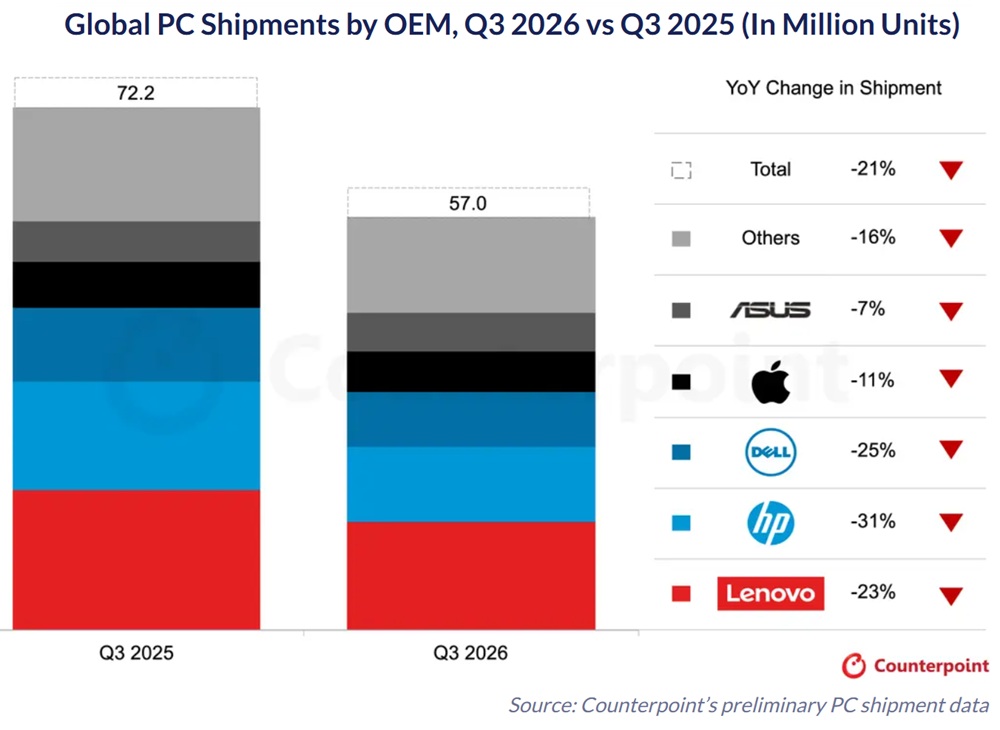
The global personal computer industry is currently navigating its most precarious landscape in recent memory. According to preliminary data released by Counterpoint Research, global PC shipments suffered a significant 21% year-over-year (YoY) decline in the third quarter of 2026, totaling just 57 million units. This contraction, coupled with a 13.8% decline quarter-over-quarter (QoQ), underscores a broader economic malaise that has moved beyond simple supply chain constraints to become a fundamental issue of affordability and consumer sentiment.
As rising memory and component costs translate directly into higher retail prices, the industry is entering what analysts describe as a period of "structural adjustment"—a phase defined by longer replacement cycles and a cooling of the post-pandemic hardware boom.
Main Facts: A Market in Retreat
The Q3 2026 figures paint a sobering picture for manufacturers and stakeholders alike. The 57 million units shipped represent a stark departure from the heights of previous years. Several factors have converged to create this environment, but none are more impactful than the rising cost of core components.
Memory prices, a key driver of total system cost, have been on an upward trajectory throughout the year. When combined with broader inflationary pressures on logistical and material costs, OEMs have found themselves in an unenviable position: either absorb these costs and sacrifice thinning profit margins or pass them on to the consumer. Most have opted for the latter, and the result has been a predictable collapse in consumer demand.
For the average household, the decision to purchase a new PC has become increasingly difficult to justify. With existing hardware still performing adequately for general tasks, the price hikes seen in 2026 have pushed consumers toward deferring upgrades indefinitely.
Chronology: From Pandemic Peaks to Structural Realignment
To understand the current state of the PC market, one must examine the timeline of the last 18 months.
- Q3 2025: The industry experienced a strong quarter, buoyed by the looming deadline for Windows 10 support. Organizations and power users were rushing to refresh their fleets, and inventory adjustments related to trade tariffs stimulated artificial growth. This created a high baseline for comparison, making the 2026 decline appear even more dramatic.
- Q1–Q2 2026: Throughout the first half of the year, component costs began to climb steadily. While manufacturers initially hoped these costs would be transitory, it became clear by mid-year that inflation in the DRAM and flash storage sectors was structural.
- Q3 2026: The full impact of these price hikes hit the retail market. Consumers, facing their own cost-of-living pressures, signaled a broad withdrawal from the PC market. While commercial entities continued to purchase units for necessary infrastructure upgrades and operating system migrations, the sheer volume was insufficient to stabilize the total market.
- The Forecast (Q4 2026 – 2027): Counterpoint Research projects a further 27% YoY decline for the final quarter of 2026, suggesting that the worst of the volatility is still ahead. The forecast for 2027 remains stagnant, indicating a "new normal" where shipment volumes remain depressed rather than rebounding.
Supporting Data: The Competitive Landscape
While the overall market is shrinking, the divergence between vendors is becoming increasingly pronounced. The "Big Five" vendors—Lenovo, HP, Dell, Apple, and ASUS—collectively command 76.7% of the global market. However, their experiences vary significantly.

The Resilience of Apple and ASUS
Data indicates that Apple and ASUS have outperformed their peers in terms of market resilience. By leveraging differentiated product portfolios—such as the performance-per-watt advantage of Apple’s silicon and the niche appeal of ASUS’s high-end gaming and creator-focused devices—these companies have insulated themselves against the "race to the bottom" in the budget segment.
In contrast, other vendors, which collectively accounted for 13.3 million units in Q3, saw their shipments plummet by 16% YoY. This suggests that the middle of the market is hollowing out. Consumers are either opting for high-end, premium machines that offer distinct utility or are holding onto older, budget-tier devices until they are completely unusable.
Component Cost Correlation
The relationship between memory price trends and PC shipments has become perfectly inverse. As shown in recent industry analysis, the trajectory of component inflation (from Q3 2025 through early 2027) maps almost exactly to the dip in shipment volume. This confirms that the decline is not due to a lack of interest in technology, but a direct result of price elasticity.
Official Responses and Expert Analysis
Industry leaders and analysts are viewing this downturn as a long-term shift rather than a temporary "blip."
Minsoo Kang, Senior Analyst at Counterpoint Research, noted: "The global PC market is facing mounting pressure as rising memory and component costs push system prices higher and force consumers to delay replacement purchases. While commercial refresh cycles and Windows migration continue to provide some support, they are no longer enough to offset weakening demand."
Kang’s assessment highlights a critical paradox: while businesses are forced to buy because of software obsolescence, the consumer segment has no such mandate. If a PC becomes too expensive, the consumer simply waits.
David Naranjo, Associate Director at Counterpoint, added a sobering warning regarding market recovery: "Stabilization should not be mistaken for recovery. The industry is entering a period of structural adjustment." Naranjo emphasized that OEMs are currently trapped in a "difficult balance" between maintaining the health of their margins and keeping products affordable enough to entice the average buyer.
Implications for the Future
The implications of this data extend far beyond mere quarterly shipment numbers. They suggest a transformation in how the world consumes computing power.
1. The Death of the "Entry-Level" PC
As component costs remain high, manufacturers are pivoting away from low-margin, entry-level hardware. The "budget" laptop of 2024 is becoming increasingly rare as brands prioritize configurations that allow them to absorb component inflation. For the price-sensitive buyer, this means fewer choices and a higher entry price, which will inevitably continue to suppress shipment volumes for the foreseeable future.
2. The Shift to "Value-Added" Computing
To counteract the decline, vendors are increasingly looking toward "AI PCs" and premium displays as the potential saviors of the market. The logic is simple: if the market is smaller, it must become more profitable per unit. By bundling AI-driven productivity software and high-end hardware, manufacturers hope to convince users that a new machine is not just a replacement, but an upgrade in capability.
3. Longer Replacement Cycles
The most profound implication is the shift in consumer behavior. The "three-year upgrade cycle" that once defined the PC industry is expanding to four or five years. As the quality of hardware plateaus and prices rise, the average user is finding that their current device is "good enough." This is perhaps the greatest challenge facing the industry: proving that a new PC is essential rather than optional.
4. Supply Chain Discipline
Moving forward, success will be determined by supply chain efficiency and product differentiation. Manufacturers that can secure components at scale and offer truly unique value propositions—rather than generic office hardware—will be the only ones to emerge from this "structural adjustment" with their market share intact.
The era of explosive growth, fueled by the pandemic and easy credit, has firmly concluded. In its place, the PC industry must learn to thrive in a high-cost, high-expectations environment. The next eighteen months will serve as a proving ground for which companies can balance the necessary price hikes with the innovation required to keep the consumer interested in the next generation of computing.