






The rapid proliferation of generative AI has fundamentally altered the software development lifecycle. For organizations, the journey from a compelling prototype to a production-ready, enterprise-grade AI product has proven to be less of a research challenge and more of a complex product management hurdle. As the gap between "cool demo" and "user-trusted utility" widens, a new, highly specialized role has emerged: the AI Product Manager (PM).
Unlike their counterparts in traditional SaaS, who manage deterministic systems where input A consistently yields output B, the AI PM operates in a landscape of shifting probabilities. They navigate environments where outputs can hallucinate, drift, or exhibit unexpected behaviors. To succeed in 2026, the modern AI PM must synthesize machine learning trade-offs, compute economics, and regulatory compliance into a coherent roadmap that bridges the divide between engineering, legal, and executive teams.
The Paradigm Shift: From Deterministic to Probabilistic Thinking
The foundational requirement for any aspiring AI PM is a cognitive shift from deterministic to probabilistic thinking. In traditional software, logic is absolute; in AI, logic is approximate and context-dependent. This is not a failure of the technology, but rather the core "terrain" that the AI PM must master.
Understanding Architecture and Latency
Success begins with building intuition regarding system architecture. While a PM need not code the models themselves, they must possess enough technical fluency to challenge engineering assumptions. Key tensions define this space:
- Latency vs. Cost vs. Accuracy: Every decision involves a trade-off. Is a higher-performing model worth the increased token cost? Can a smaller, faster model suffice for a specific user journey?
- Context Management: Managing token consumption and time-to-first-token (TTFT) is critical. The AI PM must understand how context-window sizing impacts both user experience and the bottom line.
Recommended Starting Points:
To build this intuition, practitioners should consult Hands-On Large Language Models by Jay Alammar and Maarten Grootendorst. Additionally, the fast.ai Practical Deep Learning course provides the necessary architecture intuition without requiring a background in advanced mathematics.
A Four-Phase Roadmap to AI Product Leadership
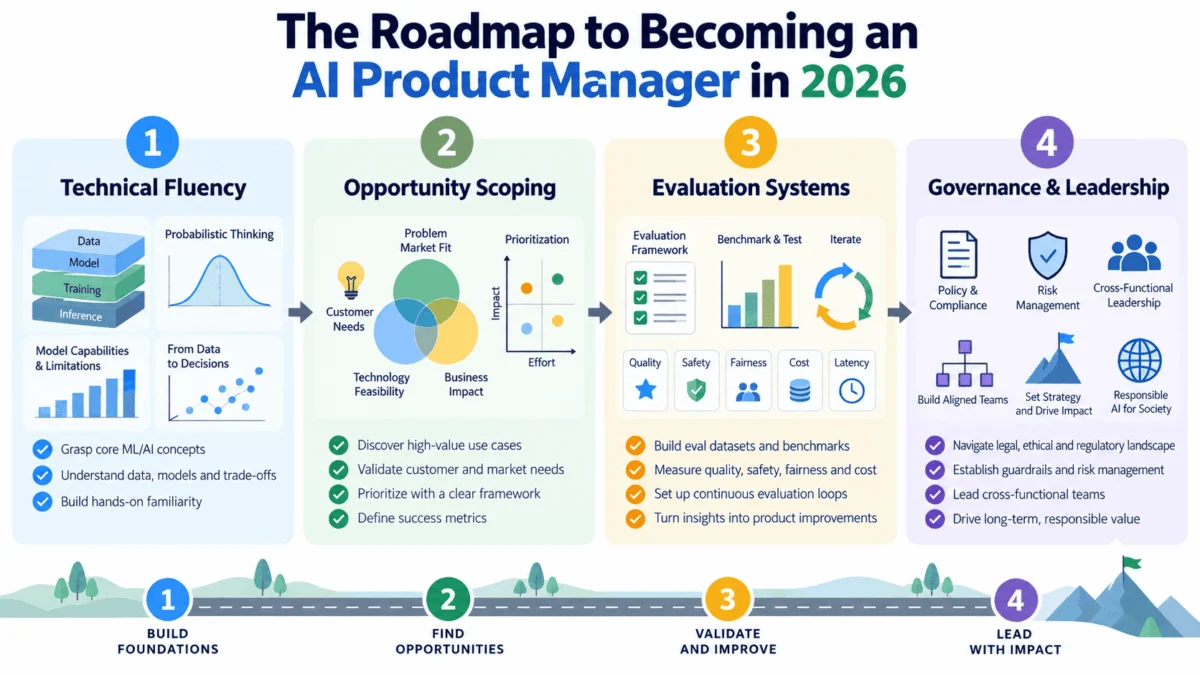
The evolution of an AI PM can be categorized into four distinct, compounding phases. Each phase builds upon the last, turning foundational technical knowledge into strategic organizational influence.
Phase 1: Developing Technical Fluency
At the outset, the focus is purely on the "Probabilistic Mindset." You must learn to ask the right questions during scoping sessions.
- Portfolio Exercise: Create a comparison matrix for three different architecture choices applied to a single business problem, such as customer support automation. Document the reasoning behind your choice based on cost, speed, and reliability.
Phase 2: Opportunity Discovery and Feasibility Scoping
Once technical vocabulary is established, the PM must discern which AI opportunities are viable. Most AI projects fail not because the technology isn’t impressive, but because the business case is weak.
The AI Product Canvas serves as a vital tool, mapping tasks based on the value delivered versus the risk posed.
- Low-Risk/High-Value: Tasks like text summarization or document extraction are ideal for early adoption.
- High-Risk/High-Value: Tasks involving compliance or safety require significant "evaluation infrastructure" before deployment.
Furthermore, the PM must master the Build vs. Buy vs. Assemble decision. This is both a technical and financial calculation. A PM must be capable of modeling the unit economics of compute. If token consumption scales, does the gross margin remain healthy? How do GPU hosting costs compare to API fees at 10x volume?
Phase 3: UX, Evaluation, and Iteration
This is where AI PM practice diverges most from traditional methodology. Because outputs are non-deterministic, binary "pass/fail" tests are insufficient. The PM must champion Eval-Driven Development.
- Designing for Uncertainty: How do you signal to a user that a model is uncertain? How do you implement "graceful degradation" when the model provides a sub-par output?
- Human-in-the-Loop (HITL): Deciding where to place human checkpoints is a critical design decision.
- Red-Teaming: Security is not an afterthought. Before any launch, structured adversarial testing—including prompt injection and boundary probing—must be integrated into the pre-launch checklist.
Phase 4: Governance, Compliance, and Leadership
The final stage of the roadmap involves moving from individual contributor to organizational leader. As AI models are deployed globally, the PM acts as the primary translator between research engineers, legal counsel, and the C-suite.
Regulatory literacy is now a non-negotiable skill. Whether navigating the EU AI Act or local sector-specific mandates in finance or healthcare, the PM must flag risk exposure early. Data lineage, privacy, and compliance (such as SOC 2 or HIPAA) are no longer just "legal issues"; they are architectural requirements that dictate how models are trained, stored, and accessed.
Supporting Data: The Economics of Scaling
Industry analysis suggests that the primary reason for "AI failure" is the failure to account for long-term operational costs. As companies transition from pilot programs to full-scale enterprise integration, the cost of inference often outstrips the initial cost of training.
According to data from AI industry leaders and public pricing models from companies like OpenAI and Anthropic, the "Unit Economics of Compute" is the most common blind spot for incoming PMs. A product that appears profitable at 1,000 requests per day may become a liability at 1,000,000 requests if the latency and vector database costs are not optimized early in the design phase.
Official Perspectives: The Role of the AI PM
Vinod Chugani, an expert in AI and data science education, notes that the AI PM role is still in its infancy, which offers a unique opportunity for early adopters to define its parameters. "The habit that distinguishes strong AI PMs is intellectual honesty about uncertainty," Chugani observes. "They don’t oversell model capabilities, they build solid fallback systems, and they treat evaluation as infrastructure rather than an afterthought."
This sentiment is echoed across the industry, where leaders emphasize that the role is essentially one of "cross-functional orchestration." The PM must reconcile the goals of research engineers (who prioritize performance benchmarks) with those of legal teams (who prioritize liability reduction) and executives (who prioritize ROI).
Strategic Implications for Organizations
For companies, the implication is clear: the era of the "Generalist PM" managing AI products is coming to an end. Organizations that do not empower their product managers to understand the technical and regulatory nuances of AI will likely face significant technical debt and, potentially, legal repercussions.
The Future Landscape
As we look toward 2026, the technical landscape will continue to shift at breakneck speed. New model architectures, reduced inference costs, and evolving international regulations will require constant learning. However, the core discipline of the AI PM—rigorous scoping, data-driven evaluation, and the ability to build trust with stakeholders—will remain the bedrock of the profession.
Recommended Resources for Continued Growth:
- For Discovery: Continuous Discovery Habits by Teresa Torres.
- For Market Context: The a16z AI Canon.
- For Evaluation: RAGAS documentation and tools like Braintrust or PromptFoo.
- For Governance: The EU AI Act summary and Trustworthy Machine Learning by Kush R. Varshney.
Final Conclusion
The AI Product Manager sits at the intersection of possibility and reality. By moving from a deterministic to a probabilistic mindset, adopting rigorous evaluation frameworks, and maintaining a firm grasp on the regulatory and economic realities of AI, these professionals provide the stability necessary to scale intelligence. As the technology matures, the ability to translate "AI" into "Value" will be the defining metric of success for the next generation of product leaders.