





In the rapidly evolving landscape of Large Language Models (LLMs), the transition from generalist chatbots to specialized, agentic systems is the defining challenge for developers. While models like Meta’s Llama 3 8B demonstrate remarkable reasoning capabilities, they often struggle with the "last mile" of production integration: outputting strictly formatted, schema-compliant JSON payloads. When an autonomous agent relies on an API, even a minor conversational "filler" or a subtle syntax error can crash the entire pipeline.
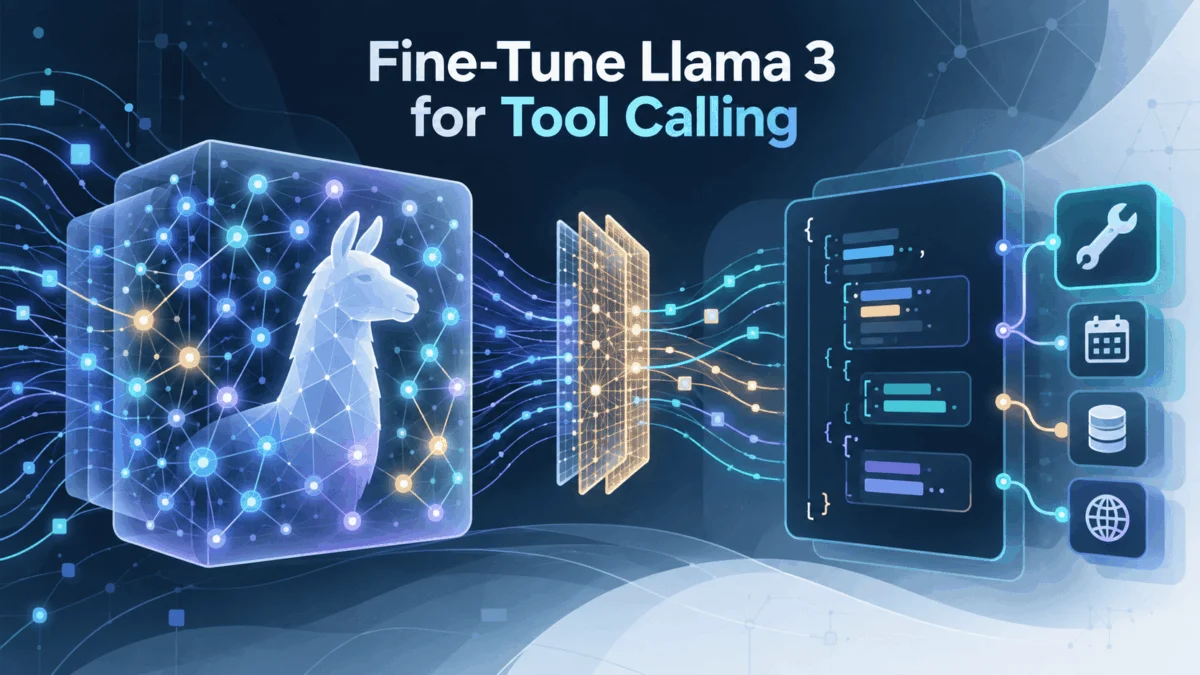
This article explores the technical imperative of fine-tuning for structured output, providing a comprehensive, step-by-step methodology to transform Llama 3 into a precise tool-calling engine using Unsloth and QLoRA.
The Core Challenge: Why Prompt Engineering Fails
At the heart of the issue lies the difference between knowledge and behavior. Prompt engineering—providing a detailed system instruction or "few-shot" examples—is a powerful tool for guiding a model’s intent. However, it is fundamentally probabilistic.
When you task a base model with returning a JSON object, it is operating under the assumption that it is a conversational assistant. Despite explicit instructions to "respond only with JSON," the model is prone to "drift," adding helpful prose, conversational transitions, or stylistic inconsistencies. For an API that expects a clean, machine-readable payload, these human-like conversational elements are essentially noise that triggers parsing errors.
Fine-tuning addresses this by fundamentally altering the model’s weight distribution to favor a specific behavioral pattern. By training the model on thousands of examples of user inputs mapped directly to the desired JSON schema, you transition from "asking" the model to follow a rule to "training" the model to perceive that rule as the default state of existence.
Chronology of the Development Pipeline
To build a production-ready tool caller on a budget, we rely on a specific, optimized workflow. The following steps outline the lifecycle of creating a specialized agent:
- Environment Preparation: Configuring a cloud-based development environment (specifically a Google Colab T4 GPU instance) to handle the quantization and training processes without requiring enterprise-grade hardware.
- Model Loading and Quantization: Utilizing Unsloth’s pre-quantized Llama 3 8B weights. By using 4-bit quantization, we reduce the memory footprint by roughly 75%, enabling training on consumer hardware while maintaining high precision.
- Adapter Injection (LoRA): Instead of modifying the entire 8-billion parameter model, we insert "Low-Rank Adapters" (LoRA). These are small, trainable weight matrices that capture the nuance of the tool-calling task while keeping the base model frozen.
- Dataset Curation: Constructing a high-quality, synthetic, or real-world dataset that forces the model to associate specific intent with specific JSON outputs.
- Training and Validation: Running the Supervised Fine-Tuning (SFT) loop and testing against unseen queries to verify that the model has internalized the JSON format.
Supporting Data: Efficiency and Performance
The efficacy of this approach is backed by the efficiency of the Unsloth library. Traditionally, fine-tuning an 8B parameter model would require massive VRAM overhead, often necessitating multiple A100 or H100 GPUs.
Through QLoRA (Quantized Low-Rank Adaptation), we update approximately 1% of the model’s parameters. This specific ratio is the "sweet spot" for behavioral fine-tuning. Research indicates that increasing the LoRA rank beyond 16 for a focused task like JSON output often leads to diminishing returns and increased risk of overfitting—where the model memorizes the training data rather than learning the logic behind the schema.
For developers, this means the training process—which would normally take hours—is compressed into a sub-10-minute operation on a free-tier Colab instance. The memory savings are significant enough that the model remains responsive during training, allowing for real-time monitoring of loss metrics.
Implementation Guide: Setting the Stage
1. Environment Setup
To begin, ensure your environment is configured for GPU acceleration. Use the following installation command to fetch the optimized Unsloth suite:
!pip install "unsloth[colab-new] @ git+https://github.com/unslothai/unsloth.git"
!pip install --no-deps xformers trl peft accelerate bitsandbytes
2. Loading the Model
We load the llama-3-8b-Instruct-bnb-4bit model. This pre-quantized version is optimized for speed and memory efficiency. By setting max_seq_length to 1024, we ensure the model has sufficient context window to process complex tool schemas.
from unsloth import FastLanguageModel
model, tokenizer = FastLanguageModel.from_pretrained(
    model_name="unsloth/llama-3-8b-Instruct-bnb-4bit",
    max_seq_length=1024,
    load_in_4bit=True,
)
3. Injecting LoRA Adapters
The get_peft_model function is where we define the "intelligence" of our adapter. By targeting the query, key, value, and projection layers, we allow the model to learn the structural requirements of our API.
- Rank (r=8): Optimal for task-specific behaviors.
- Dropout (0): Critical for Unsloth’s kernel optimization; keep this at zero to avoid performance degradation.
The Crucial Role of the Dataset
The quality of your tool-calling agent is directly proportional to the quality of your dataset. A poorly structured dataset will lead to hallucinations or inconsistent JSON structures.
The Anatomy of a Perfect Example:
- System Prompt: Defines the tools, their arguments, and the constraint (e.g., "Respond ONLY with a valid JSON tool call").
- User Input: The natural language query.
- Assistant Output: The strictly formatted JSON response.
When building this, include edge cases. If your API supports optional arguments, ensure your training data contains examples where those arguments are both present and absent. If the user asks an ambiguous question, ensure you have examples where the model returns a structured error or a "clarification" JSON.
Implications for Agentic Workflows
The implications of a reliable tool-calling model are transformative. Once a model can consistently output JSON, it ceases to be a chatbot and becomes a functional node in a larger software architecture.
- Reduced Latency: By removing the need for post-generation regex parsing or "retry" loops (where the system asks the LLM to fix its own formatting errors), the total response time of your agent drops significantly.
- Increased Reliability: Agentic pipelines (such as LangChain or AutoGPT) depend on deterministic behavior. A fine-tuned model acts as a reliable "switch," routing user queries to the correct database or API service without manual intervention.
- Cost Efficiency: Smaller, fine-tuned models are cheaper to host and faster to run than massive, general-purpose models like GPT-4 or Claude 3.5.
Conclusion: From Prototype to Production
Fine-tuning Llama 3 8B for tool calling is not merely a technical exercise—it is a strategic shift in how we build AI-native applications. By utilizing Unsloth and QLoRA, developers can bridge the gap between human intent and machine execution.
The path forward is clear: start with a focused dataset, monitor your training loss closely to avoid overfitting, and leverage the speed of quantized training to iterate rapidly. As your requirements grow, expanding your dataset to include complex, multi-tool scenarios will allow your agent to handle increasingly sophisticated workflows, ultimately enabling the creation of autonomous systems that are as precise as they are powerful.
The future of AI is not in the size of the model, but in the precision of its execution. With these tools, you are well-equipped to build the next generation of reliable, agentic software.