







By Daniel
Published as part of the AWS Weekly Roundup Series
Introduction: The Real-World Velocity of Cloud Infrastructure
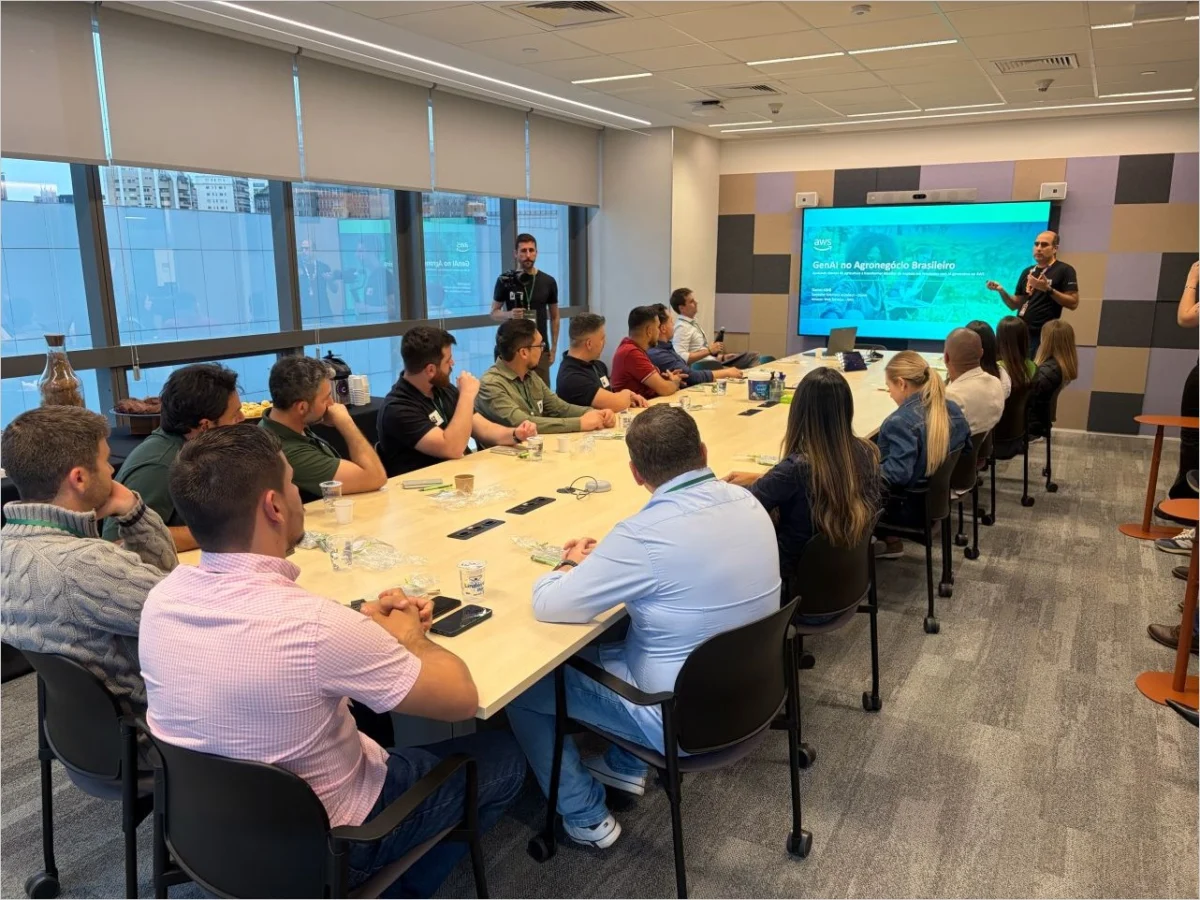
A few weeks ago, I had the privilege of presenting to a small, focused group of commercial and technology leaders from the Brazilian agribusiness sector at the AWS office in São Paulo. My talk walked through the practical applications of generative AI across the diverse, demanding stages of a modern agricultural operation—from supply chain logistics and yield prediction to predictive maintenance of heavy machinery.
The core point I kept returning to was simple yet urgent: the markets we traditionally label as "legacy" or "traditional" are precisely the ones where keeping up with rapid technological transformation dictates who stays ahead of the curve. Interestingly, not a single person in that room was debating whether artificial intelligence belongs in agriculture. The debate was entirely focused on delivery—who receives the AI output, in which language, on which device, and under what conditions. More often than not, these users are interacting with systems while driving a heavy tractor between remote fields.
When your user has both hands firmly on a steering wheel, the visual interface disappears, and the voice interface becomes paramount. That specific operational reality is why an infrastructure launch I might otherwise have filed away as routine instead leads my list this week: the Amazon Polly Generative engine upgrade, which added 14 new voices, including two native options in Brazilian Portuguese.
While voice-driven interfaces bridge the gap for field operations, the rest of the technology landscape this week carries a sharper, more urgent edge. From radically redefined vulnerability management to simplified container networking and zero-downtime database migrations, here is a comprehensive breakdown of the most critical updates, launches, and insights across the AWS ecosystem.
1. Main Facts: Core Breakthroughs and Announcements
The past week has brought a wave of substantial infrastructure, machine learning, and security updates from Amazon Web Services. Major highlights include:
- AWS Continuum (Generally Available): A groundbreaking end-to-end vulnerability management service that moves beyond static scanners by constructing context graphs, reproducing vulnerabilities in isolated sandboxes, and automatically opening verified fixes via pull requests.
- Amazon ECS Gateway: A new architectural pattern that streamlines container networking by separating network management from application deployment, enabling up to 25 services to share a single Application Load Balancer (ALB).
- Amazon Polly Generative Engine Upgrade: A major expansion adding 14 new generative voices across 9 locales—including Hindi, Finnish, and two new Brazilian Portuguese voices (Leo and Carolina)—bringing the total catalog to 57 voices across 11 languages.
- TorchNeuron (Public Beta): An open-source PyTorch backend that introduces native support for AWS Trainium chips, allowing developers to target Trainium hardware simply by changing
.to('neuron')without rewriting code. - Amazon SageMaker AI Training Sessions: A generally available feature allowing developers to build custom post-training loops and loss functions while SageMaker manages underlying GPU infrastructure, distributed execution, and fault recovery.
- Structured Outputs on Amazon Bedrock: Native, schema-compliant JSON outputs for Anthropic Claude models, eliminating the need for complex custom parsing or retry loops.
- Amazon ElastiCache Serverless for Valkey: Zero-downtime online migration capabilities enabling organizations to move self-managed Valkey or Redis OSS databases directly into ElastiCache Serverless without client errors.
2. Chronology: A Week of Accelerated Threats and Defenses
The tension between accelerating software delivery and tightening security loops defined the operational rhythm of the week.
The Security Timeline: When Disclosures Lag Behind Exploitation
The defining narrative of the week’s security landscape centers on a sobering realization: the traditional delay between the public disclosure of a vulnerability and its malicious exploitation has effectively vanished.
AWS’s own telemetry and threat intelligence divisions provided concrete proof of this shift. Amazon Threat Intelligence published telemetry findings detailing a PHP2Shell exploitation attempt captured by their internal MadPot honeypots on October 17. Crucially, this exploitation occurred four days before the official vulnerabilities—tracked as CVE-2026-109618 and CVE-2026-109619—were publicly disclosed.
The timeline tightened even further on disclosure day:
- 02:00 UTC: Functional proof-of-concept (PoC) exploits began actively circulating across open forums.
- 14:00 UTC: The official embargo was scheduled to lift, twelve hours after active exploits were already in the wild.
This chronology completely refutes the traditional "patch window" paradigm. Operating under the assumption that an enterprise has days or weeks to remediate after an advisory drops is no longer viable. Consequently, security investigations and incident responses must now measure their timelines from the earliest recorded exploitation attempt rather than the date of public disclosure.
3. Supporting Data & Technical Deep Dives
AWS Continuum: Reimagining Vulnerability Management
Traditionally, vulnerability management tools function as noisy scanners that dump sprawling lists of CVEs onto development teams, leaving engineers to manually sift through false positives, weigh severity scores, and write patches.
AWS Continuum reframes this workflow as an automated, context-aware engineering lifecycle:
- Context Graph Generation: Continuum continuously maps code repositories against the live AWS deployment environment, building a comprehensive graph of dependencies and attack paths.
- Evidence-Based Triage: Rather than relying solely on abstract severity labels, Continuum assigns an evidence level to each finding.
- Sandboxed Reproduction: To eliminate guesswork, the system safely reproduces exploitable findings inside an isolated sandbox environment, generating proof-of-concept code so engineering teams can visually confirm the threat.
- Automated Remediation (Pull Requests): Issues are ranked dynamically based on how closely an attack path intersects with business-critical systems. Once prioritized, Continuum automatically generates and opens a fix as a pull request.
The Control Boundary: To ensure enterprise safety, every remediation currently requires human approval. Engineers review and merge the pull request. However, AWS has designed the framework to accommodate autonomous remediation classes in the future, which will be strictly gated behind customizable confidence thresholds. Currently, Continuum is available in the US East (N. Virginia) and US West (Oregon) regions.
Amazon ECS Gateway: Architectural Efficiency for Containers
Managing container ingress at scale has historically created friction between platform engineering teams (who manage networks, security groups, and certificates) and application development teams (who just want to deploy code).
Amazon ECS Gateway resolves this organizational divide by splitting operational responsibilities:
- Platform Teams define a single gateway specifying organization-wide subnets, TLS certificates, listener settings, and AWS WAF web ACLs.
- Application Teams simply opt in by adding a lightweight gateway connector to their service definitions.
Under the hood, Amazon ECS automates the provisioning infrastructure: it issues an AWS Certificate Manager (ACM) certificate, generates a unique DNS hostname, configures listener rules and target groups, and establishes a strict security group admitting traffic exclusively from the Application Load Balancer.
The Economics:

- Up to 25 services can securely share a single Application Load Balancer.
- ECS automatically provisions ALBs upon a service’s first connection and decommissions them when traffic drops to zero.
- A single gateway can associate with up to 10,000 clusters, with a limit of five gateways per cluster.
Existing architectures can adopt ECS Gateway incrementally using standard UpdateService API calls without replacing active load balancers. The feature is available in all commercial regions supporting Amazon ECS at no additional charge.
Machine Learning and Silicon Diversification
The hardware and machine learning ecosystem received critical updates aimed at reducing vendor lock-in and simplifying custom training loops:
- TorchNeuron: This open-source PyTorch backend enables developers to execute models on custom AWS Trainium chips simply by invoking
.to('neuron'). Because it preserves eager execution andtorch.compilecompatibility, teams can migrate workloads without rewriting underlying codebases. It is fully integrated with the Neuron Kernel Interface for custom operators and supports both Trainium2 and Trainium3 instances. - SageMaker AI Training Sessions: Data scientists can now implement custom post-training loops, custom loss functions, and unique reward signals while SageMaker AI completely abstracts away GPU provisioning, distributed execution, fault recovery, and checkpoint storage. Billing is strictly metered against active token processing, pausing while custom reward functions compute batches.
- Claude Structured Outputs: Amazon Bedrock now delivers guaranteed, schema-compliant JSON outputs directly from Anthropic Claude models across both
bedrock-runtimeandbedrock-mantleendpoints. This eliminates the brittle custom parsing scripts and retry loops traditionally required for financial document parsing or clinical note ingestion.
4. Official Responses and Industry Perspectives
The release of AWS Continuum and the alarming telemetry surrounding the PHP2Shell exploits have triggered widespread discussion regarding enterprise risk management and the velocity of cloud defense.
In a companion technical post addressing hardware independence, AWS architectural leads emphasized that hardware choices should never restrict a software engineering roadmap. "Your last hardware decision shouldn’t decide what you build next," the analysis noted, underscoring why initiatives like TorchNeuron and multi-architecture SageMaker integrations are vital for long-term enterprise flexibility.
Furthermore, financial institutions are increasingly leaning into automated modernization pipelines. Highlighting this trend, recent case studies detailed how major institutions—such as U.S. Bank—successfully migrated massive, mission-critical database clusters (including a 119 TB Oracle Exadata migration to Amazon RDS for Oracle) using config-driven pipelines built on AWS DataSync, Oracle XTTS, and Amazon EFS. Despite strict bandwidth caps over Direct Connect links, the initial baseline copies completed in approximately seven days with zero data loss, achieving average cutover windows of just four hours per database.
5. Implications: What This Means for Enterprise Architecture
The cumulative impact of this week’s announcements points toward three major shifts in enterprise cloud strategy:
- Automation as the Primary Defense Line: With threat actors deploying exploits days before public vulnerability disclosures, human reaction times are mathematically insufficient. Tools like AWS Continuum represent the necessary evolution toward automated, context-aware remediation pipelines that bridge the gap between detection and patching.
- Decoupling Infrastructure from Application Logic: Services like Amazon ECS Gateway and SageMaker Training Sessions highlight a broader industry trend: abstracting undifferentiated heavy lifting away from product developers. By letting platform teams manage boundary controls and cloud providers manage GPU clusters, engineering velocity increases exponentially.
- Expanding Multimodal and Edge Interfaces: As demonstrated by the Amazon Polly Generative engine upgrade—bringing natural voice interaction to localized markets like Brazilian Portuguese, Hindi, and Finnish—the traditional screen-and-keyboard interface is rapidly giving way to ambient, voice-driven computing, especially in industrial, field, and agricultural environments.
Upcoming AWS Events
As the autumn conference season draws to a close, preparation is ramping up for the industry’s flagship gathering:
- AWS re:Invent: Running from November 30 to December 4 in Las Vegas, this year’s conference features over 2,200 technical sessions. The session catalog is live, and reserved seating is currently open for attendees looking to build their schedules.
- AWS Community Days: The Brazilian community season concludes with AWS Community Day Brasil Norte, taking place in Belém on October 31. Developers and cloud architects are encouraged to check the regional hub for local community meetups.
That’s all for this week. Check back next Monday for another Weekly Roundup!
— Daniel