







The festive season in India has long been synonymous with prosperity, new beginnings, and the traditional ritual of "home cleaning and upgrading" in anticipation of Diwali. However, the data emerging from the Amazon Great Indian Festival 2026 suggests that this annual tradition has evolved into a high-tech, data-driven shopping phenomenon. Amazon India has officially reported a staggering 3x growth in home-upgrade shopping volume, signaling a profound shift in how Indian households—particularly those outside the traditional metropolitan hubs—are investing in their living spaces.
The Rise of Non-Metro India: A New Consumption Powerhouse
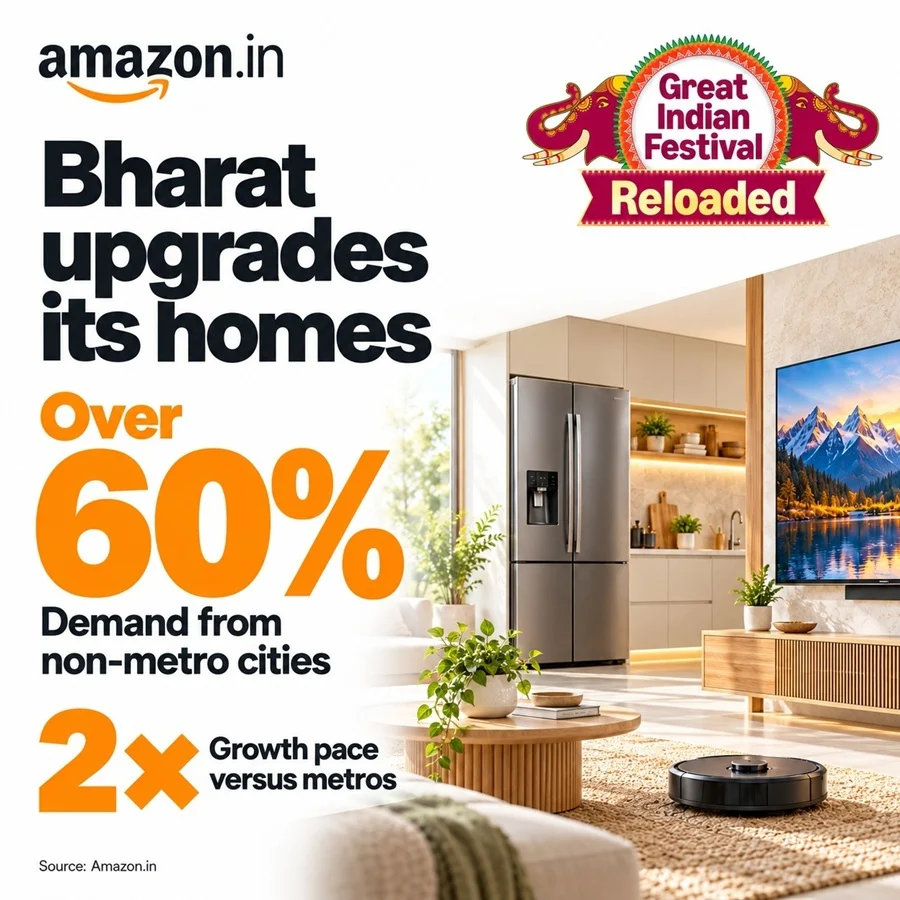
Perhaps the most striking takeaway from this year’s festival is the democratization of premium retail. Historically, major e-commerce growth was tethered to Tier-1 cities. In 2026, the narrative has flipped: non-metro cities now account for over 60% of Amazon’s total shopping volume. More impressively, these regions are expanding at twice the pace of their metropolitan counterparts.
Cities such as Lucknow, Jaipur, Patna, Guwahati, Coimbatore, Nagpur, Indore, and Kochi have emerged as the new engines of India’s consumption story. Consumers in these markets are no longer limiting their digital shopping to essentials or entry-level electronics. Instead, they are exhibiting a sophisticated appetite for categories they had never previously explored. This trend indicates that the "digital divide" is rapidly narrowing, as residents in smaller towns gain access to the same vast selection and financing options as those in Mumbai or Delhi.
Kitchen Revolution: Smart Tech Takes Center Stage
The kitchen has moved beyond being a utility space to becoming the heart of the "smart home." Amazon’s data reveals that the kitchen appliances category is growing at 3.4x its average-day pace. The sub-segment of smart and small appliances is even more dynamic, surging at 4.5x, with these two segments combined commanding over 70% of the total kitchen category volume.
The Shift Toward Precision Cooking
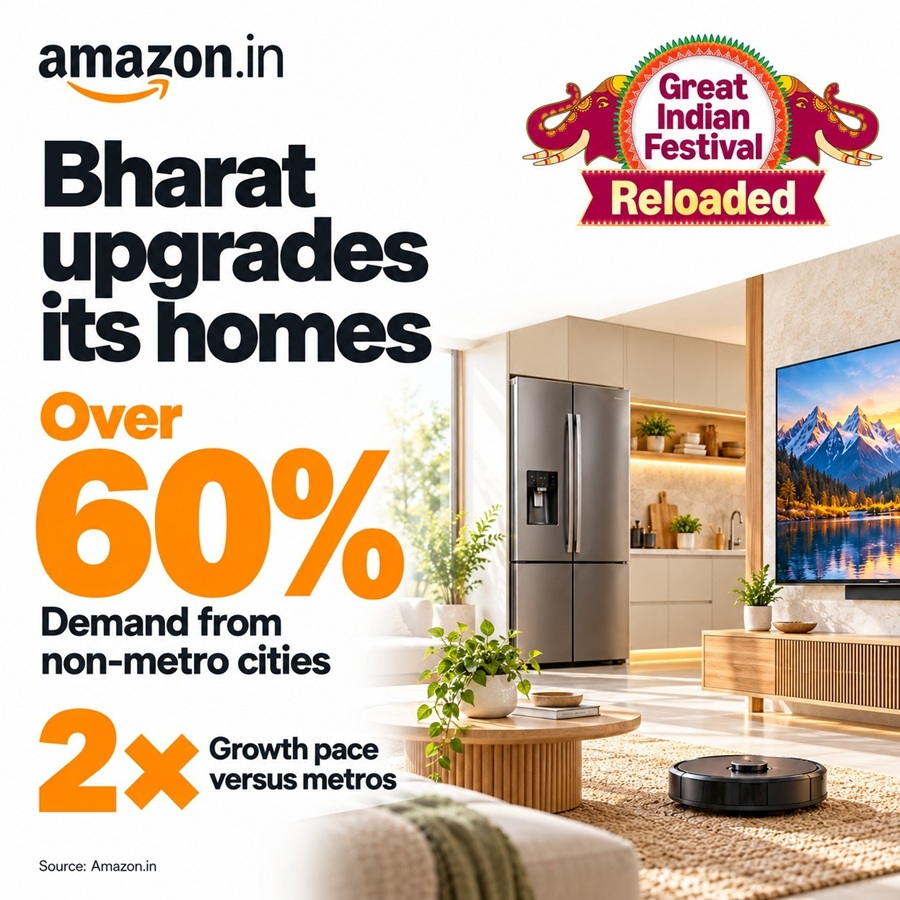
Efficiency and convenience are the primary drivers for Indian home cooks in 2026. Brands like Philips and SharkNinja have become household names, growing at more than 7x their regular levels in the air fryer and oven categories. This surge points to a clear preference for healthier cooking methods—specifically air frying—that do not sacrifice the textures or flavors traditional Indian cuisine demands.
Beyond the air fryer, there is a visible move toward safety and automation. Smart gas stoves, equipped with automatic shut-off features, and induction cooktops are seeing record-breaking interest. This reflects a growing consciousness regarding safety and energy efficiency, moving the Indian kitchen toward a modern, connected ecosystem.
Entertainment and Lifestyle: The 37x Growth Spurt
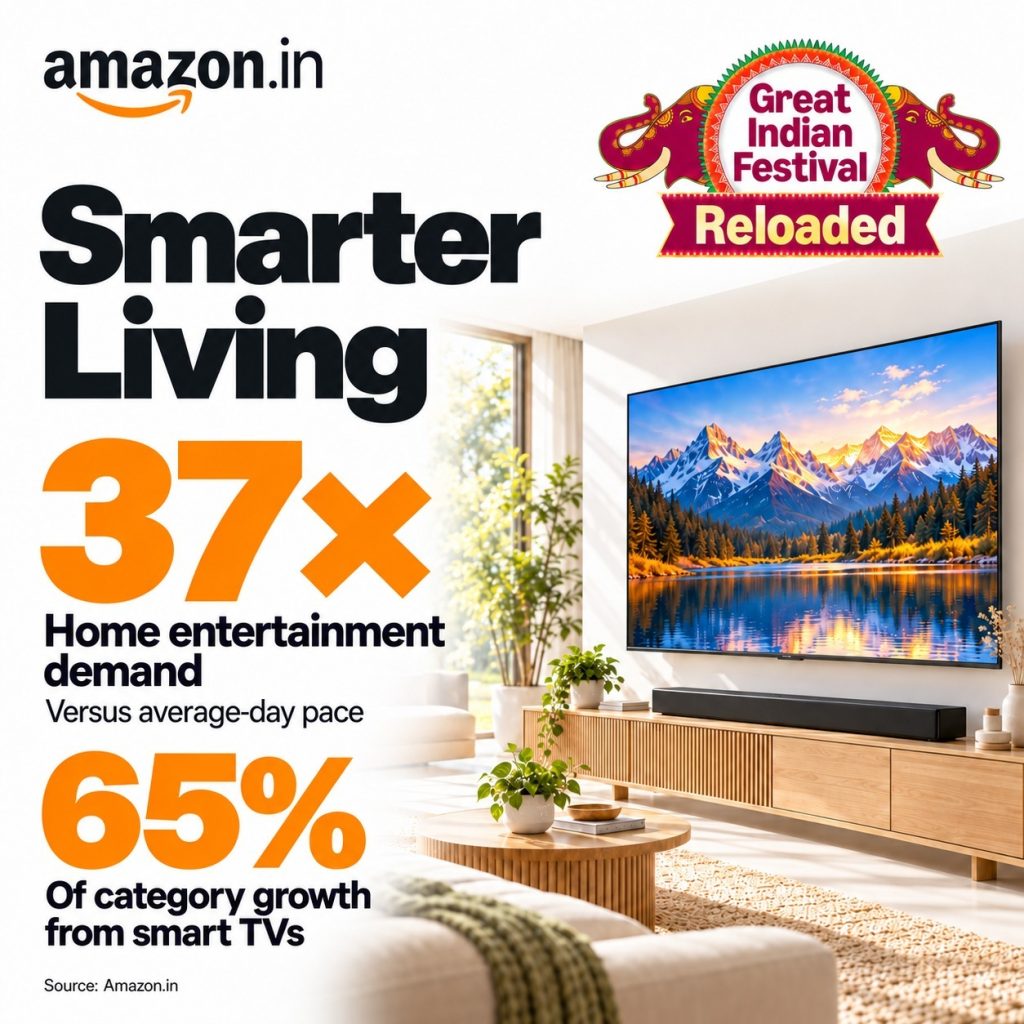
If the kitchen is the heart of the home, the living room remains its soul. Home entertainment devices, including smart TVs, high-fidelity speakers, and peripheral accessories, have witnessed an unprecedented 37x growth compared to average-day volumes.
The Smart TV Dominance
Smart TVs account for a massive 65% of this entertainment growth. Consumers are increasingly bypassing budget, low-feature models in favor of larger screens, advanced display technologies (such as QLED and OLED), and AI-integrated operating systems. Market giants like Samsung, Xiaomi, and TCL are collectively growing at 56x their average-day pace. Notably, the homegrown Direct-to-Consumer (D2C) brand Lumio has also seen a meteoric rise, recording 42x growth, proving that local players can thrive alongside global titans by meeting specific Indian consumer needs.
The Lighting Evolution
The transition in home aesthetics is perhaps most visible in lighting. The era of the singular, utilitarian light bulb is waning. Customers are increasingly opting for smart lighting solutions, including surface lights and battens that support voice commands, app-based scheduling, and dynamic color adjustments. By integrating these into home networks, users are transforming entire rooms with the simple prompt of a voice command, a trend that was once considered a luxury but is now becoming a standard expectation for modern Indian homes.
The White Goods Upgrade: Refrigerators and Washers
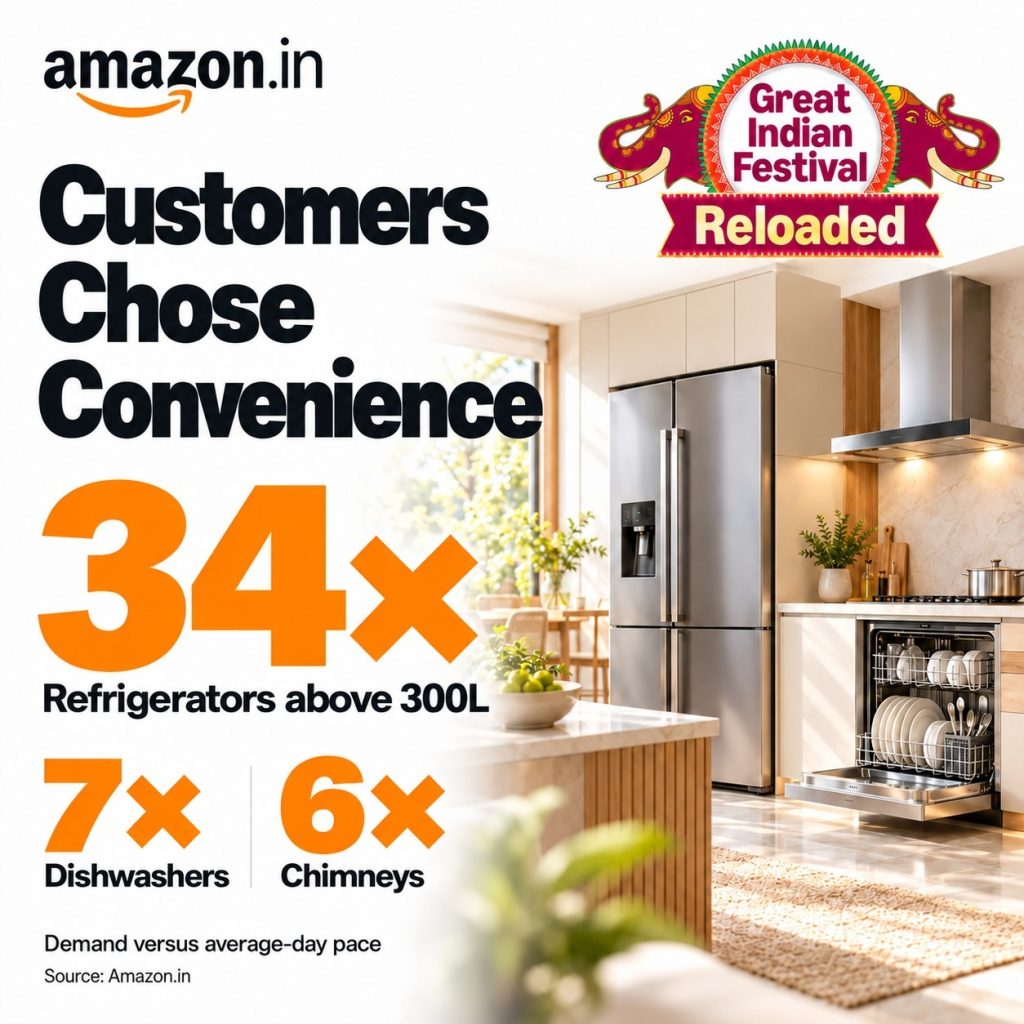
Large home appliances are perhaps the most significant investment for an Indian family. During the early days of the festival, this category grew at 25x its average-day pace. The trend here is not just replacement, but "premiumization."
Consumers are actively moving toward high-efficiency washing machines and air conditioners. The "exchange discount" model has been a critical catalyst; by allowing customers to trade in older, power-hungry models for newer, energy-efficient units, Amazon has lowered the barrier to entry for sustainable technology. Furthermore, the adoption of No-Cost EMI options starting at Rs. 99 per day has allowed middle-income households to opt for higher-specification models that they might have otherwise considered out of reach.
AI as the New Shopping Concierge
Navigating the complexities of thousands of products can be daunting, but Amazon has addressed this with AI-powered discovery tools. These features are fundamentally changing the shopping journey:
- Personalized Recommendations: Using machine learning to surface products that match a user’s specific lifestyle and budget.
- AI-Powered Comparison: Simplifying technical specifications so that non-tech-savvy users can easily compare two models of refrigerators or ovens.
- Rufus (AI Assistant): Perhaps the most significant tool, Rufus allows users to ask complex questions in Hinglish or regional languages. For instance, a user can ask, "Which air fryer is best for a family of four?" and receive a curated, contextual answer, effectively mimicking the experience of asking a knowledgeable friend.
Official Perspectives and Strategic Implications
Aman Deep Lohan, Director – Home, Kitchen and Outdoors at Amazon India, emphasizes that this isn’t just about sales volume; it’s about a fundamental shift in consumer behavior. "This festive season, we are seeing people upgrade their homes with new technology with real confidence," Lohan noted.
The implications for the broader Indian economy are significant. The high usage of financing, particularly for smart appliances, confirms that the Indian middle class is increasingly comfortable with credit when it comes to long-term home investments. By blending affordability, technological accessibility, and robust logistics, Amazon is effectively accelerating the modernization of the Indian household.
Why This Matters
- Economic Maturity: The shift toward premium, energy-efficient, and smart appliances suggests a maturing economy where consumers prioritize long-term value over short-term savings.
- The "Bharat" Opportunity: With 60% of the growth coming from outside metros, companies that ignore non-metro markets do so at their own peril.
- Logistics as a Moat: Amazon’s ability to deliver these large, heavy, and fragile items to smaller towns with unprecedented speed is a testament to the maturation of India’s supply chain infrastructure.
Conclusion: A New Era for Diwali
The Amazon Great Indian Festival 2026 has provided a clear snapshot of a country in transition. Whether it is a family in Patna upgrading to a smart, AI-enabled washing machine, or a household in Kochi investing in a state-of-the-art smart TV, the common thread is a desire for a higher quality of life. As the festive season continues, these trends are expected to solidify, setting a new benchmark for retail in India. By leveraging AI, diverse financing, and deep penetration into Tier-2 and Tier-3 markets, Amazon has successfully turned the festive shopping season into a vehicle for national technological advancement.