







The landscape of artificial intelligence-assisted software development is shifting at a breakneck pace. As AI models become integral to the daily workflows of mobile developers, Google has sought to bring transparency to this volatile market through its "Android Bench." The latest update to this benchmark, released on October 26, 2026, provides a sobering look at the current hierarchy of large language models (LLMs) specifically tailored for Android development.
The data confirms a narrative that many industry observers have suspected: despite heavy investment and aggressive internal development cycles, Google’s own flagship model, Gemini 4 Argon, is currently struggling to keep pace with the frontier models released by competitors Anthropic and OpenAI.
The Evolution of Android Bench
Introduced earlier this year, Android Bench was designed to solve a growing problem: generic coding benchmarks often fail to account for the highly specific constraints, libraries, and best practices inherent in the Android ecosystem. Writing clean, efficient code for the Android framework requires an understanding of lifecycle management, XML layouts, Jetpack Compose, and complex dependency graphs—tasks where general-purpose coding models often falter.
By creating a standardized evaluation framework, Google aimed to provide developers with a "Source of Truth." The benchmark measures two primary metrics: the "pass rate" (the ability of the model to produce code that meets functional requirements) and the "completion rate" (how effectively the model handles syntax and boilerplate generation). With the most recent October update, Google has significantly deepened the value of this resource by introducing "reasoning levels" for each model and, crucially, incorporating average cost data. This allows developers to evaluate models not just on technical prowess, but on the economic viability of integrating these tools into their CI/CD pipelines.
A Chronology of the 2026 AI Coding Wars
To understand the current standing of these models, one must look at the rapid-fire release schedule that has defined the latter half of 2026.
- Early 2026: Google introduces the Android Bench, initially benchmarking a small subset of models to establish a baseline for AI-assisted Android development.
- Late September 2026: Google officially unveils Gemini 4 Argon, marketing it as the definitive AI companion for developers embedded within the Android Studio ecosystem.
- Early October 2026: Reports begin to surface regarding internal dissent at Google. Sources suggest that engineers had voiced concerns about the model’s performance on complex architectural tasks, despite the company’s public enthusiasm.
- October 26, 2026: Google releases the most comprehensive update to Android Bench to date. This update introduces the latest generation of models: OpenAI’s GPT-6 Sol and 6.1 Sol, Anthropic’s Claude Sonnet 5 and 5.5, and the finalized production metrics for Gemini 4 Argon.
This timeline highlights a frantic race where "frontier status" is measured in weeks rather than years. The entry of the Claude 5.5 and GPT-6.1 series marks a new generation of high-reasoning, high-efficiency models that are fundamentally changing the economics of coding assistance.
Supporting Data: The Performance Divide
The latest figures from the October 26 update present a clear, if uncomfortable, picture for Google.
Top Performers
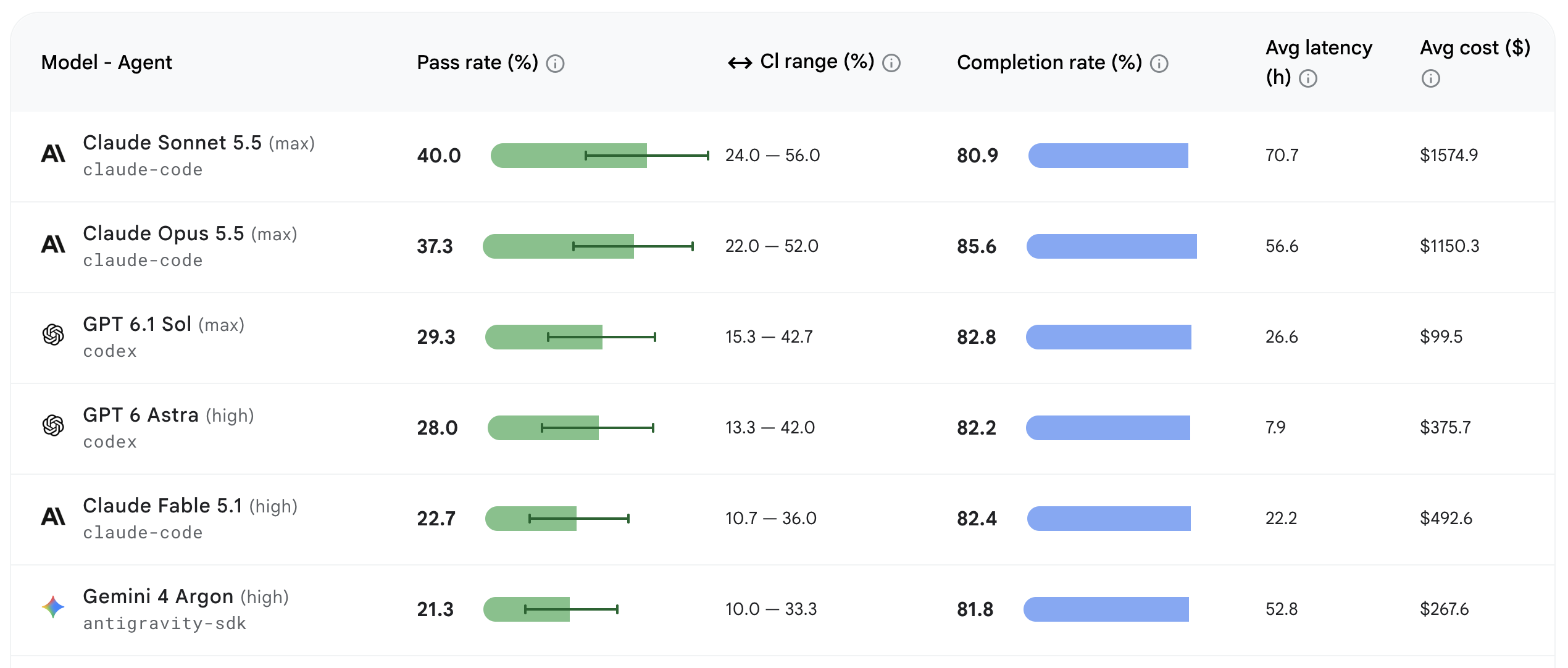
Claude Sonnet 5.5 currently leads the pack with a 40% pass rate and an 80.9% completion rate. Its predecessor, Claude Opus 5.5, maintains a strong second-place position. These models have become the gold standard for high-stakes Android development, where accuracy and adherence to modern architectural patterns are paramount.
The Value Proposition: OpenAI’s GPT-6.1 Sol
Perhaps the most significant disruptor in the current dataset is OpenAI’s GPT-6.1 Sol. While it sits behind the Claude models in terms of raw pass rate (29.3%), it achieves an impressive 82.8% completion rate. However, the true story is found in the economics: the cost of using GPT-6.1 Sol is a mere $99.50 per benchmark cycle, compared to a staggering $1,574.90 for the top-tier Claude models. For mid-sized development firms, this represents a potential turning point where "good enough" code at a fraction of the cost becomes the rational choice over the absolute highest-performing, yet prohibitively expensive, models.
Gemini 4 Argon’s Underwhelming Debut
The most glaring result of the update is the performance of Google’s own Gemini 4 Argon. It has debuted in fifth place, trailing behind Claude Fable 5.1. With a pass rate of only 21.3% and a completion rate of 81.8%, the model is failing to distinguish itself in its home territory. At an average cost of $267.70, it sits in an awkward middle ground: it is neither the most performant model nor the most cost-effective, leaving it in a precarious position for enterprise adoption.
Official Responses and Internal Tensions
The performance gap between Gemini 4 Argon and its competitors has not gone unnoticed. In late September, immediately following the announcement of the model, internal reports leaked suggesting that Gemini 4 "struggles to handle certain coding tasks."
While Google officially stood by its capabilities at the time, framing the model as a work-in-progress that would improve through iterative updates, the cold, hard data of the October 26 Android Bench provides empirical backing to those internal concerns. Google’s reluctance to acknowledge these limitations during the product launch has led to questions regarding the company’s internal quality assurance processes. When a flagship tool for developers—a group that values transparency and technical precision above all else—fails to outperform competitors, the trust deficit can be difficult to bridge.
Implications for the Android Developer Ecosystem
The current state of the Android Bench has far-reaching implications for the industry.
1. The Death of Brand Loyalty in AI
Developers are increasingly behaving like rational actors in a commodity market. The days of sticking to a vendor’s proprietary tools out of convenience are fading. If a developer is using Android Studio, they are no longer tethered solely to Google’s AI offerings. The benchmark highlights that tools like GPT-6.1 Sol are becoming indispensable for cost-conscious teams, and the flexibility to switch models via API means that Google’s own tools must compete on merit, not just integration.
2. The Cost of Reasoning
The move to include "reasoning levels" in the benchmark is a tacit admission that coding is no longer just about text completion. Modern Android development requires an understanding of long-term state management and complex asynchronous workflows. Models that can "think" through a problem before generating code are proving to be superior to those that simply predict the next token.

3. The Future of Gemini
Google finds itself at a crossroads. The company has invested billions into its Gemini architecture, yet the performance of the Argon iteration suggests a potential plateau in its current methodology. To remain relevant, Google will need to shift from merely matching the output of competitors to offering unique, value-added features that are native to the Android environment. This might include deeper integration with Android Studio’s profiler, better handling of legacy codebases, or more robust security auditing for generated code—areas where a general-purpose model might struggle but a domain-specific model could excel.
Conclusion: A Call for Innovation
The October 26 update to the Android Bench serves as a wake-up call. It demonstrates that in the fast-moving world of AI, yesterday’s frontier model can quickly become today’s legacy tech. For Google, the underperformance of Gemini 4 Argon is a hurdle that must be cleared with urgency. For the developer community, however, the current climate is a net positive. The intense competition between OpenAI, Anthropic, and Google is driving down costs, pushing the boundaries of what is possible, and forcing all players to be more transparent about the capabilities—and limitations—of their systems.
As we look toward the remainder of 2026, the question is not who will win the benchmark, but how quickly these models will move from assisting with simple functions to architecting entire, production-ready applications. The benchmark has evolved from a simple ranking list into a vital tool for technical strategy, and for the foreseeable future, it will remain the most reliable indicator of who truly leads the AI coding revolution.