




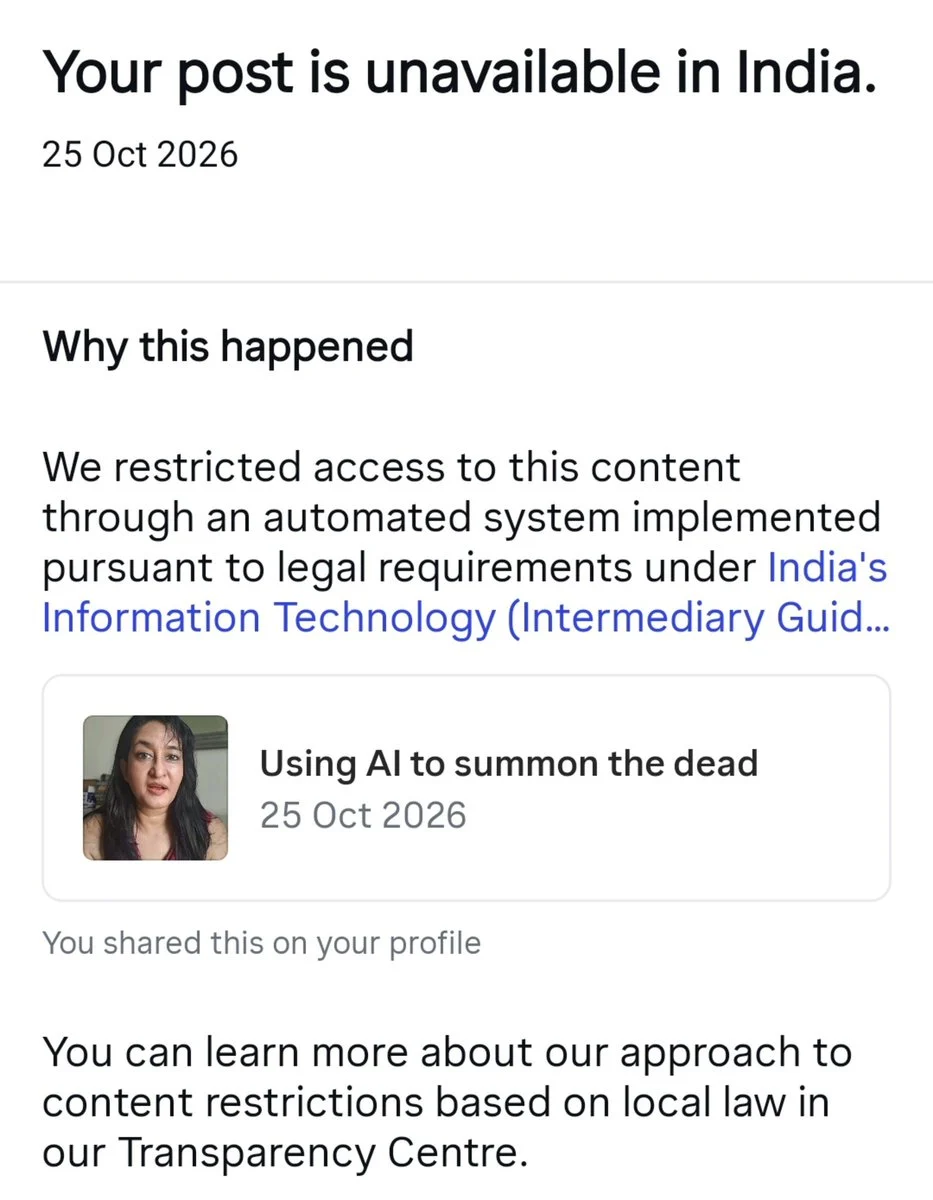
In an era where social media serves as the modern public square, the ability of platforms to suddenly render content invisible—without clear justification or accountability—has become a flashpoint for free speech advocates. Stand-up comedian Kajol Srinivasan recently found herself at the center of this ongoing debate after Instagram restricted one of her reels in India. The incident, which saw the platform oscillate between restricting and restoring the content, highlights a deepening crisis of transparency regarding how Indian legal mandates are enforced on global social media platforms.
Srinivasan’s experience is not an isolated anomaly. It is the latest in a string of incidents involving journalists, cartoonists, and creators whose work has been subjected to "legal requirement" notices, leaving them in the dark about who ordered the takedown and why.
The Incident: A Comedian Caught in the Filter
On October 25, 2026, Kajol Srinivasan took to X (formerly Twitter) to report that a reel she had posted—a humorous take on the use of AI to "summon the dead"—had been rendered unavailable to Indian audiences within minutes of its publication.
The notification she received from Instagram was characteristically vague. It cited "Indian legal requirements" as the reason for the restriction but failed to specify the underlying law, the specific regulatory authority, or the nature of the violation. What followed was a confusing sequence of events: the platform restored the reel, only to restrict it again shortly thereafter.

For a creator, such actions are not merely technical hiccups; they represent a significant form of censorship that disrupts audience engagement and curtails creative expression. By failing to identify the legal provision or the petitioner behind the takedown, Instagram effectively prevents creators from seeking legal recourse or challenging the validity of the restriction.
A Growing Pattern: The "Transparency Gap"
Srinivasan’s case mirrors a series of recent controversies involving the suppression of digital content in India. In September 2026, renowned cartoonist Satish Acharya reported that his Instagram account had been subjected to severe restrictions. Similarly, various environmental reporting collectives have seen their reels—specifically those critical of corporate infrastructure projects, such as Google’s data centers—suddenly disappear from the Indian feed.
These incidents point to a systemic "transparency gap." While platforms like Meta are legally obligated to comply with government orders, the manner in which they communicate these compliance actions to the end user is often opaque. When an account or a specific piece of content is restricted, the notification provided by Instagram rarely offers a path for appeal or a clear explanation of what specific guideline or law was breached. This lack of detail makes it impossible to distinguish between a legitimate legal takedown and a potential error in the platform’s automated moderation systems.
The Mechanisms of Control: How Content Disappears
To understand why this is happening, one must examine the legal mechanisms available to the Indian state for content moderation.

Section 79(3)(b) of the IT Act
A frequent legal tool invoked in these scenarios is Section 79(3)(b) of the Information Technology (IT) Act. This provision allows the government or law enforcement agencies to issue a notice to an intermediary—like Instagram—to remove or disable access to information that is deemed "unlawful."
When Meta acts on these notices, it effectively grants them "safe harbor" protection, shielding the company from liability. However, the misuse or over-application of this section can lead to the suppression of legitimate political commentary or satire, as seen in the cases of journalists and comedians.
Automated Moderation Systems
In addition to direct government notices, platforms have increasingly turned to "automated systems implemented pursuant to legal requirements." As examined in previous reports, these systems often function as a "black box." An AI model, trained to flag content that might potentially violate local laws, can trigger a restriction without human oversight. The danger here is that these automated filters are often overly broad, catching satire and protected speech in their dragnet.
The Sahyog Portal
The government’s Sahyog portal has also emerged as a significant conduit for these takedown requests. By centralizing the communication between government bodies and platforms, the portal is intended to streamline legal compliance. However, it has also become a source of confusion. In the case of reels documenting environmental concerns regarding Google’s data center in Visakhapatnam, the content was restricted under these protocols, only to be restored months later without a coherent explanation from the platform regarding the initial takedown.

The Illusion of Restoration
The most unsettling aspect of these incidents is the inconsistent nature of the "restoration." In several documented cases, including the Visakhapatnam data center reports, content was restored after significant delays. When Meta’s "decision" panel finally addressed the matter, the explanation often contradicted the reality of the timeline. For instance, some notices claimed a restriction ended on the same day it began, even though the content remained inaccessible to the public for weeks or months.
This suggests that the internal systems governing these restrictions are poorly synchronized with the actual enforcement actions, creating a Kafkaesque experience for creators who are left to navigate a labyrinth of contradictory notifications.
The Implications for Free Speech
The implications of this environment for Indian creators are profound.
- The Chilling Effect: When creators cannot predict whether their work will be allowed to remain online, they may begin to self-censor. The fear of an "account-level" or "post-level" restriction—without any clear explanation—is a powerful tool for discouraging critical discourse.
- Erosion of Due Process: In a democratic society, citizens have a right to know who is silencing them and on what grounds. When Instagram hides behind the vague umbrella of "Indian legal requirements," it denies the user the fundamental right to due process.
- Platform Accountability: Meta’s current approach appears to prioritize legal compliance with government directives over the rights of its users. By failing to challenge overbroad requests or provide meaningful transparency, the platform risks becoming an instrument of state censorship rather than a neutral intermediary.
What Needs to Change?
The current state of affairs is unsustainable for a healthy digital ecosystem. To bridge the transparency gap, several steps are necessary:

- Granular Disclosure: Platforms must be required to provide the specific legal provision invoked and the specific authority that issued the takedown order. A generic "legal requirement" notice is insufficient.
- Meaningful Appeal Processes: There must be a clear, accessible, and expedited path for creators to challenge takedown requests. This process should involve human review rather than relying solely on automated systems.
- Transparency Reports: Meta should publish detailed, real-time data regarding the number of government requests, the specific laws cited, and the number of instances where content was restored after a successful appeal.
- Governmental Accountability: The Ministry of Electronics and Information Technology (MeitY) should provide clear guidelines on the use of Section 79(3)(b) to prevent its weaponization against journalists, artists, and political dissenters.
Conclusion
The case of Kajol Srinivasan is a microcosm of a larger, systemic issue within India’s digital landscape. As the line between legal compliance and algorithmic censorship continues to blur, the burden of proof must shift back to the authorities and the platforms. Without a commitment to transparency, the "public square" of social media is at risk of becoming a controlled environment where the only content that survives is that which does not challenge the status quo.
As of this writing, Meta and the relevant government authorities have yet to provide a definitive response to inquiries regarding the specific nature of the restrictions on Srinivasan’s content. Until they do, the uncertainty remains, and the digital shadows continue to grow.