









In an era where digital discourse and campus activism are increasingly converging, a recent internal advisory issued by the Indian Institute of Technology (IIT) Roorkee has ignited a fierce national debate regarding the boundaries of freedom of speech within India’s premier academic institutions. The directive, which effectively cautioned students and staff against engaging in political activities or making public statements without prior institutional approval, has drawn sharp rebukes from political figures, education experts, and civil society advocates.
The Genesis of the Controversy: A Directive Under Fire
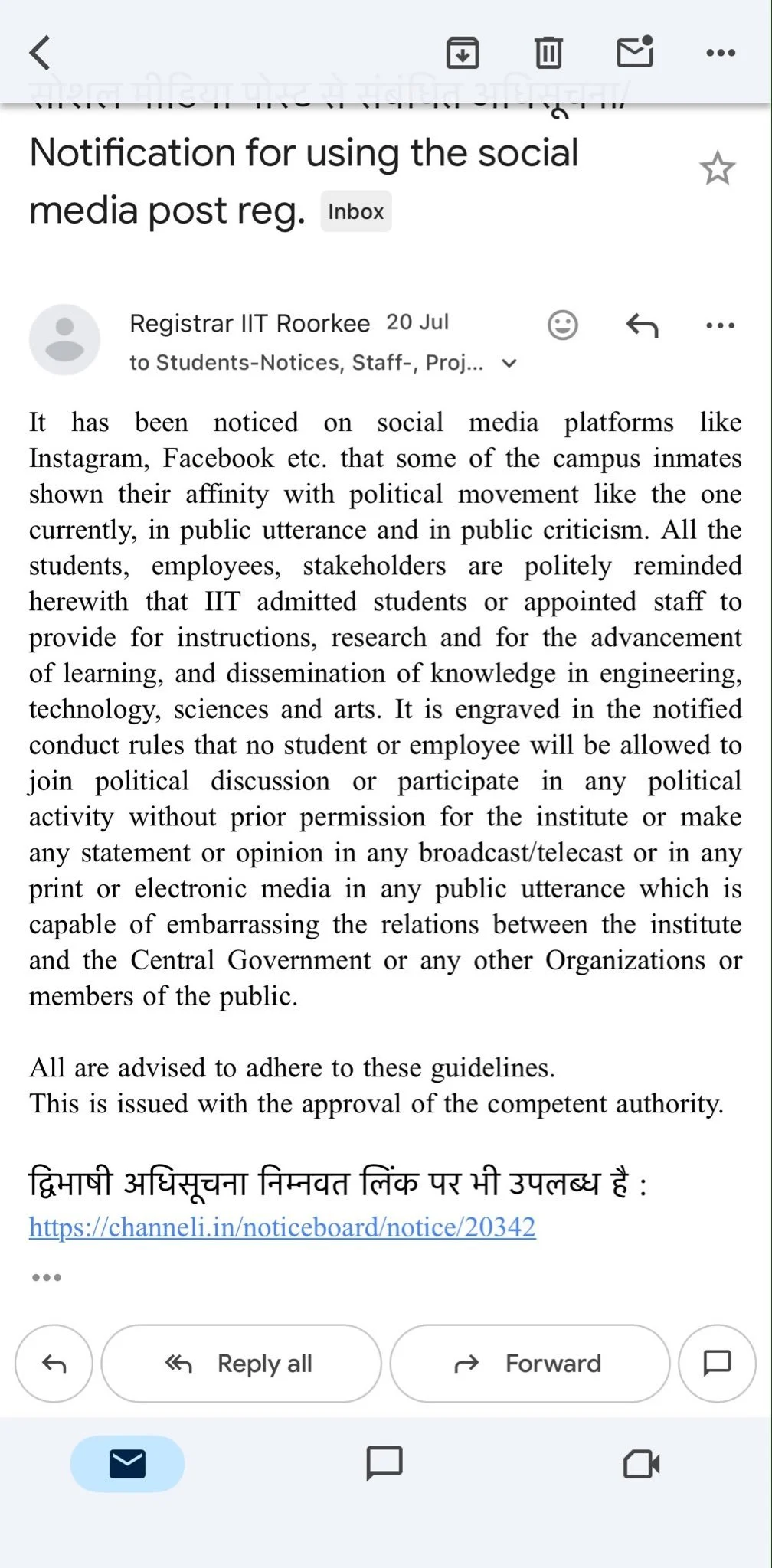
On July 20, 2026, the administration of IIT Roorkee circulated an internal advisory that sent ripples of concern through the campus community. The document explicitly urged students and employees to exercise restraint, advising them to refrain from participating in political discussions or activities without obtaining prior authorization from the institute’s authorities. Furthermore, the advisory placed a spotlight on social media conduct, warning members of the campus community to exercise "extreme caution" when posting opinions online or speaking to the media.
The timing of the communication was far from coincidental. While the advisory did not explicitly name the ongoing protests at Delhi’s Jantar Mantar—where thousands of demonstrators were calling for the resignation of Union Education Minister Dharmendra Pradhan—the climate surrounding the notification suggested a direct correlation. The protests in the capital were marked by significant tensions, including reports of mobile internet disruptions intended to curb the coordination of the march toward Parliament.
The IIT Roorkee circular cited "observed activity" on social media platforms like Instagram and Facebook, noting that certain residents of the campus had displayed an "affinity with political movements" through public utterances and criticism. By framing these actions as potentially "embarrassing" to the relations between the institute and the Central Government, the administration effectively tethered the academic freedom of its members to the political reputation of the institution.
Chronology of Events: From Internal Mail to Public Outcry
The sequence of events underscores the rapid escalation of the issue:

- July 20, 2026: IIT Roorkee issues an internal advisory mandating prior permission for political participation and cautioning against public criticism that could embarrass the institution or the government.
- July 21, 2026: The directive leaks into the public domain, triggering immediate backlash on social media platforms.
- July 21, 2026 (Morning): Prominent opposition leaders and educational policy analysts condemn the advisory as an infringement on constitutional rights.
- July 21, 2026 (Afternoon): IIT Roorkee releases an official statement characterizing the advisory as a "routine" document issued at the start of each academic session to reiterate existing conduct rules.
The Constitutional Conflict: Rights vs. Institutional Mandates
At the heart of the controversy is a fundamental clash between the mandates of a government-funded educational institution and the constitutional rights of its students and employees. The advisory reminded the community that their primary objective at the institute is the "advancement of learning, and dissemination of knowledge in engineering, technology, sciences and arts."
However, critics argue that such language is often weaponized to suppress dissent. By framing political awareness and participation as a distraction from academic pursuits, the administration is being accused of attempting to depoliticize a generation of students who are increasingly concerned with national governance and policy.
Mahua Moitra, a Rajya Sabha Member of Parliament representing the Trinamool Congress, led the political charge against the institute. In a stinging social media post, she questioned the legitimacy of the directive, stating: "And @iitroorkee our money funds you. Don’t you DARE tell our kids to forego their constitutional right to free speech & protest. Retract this email & apologise. Students ignore these bootlickers." Her comments resonated with a wide audience, highlighting the tension between the public funding of elite institutions and the perceived accountability (or lack thereof) of their administrations to the public they serve.
Implications for Academic Freedom
The discourse surrounding the IIT Roorkee advisory extends far beyond a single campus. Maheshwer Peri, the founder of Careers360 and a vocal advocate for educational reform, characterized the move as part of a larger, systemic pattern.
"The mail of @iitroorkee warning students about social media posts isn’t isolated," Peri remarked. "Legal threat is now a pattern. Increasingly, academic institutions are using threats of legal action to silence criticism."

This phenomenon—often referred to as "chilling effect"—suggests that when institutions prioritize institutional optics over open debate, they create an environment of fear. In such an environment, students may self-censor, choosing to remain silent on matters of public importance to avoid potential disciplinary action, loss of scholarships, or future career repercussions. When educational institutions, which are meant to be bastions of critical thinking and democratic values, start mirroring the defensive postures of political bureaucracies, the entire educational ecosystem suffers.
Official Responses and Institutional Justification
Faced with mounting pressure and accusations of authoritarianism, IIT Roorkee issued a formal clarification on July 21. The institute categorically denied that the advisory was a new policy or a reactionary measure to current events.
"The communication being referred to is an internal advisory circulated among students, faculty, and staff at the commencement of each academic session," the statement read. The institute maintained that it was merely reiterating its "existing notified conduct rules" and cautioned that the document should not be "misinterpreted or viewed out of context."
However, this justification has done little to satisfy critics. The core question remains: if these rules have existed for years, why was it deemed necessary to emphasize them during a period of heightened national political protest? Many observers view the "routine" nature of the advisory as evidence of a deeper, institutionalized culture of control that seeks to keep campuses isolated from the broader national political consciousness.
Broader Implications for India’s Tech and Academic Landscape
The incident occurs against a backdrop of increasing scrutiny on the management of India’s educational institutions. From the National Testing Agency (NTA) facing criticism over examination integrity to universities grappling with the influence of central government directives, the autonomy of Indian academia is being heavily tested.

The incident also highlights the role of social media as a double-edged sword. While it allows for the rapid spread of information—as seen with the dissemination of the IIT advisory—it also makes students and faculty highly visible to administrative monitoring. The ability to track "public utterance" via digital footprints has given institutions a new mechanism for surveillance that did not exist in previous decades.
Conclusion: The Path Forward
The debate at IIT Roorkee is a microcosm of a much larger struggle in Indian democracy. As the country navigates the complexities of the digital age, the tension between maintaining institutional order and upholding the fundamental right to dissent will continue to play out in lecture halls, social media feeds, and the courts.
For students and faculty, the incident serves as a stark reminder of the fragile nature of academic freedom. For the administration, the public outcry serves as a warning that in a digital-first society, internal directives are rarely "internal" for long. As the academic year progresses, the focus will likely remain on whether these institutions will choose to foster a climate of open, critical inquiry or retreat further into the protection of their own administrative mandates. The future of India’s intellectual growth may well depend on the answer.