










On October 1, 2026, Nigeria’s national postal framework underwent a fundamental transformation. The legacy system of a uniform six-digit postcode—a fixture of local logistics and administrative databases for decades—was replaced by an 11-character alphanumeric digital addressing system known as the NIPOST Digital Addressing and Postcode System (NDAPS).
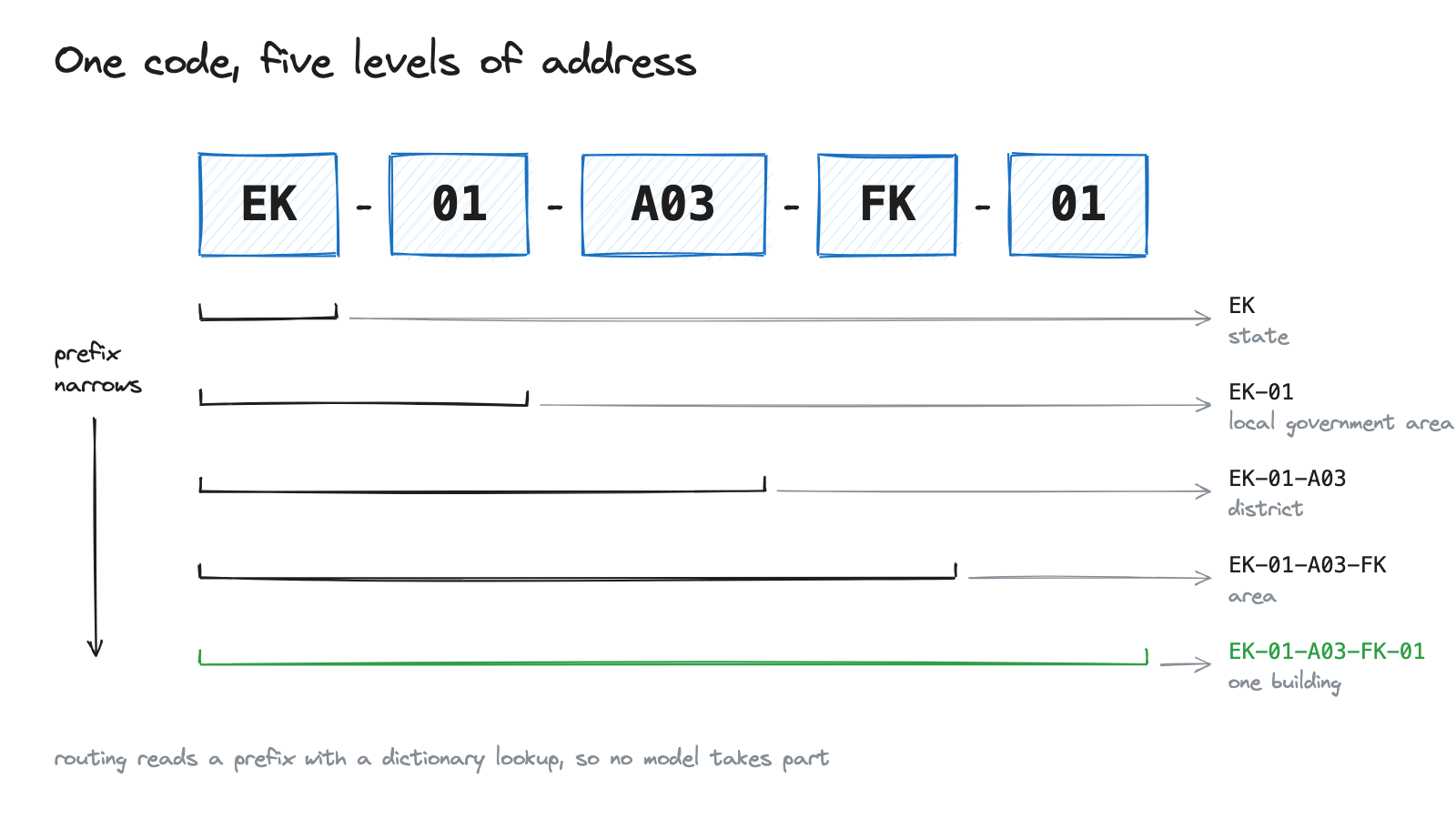
Under this new architecture, postcodes no longer broadly designate a postal zone or a neighborhood. Instead, they identify a single, specific building. A standard code now takes the form of an intricate string, such as EK-01-A03-FK-01.
While this structural overhaul represents a significant leap forward for Nigerian infrastructure, e-commerce, and emergency dispatch services, it has introduced a silent crisis into the world of software development: the artificial intelligence hallucination problem.
Language models trained on vast archives of historical text prior to October 2026 remain anchored to the old standard. When tasked with writing validation scripts, parsing user inputs, or handling customer checkouts at runtime, AI agents fall back on muscle memory—confidently inventing legacy six-digit postcodes or generating structurally invalid 11-character strings out of thin air.
For developers deploying AI-driven logistics, customer service bots, and automated checkout pipelines, this disconnect creates catastrophic failure points. This report explores the core mechanics of this AI blind spot, chronicles the timeline of the post-transition reality, evaluates supporting error data, and outlines a rigorous architectural blueprint to establish trust boundaries around autonomous agents.
The Main Facts: The AI Hallucination Crisis in Postal Data
The root of the issue is probabilistic. Large Language Models (LLMs) operate by predicting the most statistically likely continuation of a sequence based on their training data. Because the vast majority of historical web data, source code repositories, and documentation published before late 2026 reference Nigeria’s old six-digit postal format, modern AI models treat that outdated format as absolute truth.
This manifests in two distinct operational hazards within modern software stacks:
- The Coding Agent Hazard: When a developer asks an LLM-powered coding assistant (such as Claude Code or GitHub Copilot) to generate validation logic for a Nigerian checkout page, the agent generates a regular expression enforcing a six-digit rule. Consequently, the application instantly rejects every valid, real-world 11-character NDAPS postcode submitted by actual users.
- The Runtime Agent Hazard: When an autonomous conversational agent interacts directly with users—extracting shipping details from a chat message or filling out internal logistics forms—it may misinterpret, hallucinate, or improperly format building-level codes. Without strict architectural guardrails, these synthetic postcodes flow downstream into databases, triggering warehouse routing errors and costly delivery failures.
To mitigate this, engineering teams must recognize that an AI model cannot be trusted as an authority on deterministic standards. It must be demoted to a simple text-extraction tool, bounded by hardcoded validation logic and official registry lookups.
Chronology of the Transition and the AI Lag
The timeline of Nigeria’s digital addressing evolution highlights the growing gap between infrastructural reality and machine learning datasets:
- Pre-2026 Era: The standard six-digit postal code system remains dominant across all digital records, e-commerce platforms, and global developer documentation. LLMs ingest this data uniformly, embedding the six-digit assumption deep into their weights.
- October 1, 2026: NIPOST officially rolls out the 11-character NDAPS standard, shifting the national paradigm to building-level identification (e.g.,
EK-01-A03-FK-01). - October 5, 2026 (Benchmark Testing): Empirical testing across multiple programming languages (Python, JavaScript, Rust, and Java) reveals that state-of-the-art coding agents equipped with web-search capabilities still default to writing outdated six-digit validation logic from memory without verifying current standards.
- Mid-October 2026: Introduction of targeted prompt injection rules (such as project-level
CLAUDE.mdguidelines) and specialized open-source libraries likeng-postcodebegin to successfully steer coding agents toward the 11-character standard. However, runtime agents handling live user input continue to require rigid, deterministic trust boundaries.
Supporting Data: Coding Agent Benchmarks and Failure States
To measure the depth of the AI lag, controlled experiments were conducted using isolated development environments. Coding agents were prompted to provide Python, JavaScript, Rust, and Java validation logic for Nigerian postcodes, complete with strict formatting requirements.
Despite having access to web-search tools and explicit date prompts set to post-October 2026, the results were uniform:
| Language | Recommended Library | Format Assumed | Web Search Executed? |
|---|---|---|---|
| Python | None | Exactly six digits (e.g., 100001) |
No |
| JavaScript | None | Six digits, starting with 1–9 | No |
| Rust | None | Exactly six ASCII digits | No |
| Java | None | Six digits, starting with 1–9 | No |
In every instance, the agent bypassed its search capabilities, relying instead on its parametric memory. When tested against real NDAPS data, the generated code produced immediate rejections:
import re

# The coding agent's hallucinated regex rejects modern NDAPS codes
print(re.fullmatch(r"[1-9]d5", "EK-01-A03-FK-01"))  # Returns None
Systemic Failure States in Runtime Operations
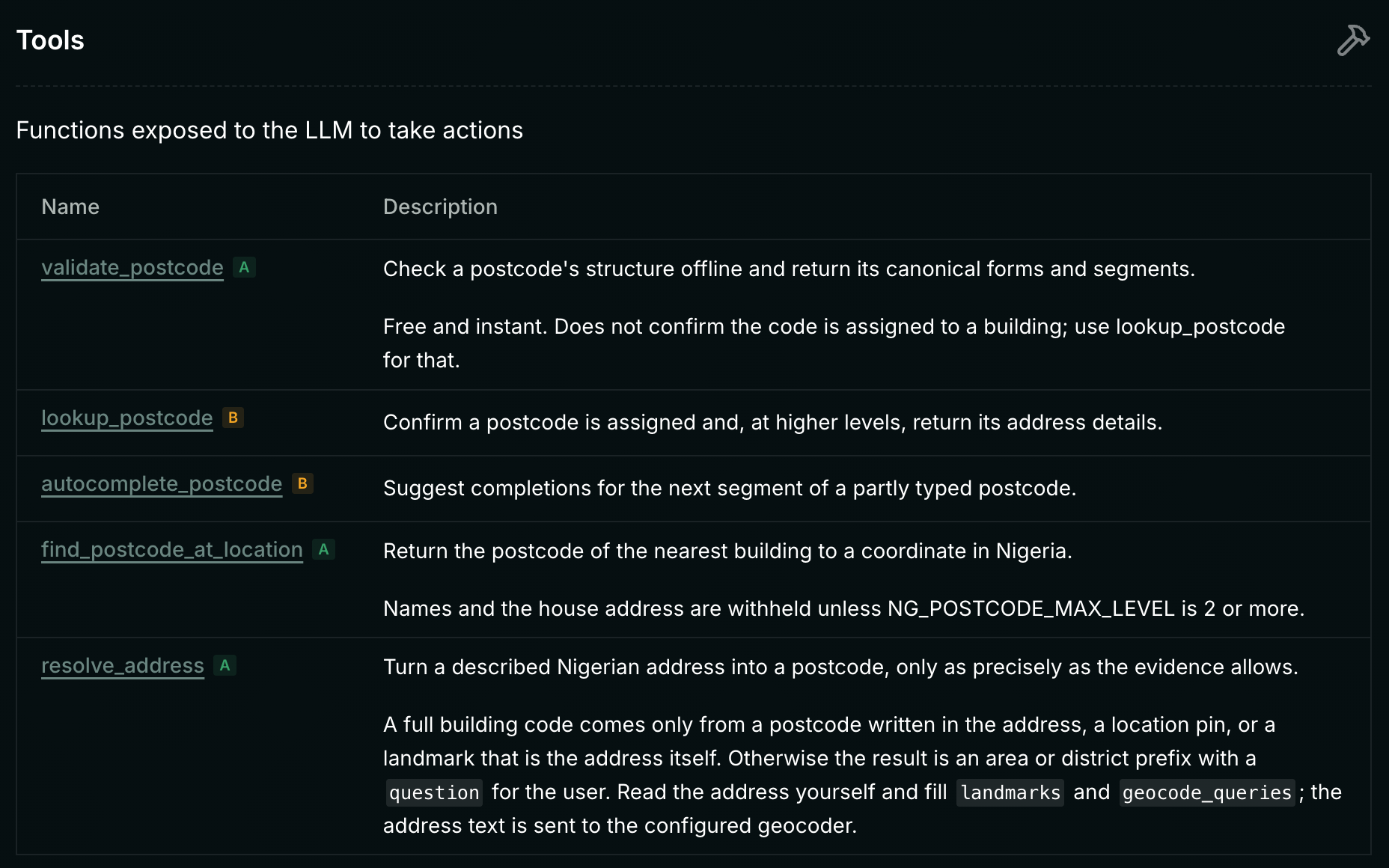
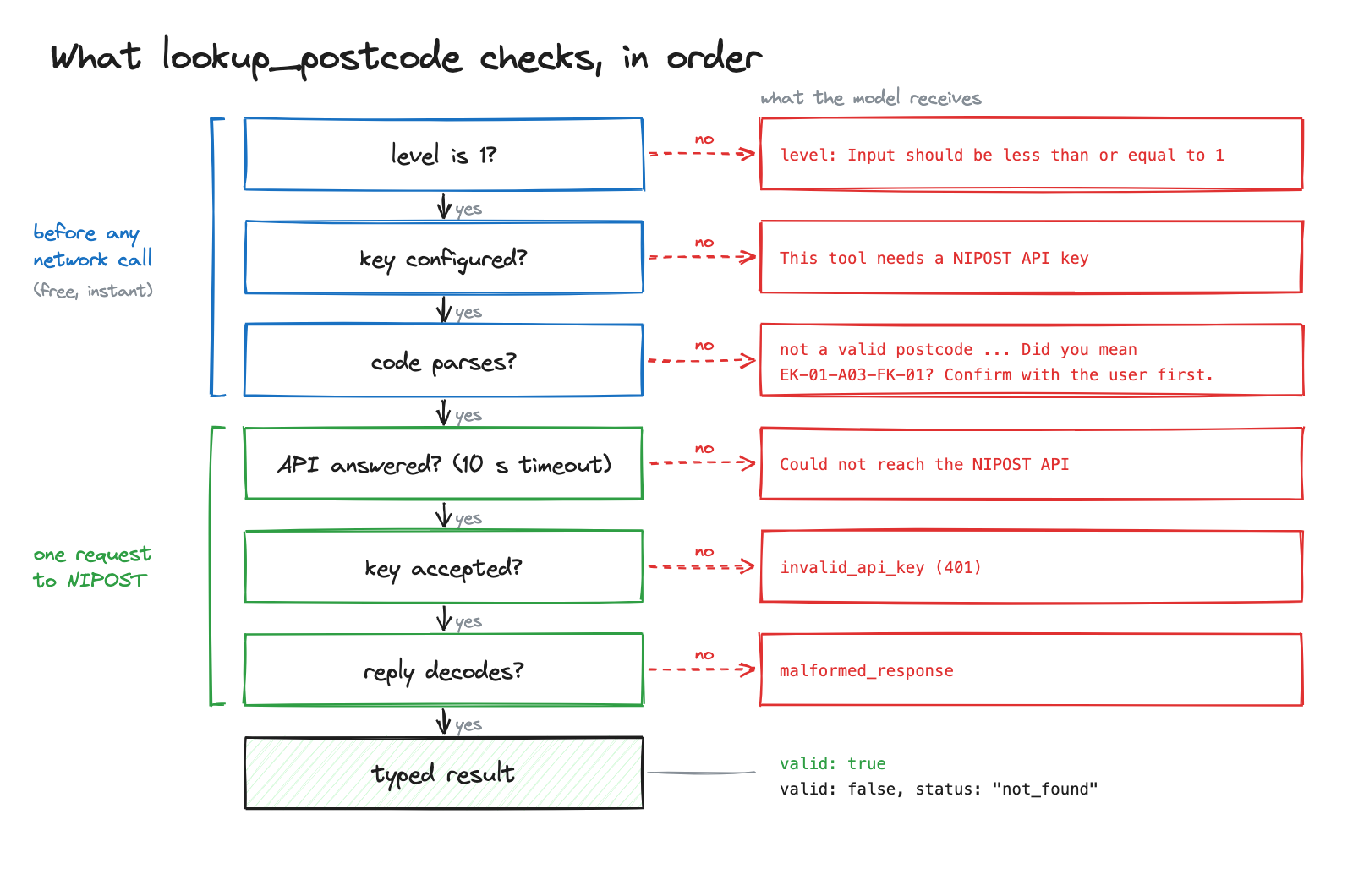
When deploying runtime agents connected to the NIPOST API via Model Context Protocol (MCP) servers, systems encounter a predictable array of failure states. Understanding these states allows engineers to handle them gracefully rather than crashing workflows:
| Failure State | Detected By | System Response / Output |
|---|---|---|
| Legacy Six-Digit Code | Offline Parser | expected 11 letters and digits, found 6 |
| Segment Out of Range | Offline Parser | invalid lga segment |
| Look-Alike Typo (e.g., Letter ‘O’ for Zero) | MCP Server (Pre-network) | Refused with a suggested correction, prompting user confirmation |
| Well-Formed, Unassigned Code | NIPOST Registry | "valid": false, "status": "not_found" |
| Missing API Key | Server Configuration | This tool needs a NIPOST API key |
| Revoked or Invalid Key | NIPOST API | invalid_api_key (401) |
| Network Timeout / Unreachable API | HTTP Transport Layer | Could not reach the NIPOST API: All connection attempts failed |
Architectural Implications: Building the Trust Boundary
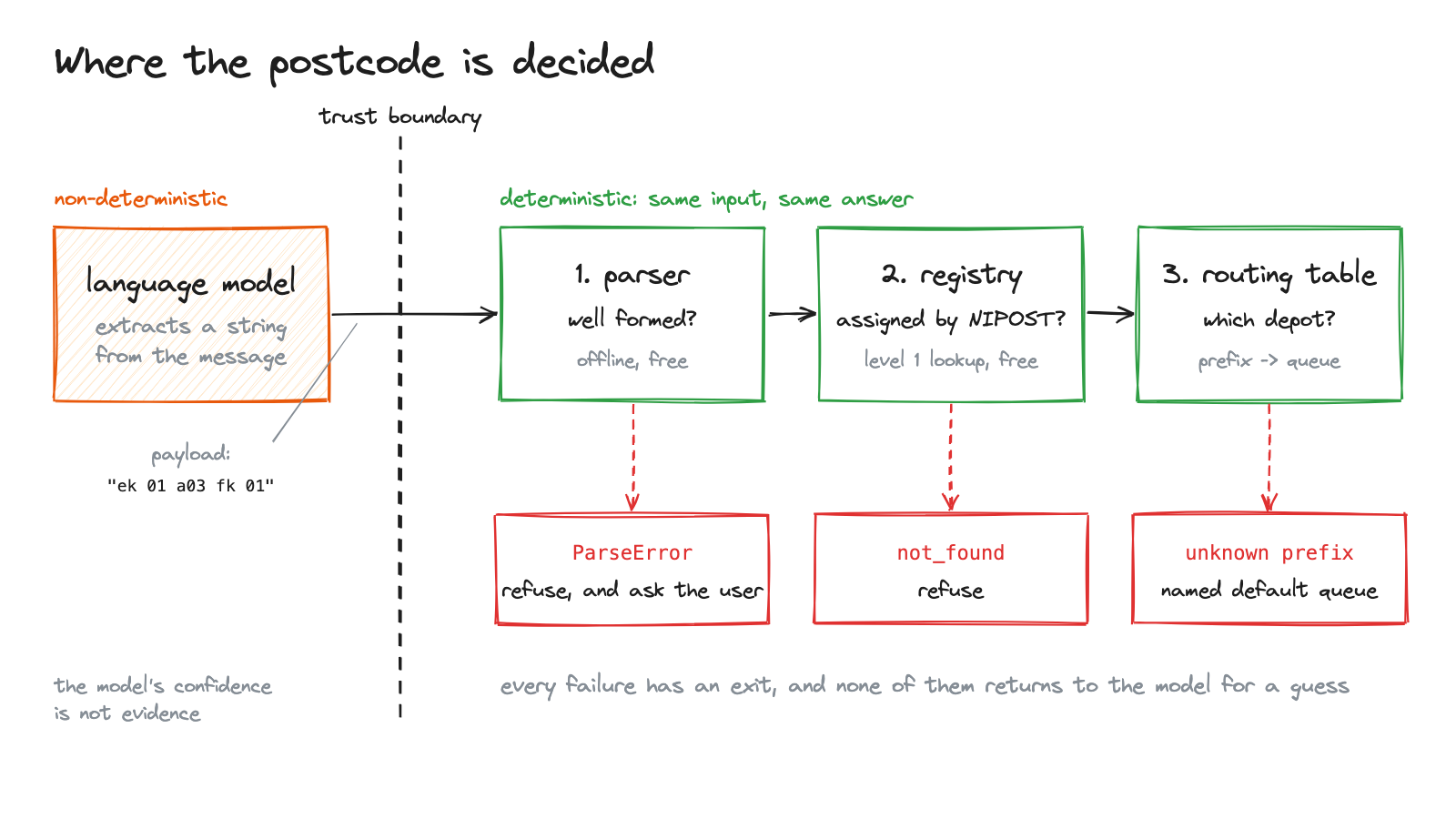
To neutralize the risks of AI hallucination, systems must implement a strict Trust Boundary. In this architecture, the language model is sequestered to a single, low-responsibility task: extracting raw text strings from user communications.
Every subsequent action—parsing, validation, registry verification, and depot routing—is handled by deterministic code that operates independently of the model’s confidence levels.
[ User Message ]
       │
       ▼
┌──────────────┐
│ AI Model     │ (Task: Extract raw string only)
└──────┬───────┘
       │
       ├─ [ Trust Boundary ] ─────────────────────────┐
       ▼                                              │
┌──────────────┐                                      │
│ Parser       │ ──(Fails)──► [ Return Error to User ]│
└──────┬───────┘                                      │
       │ (Passes)                                     │ Deterministic
       ▼                                              │ Code Layer
┌──────────────┐                                      │
│ NIPOST API   │ ──(Not Found)──► [ Prompt for Fix ]  │
└──────┬───────┘                                      │
       │ (Assigned)                                   │
       ▼                                              │
┌──────────────┐                                      │
│ Routing Table│ ──► [ Assign to Depot ]              │
└─────────────────────────────────────────────────────┘
1. Correcting Coding Agents at the Source
To prevent coding agents from writing obsolete validation logic into new software projects, developers must inject explicit structural instructions into repository-level configuration files (such as AGENTS.md or CLAUDE.md):
Nigerian postcodes: since 1 October 2026 a building's postcode is NIPOST's 11-character
digital postcode (NDAPS), such as EK-01-A03-FK-01, and a six-digit pattern does not match it.
Validate and format it with ng-postcode (pip, cargo), ng-postcode-js (npm), or
io.github.adeniyikayodee:ng-postcode (Maven).
Reference: https://adeniyikayodee.github.io/ng-postcode/llms.txt
2. Implementing the Runtime Gate
At runtime, user-submitted or AI-extracted strings must pass through a strict parser gate before touching business logic or external APIs. The NDAPS format relies on a strict five-segment structure:
- State: 2 letters (e.g.,
EK) - Local Government Area (LGA): 2 digits,
01to99(e.g.,01) - District: 3 alphanumeric characters (e.g.,
A03) - Area: 2 letters (e.g.,
FK) - Building Unit: 2 digits,
01to99(e.g.,01)
Using open-source tooling such as the ng-postcode library, developers can construct robust validation gates in Python:
from ng_postcode import Corrected, Postcode, parse, parse_lenient

def postcode_gate(text: str) -> Postcode | str:
    match parse(text):
        case Postcode() as code:
            return code
        case error:
            match parse_lenient(text):
                case Corrected(postcode=fixed):
                    return f"Refused: error. Did you mean fixed?"
                case _:
                    return f"Refused: error"
3. Registry Confirmation and Prefix Routing
Passing offline syntax checks only proves a code is well-formed. To confirm that NIPOST has actually assigned the code to a physical building, systems must query the official registry at Level 1.
Furthermore, because each segment progressively narrows the geographic scope, routing packages to regional sorting centers or depots should be handled via deterministic prefix dictionaries rather than AI interpretation:
from ng_postcode import Postcode, Segment, parse

# Deterministic routing based on LGA prefix
DEPOTS = "EK-01": "depot-ekiti-central", "LA-05": "depot-lekki"

def route_shipment(code: Postcode) -> str:
    lga_prefix = code.prefix(Segment.LGA)
    return DEPOTS.get(lga_prefix, "national-sorting-default")
Official Responses and Strategic Outlook
As software ecosystems adapt to the October 2026 transition, regulatory and open-source maintainers emphasize that technological readiness requires a cultural shift in how developers handle AI integration.
NIPOST developer documentation stresses that programmatic interactions with national digital addressing infrastructure must rely on verified API clients rather than heuristic estimations. Meanwhile, maintainers of open-source validation libraries—available via Python (pip install ng-postcode), JavaScript (npm install ng-postcode-js), and Rust (cargo add ng-postcode)—have updated their packages to include Model Context Protocol (MCP) servers, allowing secure, rate-limited tool exposure to LLM clients.
Ultimately, the challenge of stopping AI agents from inventing Nigerian postcodes serves as a cautionary tale for the broader software engineering industry. As governments and institutions continue to digitize and restructure foundational identifiers, AI models will invariably lag behind.
By erecting unyielding trust boundaries—relegating AI to text extraction while enforcing strict parsers, offline validation, and programmatic registry lookups—developers can insulate their applications from the inherent volatility of probabilistic machines.



