










Main Facts
In a landmark achievement for the field of quantum information science, researchers at the Institute of Science and Technology Austria (ISTA) have successfully demonstrated a fully autonomous method for connecting widely separated quantum bits (qubits) using a "quantum bath" composed of correlated particles of light. Published recently in Physical Review X, the experiment brings to life a theoretical prediction first proposed more than twenty years ago.
The breakthrough addresses one of the most stubborn bottlenecks in quantum computing and networking: the requirement for active control, complex feedback loops, and repeated measurements to establish distributed entanglement between physically isolated systems. By leveraging a continuous stream of microwave photons to bathe remote qubits in a synchronized environment, the ISTA team has bypassed traditional limitations, creating a robust ground state that stabilizes entanglement natively.
While the prototype currently operates at an efficiency rate of roughly 10% regarding the transfer of the bath’s available entanglement, the research lays down a foundational architecture that could ultimately scale to synchronize multiple distant nodes. This development marks a pivotal step toward the realization of modular quantum computers and distributed quantum networks capable of fault-tolerant operation.
Chronology
To understand the magnitude of the ISTA team’s achievement, it is necessary to examine the timeline of how distributed entanglement has been pursued, and how a two-decade-old theory finally met empirical reality.
Phase 1: The Theoretical Genesis (Early 2000s)
More than twenty years ago, theoretical physicists began exploring alternative methods to couple independent quantum systems without relying on direct, hard-wired connections. Among the proposals was the concept of a "dissipative engineering" approach or a "quantum bath." In these theoretical models, rather than viewing the surrounding environment as a destructive force that causes decoherence, theorists asked whether an engineered environment could actively generate and protect quantum correlations. However, at the time, the theoretical frameworks relied on idealized conditions that far exceeded the capabilities of contemporary laboratory hardware.
Phase 2: The Era of Active Control and Post-Selection (2000s–2022)
As experimental quantum physics advanced, researchers turned their attention to more immediate mechanisms for creating distributed entanglement. Two primary paradigms emerged:
- The Single-Photon Transfer Method: Sending an actively controlled photon from one qubit to another.
- The Photon-Matching Method: Having each independent qubit emit a photon, subsequently routing and matching those photons to trigger probabilistic entanglement.
The latter approach achieved profound historical recognition when it underpinned the science rewarded by the 2022 Nobel Prize in Physics. Despite its success, this methodology harbored a persistent vulnerability: it required rigorous post-selection, active interventions, and repeated measurements. If the photon matching failed, the entanglement attempt failed, demanding a fresh try.
Phase 3: The ISTA Breakthrough (Present)
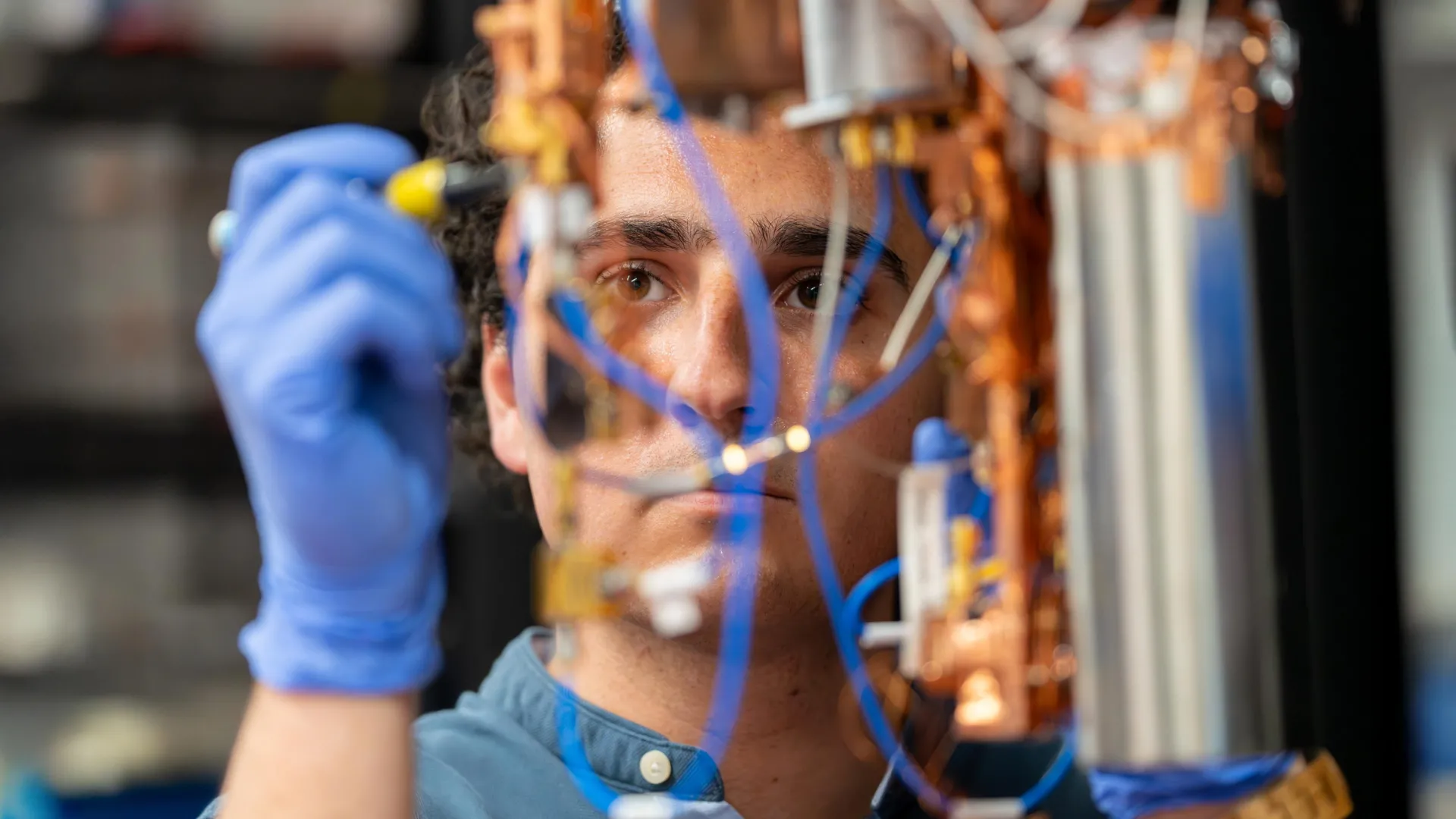
Led by PhD student Alejandro Andrés-Juanes and Professor Johannes Fink at ISTA, alongside a team of international collaborators, researchers bridged the gap between abstract theory and physical hardware. Utilizing a shared source of correlated microwave photons, the team built a prototype system that automatically locked two isolated qubits into a synchronized, entangled state. By doing so, they provided the first empirical validation of the two-decade-old quantum bath prediction, shifting the paradigm from fragile, transient entanglement to a continuous, self-stabilizing resource.
Supporting Data
The mechanics behind the ISTA experiment involve a sophisticated orchestration of microwave engineering, continuous-variable systems, and advanced quantum measurement techniques.
Bridging Continuous and Discrete Variables
A fundamental challenge in quantum physics lies in the mismatch between different types of quantum states:
- Continuous-Variable States: These states can be produced efficiently and behave analogously to a classical pendulum, where position and momentum change smoothly across a continuous spectrum.
- Discrete-Variable States: Many advanced quantum computing algorithms and stationary architectures rely on "all-or-nothing" discrete states (akin to digital bits, but existing in superpositions of 0 and 1).
The ISTA team successfully devised a pathway to translate the readily accessible, continuous forms of entanglement generated by a light bath into the robust, discrete-variable entanglement required by practical quantum processors.
The Physics of Microwave Photons
To couple the qubits with the entangled photon source, the researchers implemented microwave photons. These low-energy particles possess unique advantages:
- They are exceptionally well-suited for manipulating delicate quantum information.
- They form the backbone of leading superconducting-qubit hardware architectures.
By deploying microwave photons within a carefully designed circuit, the environment itself assumed the responsibility of driving and protecting the qubits’ correlations.
Quantum Tomography and Nanosecond Measurements
Verifying that the two distant qubits were genuinely synchronized inside the quantum bath required extraordinary precision. Because measuring a qubit collapses its superposition into a definite binary state (0 or 1), direct observation destroys the very phenomenon researchers wish to study.
To circumvent this, the team deployed quantum tomography. This rigorous analytical technique reconstructs the underlying state of a quantum system by observing numerous statistical "slices" of its behavior across repeated trials. The team executed measurement windows lasting merely 20 to 80 nanoseconds (with a nanosecond defined as one billionth of a second). These ultra-fast snapshots allowed them to map the hidden quantum states without permanently disrupting the system’s overall coherence.
Official Responses
The implications of the experiment have drawn significant commentary from the principal investigators at the Institute of Science and Technology Austria, highlighting both the conceptual elegance of the work and the hurdles that remain for future scaling.
Addressing the core motivation behind the research, PhD student and lead author Alejandro Andrés-Juanes emphasized the significance of resolving the format mismatch between quantum resources:
"In this work, we aimed to overcome this mismatch between the readily available and the practically useful forms of entanglement. By stabilizing the entangled states remotely, our approach is fully autonomous and requires no active control or measurement."
Andrés-Juanes also noted the practical realities of pioneering a two-decade-old theory, pointing out why it resisted implementation for so long:
"Our experiments helped us reveal several factors that may have prevented scientists from designing a functional quantum bath using a single source of correlated photons for distributed entanglement."
He added regarding future scalability: "We present a relatively simple method that could be scaled up to synchronize multiple distant qubits… Our method currently transfers about 10% of the bath’s available entanglement."
Professor Johannes Fink underscored the unique paradigm shift introduced by turning the environment—traditionally the enemy of quantum states—into an asset:
"In our method, the quantum bath—meaning the qubits’ environment—is the source of entanglement. It creates a new ground state through a continuous stream of correlated photons. This way, the entangled qubit state is stabilized, even beyond the qubits’ own ‘lifetime’, and remains always available as a resource for further quantum processing. This makes the approach conceptually significant."
Implications
The successful demonstration of a fully autonomous quantum bath carries profound implications for the future trajectory of quantum technology, particularly in modular computing and secure communications.
1. Toward Modular and Scalable Quantum Architectures
Building a fault-tolerant quantum computer with millions of physical qubits on a single microchip is an engineering nightmare due to thermal management, crosstalk, and wiring constraints. A more viable path forward involves modular quantum computing, where smaller, manageable quantum processing units (QPUs) are linked together into a unified supercomputing fabric.
The ISTA approach offers a blueprint for connecting these separated modules natively. Because the quantum bath continuously stabilizes the entanglement, the linked qubits remain ready for processing whenever the system demands them, removing the frantic race-against-the-clock inherent to temporary, fragile entanglement methods.
2. Paving the Way for Distributed Quantum Networks
Beyond localized processors, distributed entanglement is the cornerstone of the emerging quantum internet. While the ISTA prototype relied on microwave photons—ideal for superconducting circuits on the chip scale—the broader research group led by Professor Fink is also exploring optical photons. Optical frequencies are vital for transmitting quantum data over long distances via standard fiber-optic cables. The principles established in this microwave experiment could eventually inspire analogous optical baths, bridging isolated quantum data centers across cities or continents.
3. Reducing System Overhead and Complexity
Traditional entanglement schemes demand complex electronic feedback loops, fast photon detectors, and real-time decision-making logic to determine whether a photon-matching event succeeded. By automating the creation of entanglement through environmental engineering, the ISTA architecture drastically slashes the hardware and algorithmic overhead required to maintain synchronization.
4. Overcoming Environmental Decoherence
Decoherence—the loss of quantum information due to interactions with the external world—has historically been treated as an adversary to be shielded against. By demonstrating that a carefully tailored "quantum bath" can actually foster and protect quantum coherence, the research opens a new frontier in open-system quantum mechanics. Future engineers may increasingly look toward dissipative engineering not just to protect qubits from noise, but to actively harness environmental noise as a computational fuel.
Looking Ahead
While the ISTA prototype currently operates at a 10% transfer efficiency of the bath’s available entanglement—trailing the raw efficiency of active-control methods—its conceptual advantages in autonomy and scalability set a new direction for the field. As laboratories worldwide refine these techniques, the twenty-year-old dream of a self-syncing quantum environment is steadily evolving from theoretical physics into the bedrock of tomorrow’s quantum infrastructure.



