










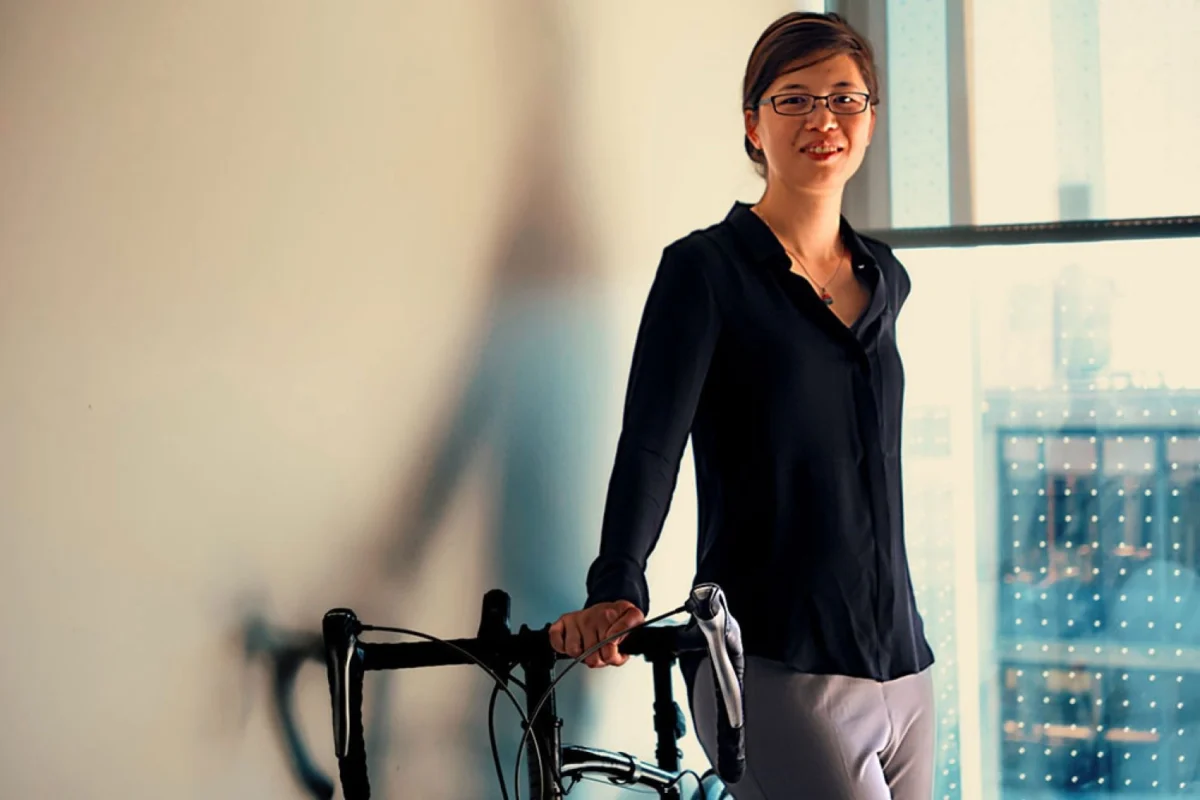
In the modern urban landscape, transportation is more than just a network of roads, trains, and signals; it is the lifeblood of society, a shared experience that connects billions. Yet, as our cities grow denser and more complex, the systems that move us are increasingly strained. Enter Cathy Wu, an associate professor at the Massachusetts Institute of Technology (MIT), who is pioneering a new frontier in civil engineering. By bridging the gap between machine learning and infrastructure, Wu is working to transform how we design, optimize, and experience the world’s transportation networks.
The Seeds of a Visionary
Long before she was a leading voice in artificial intelligence, Cathy Wu’s path was paved by personal experience. The daughter of Taiwanese immigrants, Wu grew up observing the tangible consequences of poor infrastructure. Her father’s grueling, hours-long commute—a daily ritual that pulled him away from family life—became a defining memory.
“I like transportation because it connects everyone,” Wu says. “We all use it, we all experience it, we all have issues with it. So, at some level, we’re all interested in the system being better.”
Limited by a tight household budget and living on a street too congested for safe play, Wu and her siblings spent much of their childhood interacting with virtual worlds. Games like SimCity provided an early sandbox for her curiosity, allowing her to experiment with urban planning and resource allocation. These childhood experiences served as the bedrock for her professional mission: to solve complex, systemic problems that improve the quality of human life.
A Chronological Evolution: From Robotics to Reinforcement Learning
Wu’s academic journey is inextricably linked to MIT, where she earned her undergraduate degree and master’s degree. Her interest in applying AI to transportation was ignited during an Independent Activities Period (IAP) robotics competition, where she won first place. The victory prompted a pivotal lecture from the late professor Seth Teller, an expert in autonomous vehicles.
“I’m very grateful to the people who helped me explore those interests,” Wu notes. Under Teller’s mentorship, and later under the guidance of Professor Daniela Rus—a specialist in robotaxis—Wu began to conceptualize how autonomous systems could reshape the urban fabric.
After completing her master’s at MIT, Wu pursued her PhD at the University of California at Berkeley. It was here that she identified a critical bottleneck: transportation researchers were spending years developing optimization models for single-system variants. She realized that traditional methods were failing to keep pace with the exponential growth of urban complexity.
In 2018, as she neared the completion of her doctoral studies, Wu made waves with a viral research project that used Reinforcement Learning (RL) to analyze the impact of autonomous vehicles on traffic flow. This success marked her transition from a student of the field to a trailblazer. Following a postdoctoral stint at Microsoft, where she dove deeper into the theory of RL, she returned to MIT as faculty, drawn by the university’s commitment to sustainability and data-driven interdisciplinary research.
The “Dark Tunnel” of Reinforcement Learning
The road to innovation is rarely linear, and for Wu, the promise of RL proved to be a "flighty friend." Following her early success, she hit a two-year wall where subsequent attempts to apply RL to traffic problems yielded disappointing results.
“That was stressful,” she admits. “It was unclear whether the problem was me, my students, the traffic domain, or RL itself.”
However, persistence paid off in 2023. Wu and her team discovered that RL algorithms are hypersensitive; an algorithm that excels in one scenario often fails in a slightly different one. This realization led to a breakthrough: the researchers identified that while RL might struggle with 90 percent of a problem set, it can be hyper-efficient on the remaining 10 percent.
By training models on this "generalizable" 10 percent, the team created a framework that performs exceptionally well across a wide variety of related problems. Their new algorithm improved training efficiency by a factor of 30, meaning a task that previously required 100 training models could now be accomplished with only three. This discovery restored confidence in RL as a viable tool for large-scale, real-world optimization.
Supporting Data: Efficiency and Emission Reduction
The implications of Wu’s research are quantifiable and far-reaching. Her recent work on "eco-driving"—using intelligent speed control to minimize the stop-and-go nature of traffic—demonstrates a clear pathway to environmental impact.
By utilizing RL to regulate vehicle flow, Wu’s research indicates that cities could see a reduction in vehicle emissions between 11 and 22 percent. This is not merely a theoretical exercise; it is a proof-of-concept that demonstrates how evidence-based policy can be fueled by machine learning.
“I am a big fan of evidence-based policy and believe it’s the basis for a thriving democratic society,” Wu says. “People can bicker forever about what’s better or worse, but I do believe there are questions we bicker about that can be analyzed systematically using data.”
The Philosophy of "Use-Inspired Basic Research"
Wu defines her academic methodology as "use-inspired basic research." This approach prioritizes solving a specific, real-world problem—such as traffic congestion—to uncover fundamental knowledge that can then be applied to other sectors, including logistics, supply chains, and manufacturing.
This philosophy extends into her classroom. As a mentor, Wu is deeply invested in the growth of her students, receiving the Ole Madsen Mentoring Award in 2025. When students feel overwhelmed by the sheer scale of the challenges they face, Wu offers a grounded perspective:
“Be patient. Start small. Societal impact is a lifelong endeavor, not something to be accomplished in a few years,” she advises. “It will take years to really understand what’s going on and where the real problems are. In the meantime, try to be helpful. Be curious. Ask many questions.”
Implications for Future Infrastructure
Looking ahead, Wu’s work serves as a blueprint for the "smart city" of the future. By moving away from rigid, static models and toward flexible, context-aware AI systems, researchers can finally address the fluidity of human behavior and urban movement.
The implications for policy are profound. As cities look to meet aggressive carbon neutrality targets, the ability to optimize existing infrastructure through algorithms—rather than relying solely on expensive, long-term construction projects—could save governments billions while improving the daily lives of citizens.
Furthermore, by integrating data science into the heart of civil engineering, Wu is training a new generation of engineers who are as comfortable with Python code as they are with concrete and steel. This cross-disciplinary fluency is essential for addressing the "wicked problems" of the 21st century.
Conclusion: A Lifelong Commitment to Connection
From the young girl watching her father struggle against a broken commute to the professor pioneering algorithms that could heal the planet’s transit systems, Cathy Wu’s journey has come full circle. She has transformed her childhood curiosity into a rigorous, evidence-based discipline that seeks to serve the common good.
In the end, Wu’s work reminds us that while technology is the tool, humanity is the objective. Whether she is teaching a student the nuances of reinforcement learning or presenting a model that could cut carbon emissions in a major metropolis, her focus remains consistent: to use the power of data to make the systems that connect us all a little more efficient, a little more sustainable, and a lot more human.



