










By Swati Khandelwal
Published: October 9, 2026
Cybercrime / Data Breach Investigation
Main Facts: The Pennsylvania Arrest and Ongoing Manhunt
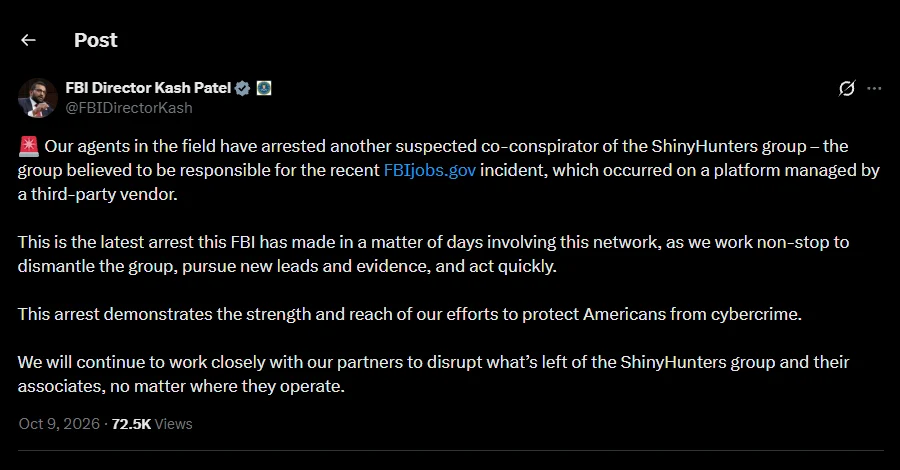
Federal law enforcement authorities have scored a significant, albeit developing, victory in their high-stakes pursuit of the notorious cyber extortion syndicate known as "ShinyHunters." On October 9, 2026, Federal Bureau of Investigation (FBI) Director Kash Patel officially announced via a public statement on X (formerly Twitter) that federal agents had successfully apprehended a third suspected co-conspirator linked to the sprawling criminal enterprise.
While the bureau has maintained a tight lid on specific identifiers—refusing to formally name the individual or make public criminal charges at this preliminary stage—authorities have confirmed crucial details regarding the operation. According to investigative reports from The New York Times and CBS News, which cited credible, unnamed law enforcement sources close to the ongoing investigation, the suspect is a Canadian citizen who was tracked down and arrested within the Commonwealth of Pennsylvania.
Law enforcement insiders have indicated that this latest detainee is believed to have played a direct role in the unprecedented cyber breach that targeted the bureau’s internal and external infrastructure late last month. However, Director Patel’s announcement remained deliberately measured, categorizing the suspect broadly as being tied to the collective responsible for the recent security compromise affecting the official FBI recruitment portal, FBIjobs.gov.
The arrest highlights an aggressive, cross-border counter-cyberoffensive launched by American law enforcement. Director Patel emphasized in his social media update that the bureau will not relent in its mission, vowing that the FBI and its international allies will continue to relentlessly pursue, dismantle, and disrupt "what’s left of the ShinyHunters group and their associates, no matter where they operate." Law enforcement sources familiar with the matter have confirmed that despite this recent sweep, several other co-conspirators and key figures within the extortion network remain at large, fueling an active global manhunt.
Chronology of the Crisis: From Breach to Global Sweep
To fully understand the gravity of the Pennsylvania arrest, one must retrace the rapid and chaotic timeline of events that began unfolding in mid-September 2026. The crisis represents one of the most embarrassing and high-profile security breaches in the modern history of American federal law enforcement.
Phase 1: The Initial Dutch Sweep (Mid-September)
The international dragnet actually closed in on suspected leadership before the broader public was even aware of the impending cyber storm. On September 15, 2026, coordinated raids executed by Dutch law enforcement—acting with critical operational intelligence and support from the FBI—resulted in the arrest of a 24-year-old resident of Amsterdam.

While Dutch authorities initially kept identifying details sparse, journalistic investigations by Reuters and CBS News later identified the suspect as Pepijn van der Stap. Notably, the official public statements released by Dutch police at the time made no explicit mention of the FBI or the impending portal breach. However, a subsequent video statement published by the FBI on September 29 explicitly cast van der Stap as one of the principal leaders of the ShinyHunters collective. Interestingly, representatives of ShinyHunters actively disputed this claim in statements given to The Hacker News, vehemently denying any formal association between the arrested Dutch national and their core operation.
Phase 2: The Breach Announcement and Jordanian Detainment (Late September)
Just one week after the Amsterdam raid, on September 22, 2026, ShinyHunters publicly detonated a massive information security bomb: the group claimed responsibility for completely breaching the FBI’s primary jobs and recruitment portal, boasting that they had successfully exfiltrated sensitive dossier data pertaining to virtually all active FBI agents and prospective job applicants.
As federal panic set in and internal remediation efforts scrambled into motion, international intelligence channels bore fruit in the Middle East. On September 29, 2026, according to confidential intelligence sources cited by Reuters, a second key operative was detained in Jordan. Jordanian state media subsequently verified that an arrest had been made in connection with ongoing international cyber investigations, though initial official releases withheld names. Sources later identified this second individual as Saif al-Din Khader. Unlike the contested affiliations seen in the Netherlands, intelligence reports confirmed that Khader almost immediately began cooperating with federal investigators—a development that may have catalyzed subsequent domestic and international leads.
Phase 3: The Pennsylvania Sweep (Early October)
Culminating the first wave of post-breach apprehensions, the FBI executed the Canadian citizen’s arrest in Pennsylvania during the first week of October. Confirmed publicly by Director Patel on October 9, this third public milestone marks an escalation of domestic enforcement capabilities, shifting the battlefield from foreign jurisdictions directly onto U.S. soil.
Supporting Data: The Anatomy of the FBIjobs.gov Breach
The operational scope of the ShinyHunters breach goes far beyond a typical defacement or minor database leak. Forensic analysis of data samples leaked by the extortion group reveals a devastating compromise of personal, medical, and professional records belonging to individuals who uphold the nation’s security.
What Was Stolen?
An investigative analysis conducted by Reuters, alongside internal corporate and government communications reviewed by CBS News, paints a grim picture of the exfiltrated dataset. The compromised files contained:
- Extensive, personally identifiable information (PII) regarding active FBI employees and personnel.
- Classified or highly sensitive details outlining specialized job roles, operational designations, and internal agency assignments.
- Deeply private psychiatric and medical histories submitted as part of standard federal background checks and security clearance evaluations.
How Did It Happen? A Contractor Security Failure
For weeks, cybersecurity experts and congressional leaders demanded answers regarding how an organization tasked with protecting the nation could suffer such a catastrophic digital intrusion. On October 5, 2026, Brett Leatherman, Assistant Director of the FBI’s Cyber Division, provided clarity during a briefing with Reuters, confirming that the root cause of the breach was not an advanced zero-day exploit launched by elite hackers, but rather a catastrophic human and procedural failure.

According to Leatherman, the vulnerability stemmed entirely from a third-party managed platform. Specifically, "a contractor failed to implement a security patch explicitly issued to secure the platform." In the wake of this revelation, the bureau swiftly moved to sever ties, formally removing the contractor from its roster.
While official statements initially withheld specific vendor names, investigative reporting by Reuters revealed that the compromised system relied on PeopleSoft—Oracle’s enterprise-grade human resources software—managed under a federal contract by multinational professional services giant Accenture. When pressed for comment, Accenture issued a brief statement affirming that the company was "proud to support the mission of the FBI," but repeatedly declined to answer direct inquiries regarding the specific contractor’s failure to apply the mandated security update.
Official Responses and Motives: Cybercriminals Seeking Retribution
The confrontation between ShinyHunters and the FBI is rooted in a bitter digital war of attrition. According to statements released by the extortion group, the decision to target the federal law enforcement agency was not merely opportunistic; it was explicitly retaliatory.
ShinyHunters asserted that the hack was direct payback for a formal Public Service Announcement (PSA) issued by the FBI’s Internet Crime Complaint Center (IC3) back in May 2026 (PSA260515). The advisory characterized the syndicate as a ruthless cybercriminal enterprise specializing in large-scale corporate data exfiltration and systemic digital extortion.
The federal government stands by its characterization. According to FBI tracking data and indictments, ShinyHunters has established a notorious global footprint over the past several years, allegedly breaching more than 140 high-profile organizations worldwide and extorting at least $70 million in illicit cryptocurrency payments since the previous year alone.
Implications: The Long-Term Fallout for Federal Cybersecurity
The ShinyHunters breach and the subsequent international arrests carry profound implications for the future of U.S. national security infrastructure, federal contracting standards, and global cyber diplomacy.
- Vulnerability of Supply Chain Contractors: The incident has laid bare the inherent risks associated with federal outsourcing. By relying on third-party contractors—such as Accenture and platforms like PeopleSoft—to manage sensitive government databases, federal agencies inadvertently introduce massive attack surfaces. The failure to apply a basic security patch underscores an urgent need for stricter oversight, automated compliance monitoring, and harsher penalties for defense and civilian contractors who drop the ball on digital hygiene.
- Erosion of Trust in Federal Recruitment: For job applicants and active agents alike, the realization that their medical histories, psychological evaluations, and personal backgrounds are sitting in the hands of malicious extortionists is deeply unsettling. Restoring faith in the privacy and security of federal onboarding portals will require monumental infrastructural overhauls.
- Cross-Border Law Enforcement Cooperation: Despite the embarrassment of the initial breach, the rapid arrest of suspects across three distinct continents—the Netherlands, Jordan, and now the United States—demonstrates the formidable power of international cyber intelligence sharing. The cooperation of detained actors, such as Saif al-Din Khader, signals that the criminal underworld operated by groups like ShinyHunters is susceptible to internal fracturing under the immense weight of coordinated global prosecution.
As the Department of Justice prepares to unveil formal indictments and unseal court documents regarding the Canadian suspect arrested in Pennsylvania, the digital world watches closely. The message from FBI leadership is clear: while the criminal syndicates may occasionally land a devastating blow against government infrastructure, the full weight of global law enforcement will be leveraged to hunt them down to the last operative.



