










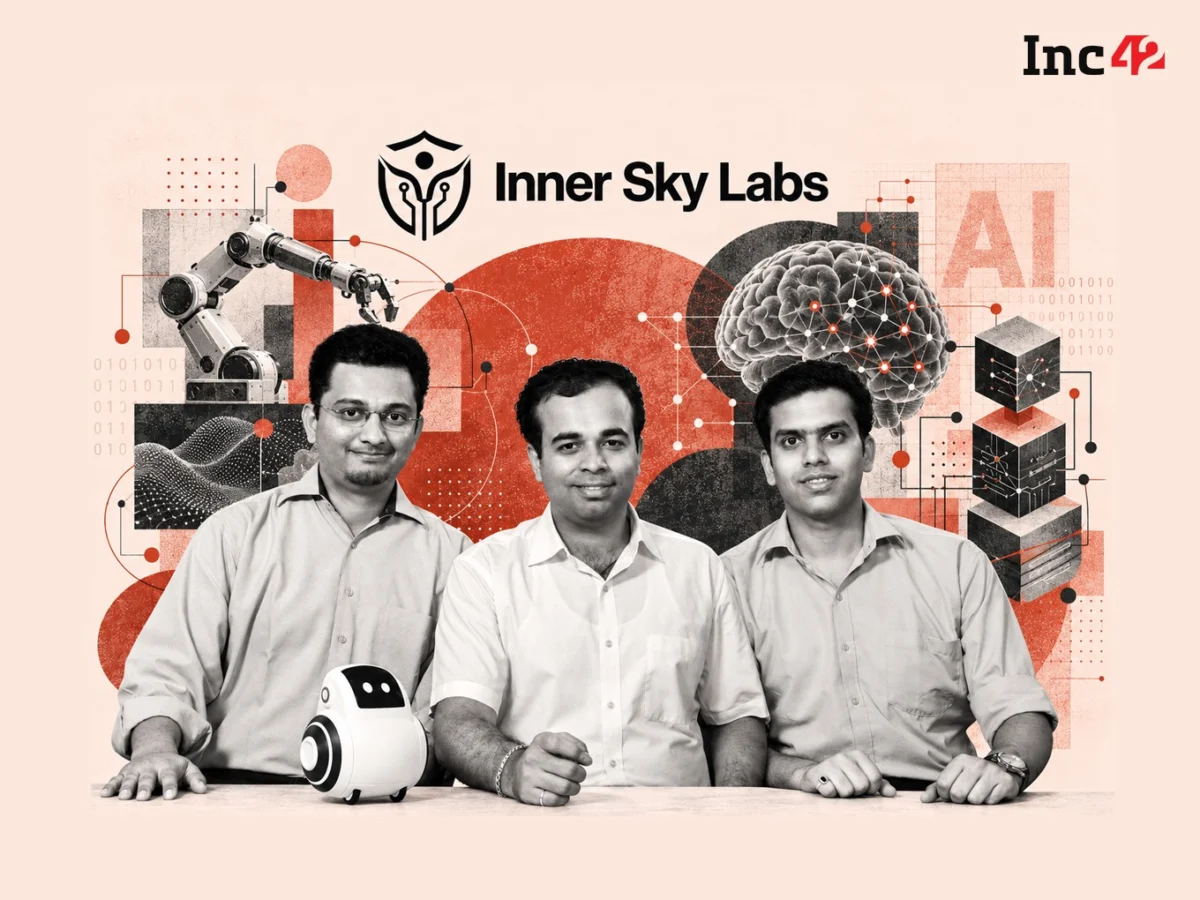
NEW DELHI — In a strategic pivot nearly a decade in the making, the creators of the popular children’s companion robot Miko are stepping out from behind consumer-facing hardware to reshape the global landscape of physical artificial intelligence. Inner Sky Labs, operating under the same legal entity as Miko, has officially broken cover to launch a comprehensive suite of proprietary foundation models tailored for robots, automation systems, and critical infrastructure.
The launch marks a defining milestone for the startup, which was founded in 2015 by a trio of IIT Bombay alumni: Sneh Vaswani, Prashant Iyengar, and Chintan Raikar. While Miko became a household name across global markets for its interactive educational robots, the team has spent the last ten years quietly building the underlying cognitive and motor architecture that powers advanced machines.
Simultaneously, Inner Sky Labs is closing a mammoth INR 300 Cr (approximately $30.9 Mn) funding round. Backed by existing investors—including YourNest Venture Capital and prominent angel investor Keshav R Murugesh—alongside a roster of new global funds, this capital infusion will push the company’s cumulative funding past the $100 Mn mark. The new capital will be directed toward aggressive real-world data collection, scaling up heavy computing infrastructure, and accelerating model training as the company expands its B2B footprint across enterprise, industrial, and government verticals.
Main Facts
- The Pivot to Physical AI: Inner Sky Labs has launched a vertically integrated suite of proprietary foundation models designed to give machines sensory perception, physical action planning, and automated safety compliance.
- Expanding Beyond Miko: While the consumer-facing Miko brand remains active, the newly unveiled umbrella entity, Inner Sky Labs, allows third-party manufacturers to license advanced AI infrastructure without building models from scratch.
- Massive Capital Injection: The startup is finalizing an INR 300 Cr ($30.9 Mn) funding round, lifting its total historical funding to $100 Mn. Backers include YourNest Venture Capital and Keshav R Murugesh, alongside new international investors.
- Hardware-Agnostic Ecosystem: The foundation models are designed to operate across a broad spectrum of physical form factors, including industrial robotic arms, humanoid robots, mobile service bots, quadrupeds, autonomous vehicles, and municipal CCTV frameworks.
- Enterprise and Sovereign Focus: The platform offers local, on-premise, and air-gapped deployments, addressing the growing global demand for sovereign AI solutions that keep sensitive operational data away from foreign networks.
Chronology: A Decade-Long Journey from Consumer Robots to Deep Tech
The genesis of Inner Sky Labs traces back to 2015, when Vaswani, Iyengar, and Raikar laid the groundwork for Miko at IIT Bombay. However, the vision was never confined to children’s toys.
- 2015–2017 (The Blueprint): During early investor pitches in 2017, the founders openly discussed their long-term ambition: to build a foundational AI stack for physical systems. At the time, however, the global market for standalone robotics models was virtually non-existent.
- The Miko Incubation Strategy: Recognizing that the market was unprepared for raw AI models, the team pivoted to a vertically integrated approach. They created Miko—a conversational, empathetic companion robot for children—to serve as a living laboratory. Miko provided a controlled, high-frequency environment to test natural language processing, conversational safety, and physical interaction dynamics.
- Stealth Development (2018–2025): While consumers interacted with Miko in homes across dozens of countries, the engineering team spent the better part of a decade operating in stealth mode. They amassed a vast proprietary dataset sourced from real-world manufacturing plants, Miko’s supply chain ecosystem, and interactive deployments.
- Late 2023–Early 2026 (Commercial Pilots): Before the public unveiling of Inner Sky Labs, the company initiated commercial pilots two to three quarters prior. These early efforts translated into four to five large-scale deployments across enterprise and government sectors, both inside and outside India.
- Mid-2026 (The Public Launch): Inner Sky Labs emerges as the parent enterprise brand, opening its model architecture to qualified global partners by invitation, backed by a fresh $30.9 Mn funding tranche.
Supporting Data: Decoding the Inner Sky Labs AI Architecture
Developing state-of-the-art foundation models for physical systems requires a complex orchestration of sensory input, spatial computing, and safety verification. Inner Sky Labs has segmented its platform into three distinct operational layers: Perception, Action, and Safety.
1. The Perception Suite (Sensing the World)
Machines cannot act intelligently without understanding their environment. Inner Sky Labs has developed three dedicated models for sensory input:

- Drishti: A vision foundation model that processes complex visual scenes, spatial layouts, and object recognition.
- Shruti: An audio model designed to interpret acoustic environments, vocal commands, and ambient industrial sounds.
- Sparsh: A touch-based model that processes tactile feedback, crucial for delicate manipulations.
2. The Action Suite (Planning and Execution)
Once a machine perceives its environment, it must translate that data into physical motion. The startup’s action models process multi-modal inputs to plan and execute tasks:
- Kriya, Prana, and Karma: These models help machines plan movements and anticipate the physical consequences of their actions.
- Parameter Scaling Roadmap: According to company disclosures, the parameter sizes for these action models are scaling rapidly. Kriya, Karma, and Prana are expanding from 4 billion, 4 billion, and 9 billion parameters to 12 billion, 16 billion, and 37 billion parameters, respectively.
- Generational Capabilities: First-generation deployments are already active in industrial settings, combining vision, positional telemetry, and torque readings. The upcoming generation will focus on coordinating multi-arm robotic systems, handling hyper-complex visual scenes, and parsing ultra-fine touch signals from fingertips and palms.
3. The Safety Layer (Kavach)
Perhaps the most critical differentiator in industrial automation is deterministic safety. Inner Sky Labs has built Kavach, an independent safety and guardrail layer that evaluates every proposed physical action before execution.
- Real-Time Veto Power: Kavach can instantly block actions that violate predefined operational rules.
- Robust Guardrails: The system integrates more than 20 distinct safety checks, including human proximity detection, movement speed limitations, and geo-fenced operating boundaries.
Practical Application: In a heavy manufacturing facility, a robotic arm powered by Inner Sky Labs can utilize Drishti and Sparsh to identify, grip, and assemble a precision component. Simultaneously, Kavach monitors the surrounding workspace; if a human worker steps into the robot’s immediate operating zone, the safety layer overrides the action models, halting the arm instantaneously.
Official Responses and Strategic Vision
In an exclusive interaction, cofounder and CEO Sneh Vaswani detailed the strategic rationale behind the launch and the structural shift in the global robotics market.
"We built these AI models ourselves, with a strong focus on safety and sovereignty," Vaswani told Inc42. "Now, we are scaling these models beyond Miko, taking them into enterprises, government applications that require sovereign AI, and other areas."
Vaswani emphasized that building foundation models from scratch has simply become too cost-prohibitive for individual machine manufacturers, especially at modest production volumes. By offering a centralized, hardware-agnostic platform, Inner Sky Labs allows diverse manufacturers to bypass the grueling multi-year R&D cycle required to develop proprietary AI.

Crucially, the platform is entirely homegrown. Addressing the trend of startups relying on open-source weights, Vaswani noted:
"This is not fine-tuned on an open source model. It is our own model."
Furthermore, the company is leaning heavily into the concept of Sovereign AI—a critical selling point for governments and enterprises wary of foreign data jurisdiction. Inner Sky Labs allows clients to host models locally within their own secure infrastructure.
Addressing security-sensitive deployments like municipal surveillance, Vaswani stated:
"If you have CCTV cameras in a city, those cameras need to monitor exactly what has happened. You would not rely on a vision model coming from another country for any purpose. So, you would use a vision model from us."
Deployments are flexible, supporting cloud APIs, on-premise hardware installations, and air-gapped environments entirely isolated from external networks.

Industry Implications and Market Dynamics
The official launch of Inner Sky Labs arrives at a watershed moment for India’s deep-tech and physical AI ecosystems. For years, the country’s tech narrative was dominated by enterprise software-as-a-service (SaaS) and consumer internet applications. Today, a new wave of hardware and robotics innovators is bridging the digital-physical divide.
Companies like Addverb are aggressively building humanoid robots for warehouse logistics and industrial automation, while Mowito is pioneering AI models that allow standard industrial robotic arms to learn tasks directly from human operators through imitation.
By positioning its platform as hardware-agnostic—capable of running on industrial arms, humanoids, mobile companion bots, quadrupeds, autonomous cars, and municipal CCTV networks—Inner Sky Labs is setting its sights on becoming the foundational "operating system" for the physical world.
Global Ambitions and Local Roots
While Inner Sky Labs maintains its primary engineering and operational footprint in India, its market ambitions are resolutely international. The startup has already established a commercial presence serving enterprise markets across the United States and Europe, with active explorations underway in emerging markets like Africa.
As global supply chains decouple and industries race to automate amidst labor shortages, the demand for reliable, secure, and locally governable physical AI will only accelerate. With $100 million in total funding, a decade of proprietary real-world data, and a battle-tested architecture born from the demanding environment of children’s robotics, Inner Sky Labs is poised to transition from a consumer success story to a foundational pillar of global industrial automation.



