











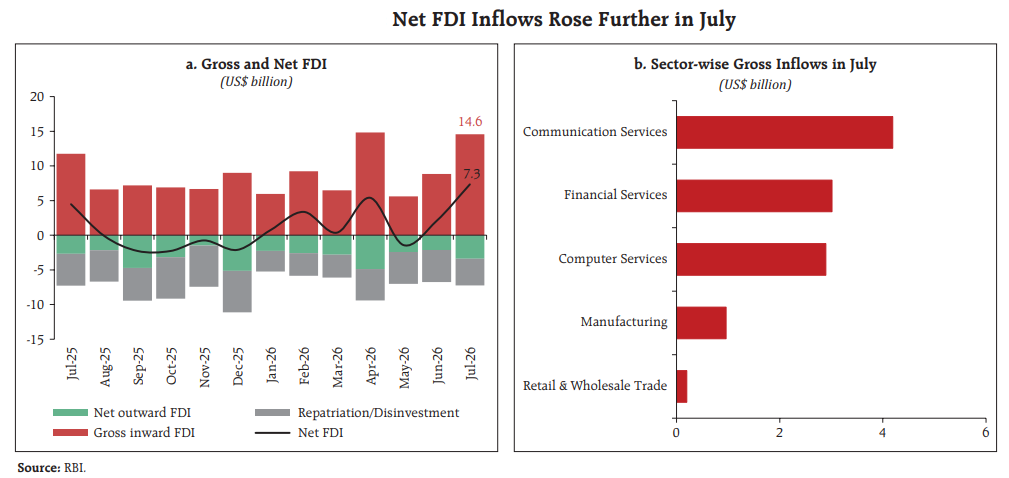
NEW DELHI — In a surprising and robust upturn for the domestic economy, India’s net Foreign Direct Investment (FDI) soared to an over five-year high of $7.35 billion in July 2026, according to data released late Friday by the Reserve Bank of India (RBI).
The latest monthly print represents the highest net inflow since May 2021, when inflows reached $8.80 billion. This resurgence arrives despite a shifting global investment landscape, heightened macroeconomic volatility, and stern warnings from government officials regarding external pressures that continue to challenge emerging markets.
Main Facts
The latest economic data paints a picture of stark resilience in long-term foreign capital commitments, even as portfolio investments face ongoing outflows. Key highlights from the RBI’s July data release include:
- Net FDI Surge: Net FDI reached $7.35 billion in July 2026, marking a 64% increase compared to July 2025.
- Gross FDI Expansion: On a gross basis, FDI inflows hit $14.58 billion in July—representing the third-highest monthly figure recorded over the last six years and a 24% year-on-year jump.
- Fiscal Year Progress: For the first four months of the 2026–27 financial year (April–July), cumulative net FDI inflows rose 38% year-on-year to $13.43 billion, while gross FDI climbed 13% to $43.85 billion.
- Sectoral Drivers: Communication, financial, and computer services emerged as the primary magnets for capital, capturing more than four-fifths of total equity inflows.
- Geographic Sources: Mauritius, the United Arab Emirates (UAE), and the United States remained the dominant source nations, collectively accounting for roughly 70% of total equity inflows.
Chronology and Context: How the Numbers Stack Up
To fully appreciate the significance of the July print, financial analysts must look at the trajectory of capital movements over recent years.
For the past several years, India has experienced a divergence between gross and net FDI. While global corporations have continued to view India as a prime destination for physical capital investments—evidenced by gross FDI touching a remarkable $97 billion in the 2025–26 fiscal year—net FDI figures have moderated sharply. This moderation was driven by two main factors: an escalation in overseas investments by ambitious Indian corporations expanding their global footprints, and foreign investors repatriating profits from past domestic investments.
Between 2024–25 and 2025–26 combined, India’s net FDI inflows slumped to a modest $7.7 billion. The stark contrast makes the July 2026 surge of $7.35 billion in a single month a notable structural outlier.
The mechanics behind the net calculation for July reveal specific shifting currents:

- Repatriation: Foreign investors repatriated $3.84 billion in July, reflecting a 16% decrease compared to the same month last year.
- Outward FDI: Conversely, outward direct investments by Indian companies rose by 26% to $3.39 billion in July. More than two-thirds of these outbound flows targeted Singapore, the UK, and the UAE, primarily concentrated within financial, insurance, business services, and manufacturing sectors.
Supporting Data and Structural Breakdown
The RBI’s monthly State of the Economy publication provides deeper insights into the structural composition of these financial flows. While foreign direct investors are showing renewed confidence in establishing physical footprints and funding domestic service sectors, the story in the secondary financial markets remains vastly different.
+-----------------------------------------------------------------+
|                    JULY 2026 FDI AT A GLANCE                    |
+-----------------------------------------------------------------+
| Net FDI Inflows       : $7.35 billion  (Up 64% YoY)             |
| Gross FDI Inflows     : $14.58 billion (Up 24% YoY)             |
| Repatriations         : $3.84 billion  (Down 16% YoY)           |
| Outward FDI (Indian)  : $3.39 billion  (Up 26% YoY)             |
+-----------------------------------------------------------------+
The Portfolio Outflow Paradox
Even as foreign direct investment sets multi-year records, foreign portfolio investors (FPIs) continue to pull capital out of domestic stock and bond markets.
- During the 2025–26 fiscal year, foreign investors liquidated $16.59 billion in domestic equities and debt.
- This trend has persisted into the current fiscal year, with cumulative FPI sales reaching $6.54 billion so far in 2026–27.
This decoupling highlights a critical distinction in investor behavior: foreign entities are increasingly willing to commit long-term capital to Indian operational enterprises, yet they remain cautious about liquid public market assets amid elevated global interest rates and currency pressures.
Official Responses and Policy Interventions
The record-breaking FDI print comes against the backdrop of cautious commentary from the highest levels of economic policymaking. Just hours before the RBI released the data, Chief Economic Advisor (CEA) V Anantha Nageswaran publicly cautioned that domestic policy excellence does not automatically guarantee immediate capital rewards in the current international climate.
Speaking at a financial conclave on Friday, Nageswaran noted that global conditions have fundamentally shifted. "You can do everything right, the public will see that there is no result, and will therefore be clamouring for more. But the point is global context has shifted," he remarked, pointing to persistent high global interest rates and geopolitical realignments as primary friction points.
Defensive and Proactive Measures
Over the preceding four months, both the Ministry of Finance and the central bank have implemented targeted measures to safeguard the external sector and encourage foreign inflows:
- FCNR(B) Deposit Swaps: A concessional swap window introduced for Foreign Currency Non-Resident (Bank) deposits has turned out to be overwhelmingly successful, shoring up foreign exchange reserves.
- Monetary and Fiscal Synergy: Authorities have continuously streamlined regulatory frameworks to ease business entry barriers, attempting to offset external tightening by major central banks abroad.
Despite these interventions, domestic macroeconomic pressures persist. The Indian rupee has faced intense depreciation pressure, trading close to its all-time low of 96.96 against the US dollar, closing at 95.82 on Friday.
Implications for the Broader Economy
The July FDI surge carries several profound implications for India’s macroeconomic trajectory:
1. Validation of the "Make in India" and Service Sector Hub Thesis
The heavy concentration of equity inflows within communication, computer, and financial services demonstrates that global tech and service giants continue to view India as an indispensable node in their global supply and delivery chains. This influx helps offset wider current account pressures and provides non-debt-creating foreign capital.
2. Cushioning Against Currency Depreciation
With the rupee hovering near historic lows against the greenback, strong net capital inflows are vital. The $7.35 billion net injection provides much-needed foreign exchange buffers, helping the RBI manage excessive currency volatility without overly depleting its foreign exchange reserves.
3. Divergence in Global Risk Appetite
The coexistence of record FDI inflows and heavy FPI sell-offs signals a bifurcated view among international investors. Multinational corporations are executing long-term strategic expansions by deploying direct capital into physical assets and joint ventures, whereas institutional portfolio managers are reallocating liquid funds back to Western markets to capitalize on high benchmark yields.
4. Outlook for the Remainder of 2026–27
As India navigates the remainder of the fiscal year, policymakers will monitor whether the July FDI print is an isolated anomaly or the beginning of a sustained upward cycle. If global interest rate cycles begin to ease in the coming quarters, the combination of robust domestic growth and loosening external financial conditions could unlock even greater tranches of foreign investment, further cementing India’s position as a resilient pillar in the global economy.



