










SAN FRANCISCO — As enterprises rush to deploy autonomous artificial intelligence agents, a foundational security crisis has taken center stage: organizations cannot govern what they cannot see. To address this mounting vulnerability, Salesforce has officially announced the general availability of Shield: Data Detect for Data 360.
The new offering arrives at a critical juncture in the enterprise software market. While corporate adoption of generative AI and autonomous agents has accelerated exponentially, data governance strategies have often lagged behind. By integrating deep, automated sensitive data discovery directly into Data 360, Salesforce aims to give organizations the visibility, compliance tracking, and risk mitigation tools required to run modern AI workloads securely.
Main Facts: Securing the AI Data Supply Chain
The core challenge facing modern enterprises is not merely the presence of sensitive data within their digital ecosystems, but the speed and scale at which AI agents interact with that data. Autonomous agents require vast quantities of contextual information to function effectively, often pulling from disparate data lakes, customer relationship management (CRM) repositories, and unstructured file stores.
If an enterprise lacks a granular mapping of where personally identifiable information (PII), financial records, intellectual property, and regulated data reside, deploying AI agents introduces severe compliance and security liabilities.
- The Core Vulnerability: AI agents process enterprise data at unprecedented velocities. Without real-time discovery and governance, data leakage, unauthorized access, and regulatory non-compliance become systemic risks.
- The Solution: Shield: Data Detect for Data 360 provides a unified, scalable discovery mechanism that maps, monitors, and flags sensitive data across the enterprise architecture.
- General Availability: The tool is now fully live and generally available for Salesforce customers utilizing Data 360, transforming passive data stores into actively governed assets.
- Regulatory Alignment: The platform helps organizations meet increasingly stringent global privacy laws—such as GDPR, CCPA, and industry-specific mandates—by providing clear, auditable lines of sight into data exposure.
Chronology: The Evolution of Enterprise Data Governance in the Age of AI
To understand the significance of Shield: Data Detect for Data 360, it is helpful to trace the timeline of how enterprise data security has evolved alongside the rise of artificial intelligence.
Phase 1: The Siloed Data Era (Pre-2023)
For decades, enterprise data governance focused primarily on perimeter defense and role-based access control (RBAC) within traditional databases. Data was largely static, stored in predictable silos, and accessed almost exclusively by human users through structured application interfaces. Security teams relied on periodic audits and manual classifications to ensure sensitive files were encrypted or restricted.
Phase 2: The Generative AI Boom and the Visibility Gap (2023–2024)
The widespread commercialization of large language models (LLMs) and generative AI completely disrupted this paradigm. Enterprises began feeding massive data lakes into AI models to train custom agents and fuel retrieval-augmented generation (RAG) pipelines.
However, organizations quickly realized they had a massive "blind spot." AI agents did not respect traditional human intent; they could aggregate, summarize, and expose sensitive information buried deep within unstructured documents if the underlying data pipelines were left unmonitored. Compliance officers raised alarms over shadow IT, unvetted data ingestion, and accidental leaks of protected customer information.
Phase 3: The Shift Toward Unified Data Platforms (2024–2025)
In response, enterprise software vendors began consolidating data architectures. Salesforce introduced and expanded Data 360 to serve as a single source of truth, helping businesses harmonize customer data streams while maintaining compliance guardrails. Yet, simply centralizing data was not enough; companies needed automated mechanisms to scan, classify, and protect that data continuously.
Phase 4: Discovery Meets Defense—The Launch of Shield: Data Detect (Present)
With the general availability of Shield: Data Detect for Data 360, Salesforce has closed the loop between data ingestion and active governance. The tool shifts security posture from reactive auditing to proactive, automated discovery, establishing a new baseline for how enterprises prepare their data estates for autonomous agent deployment.
Supporting Data: The Quantitative Reality of AI Data Risk
Industry research underscores why automated data discovery tools like Shield: Data Detect have become non-negotiable for modern IT leadership.

- The Unstructured Data Explosion: According to recent enterprise IT benchmarks, upwards of 80% to 90% of all organizational data exists in unstructured or semi-structured formats—emails, transcripts, chat logs, and document repositories—making manual compliance audits virtually impossible.
- The Cost of Data Breaches: Global data protection reports indicate that the average cost of an enterprise data breach continues to hover near historic highs, driven not just by financial penalties from regulatory bodies, but by catastrophic brand damage and loss of consumer trust.
- AI Agent Expansion: Enterprise adoption of autonomous agents is projected to grow exponentially over the next three years. As agents move from answering simple queries to executing multi-step business workflows autonomously, the volume of data they process daily multiplies manifold, magnifying the potential impact of any single governance failure.
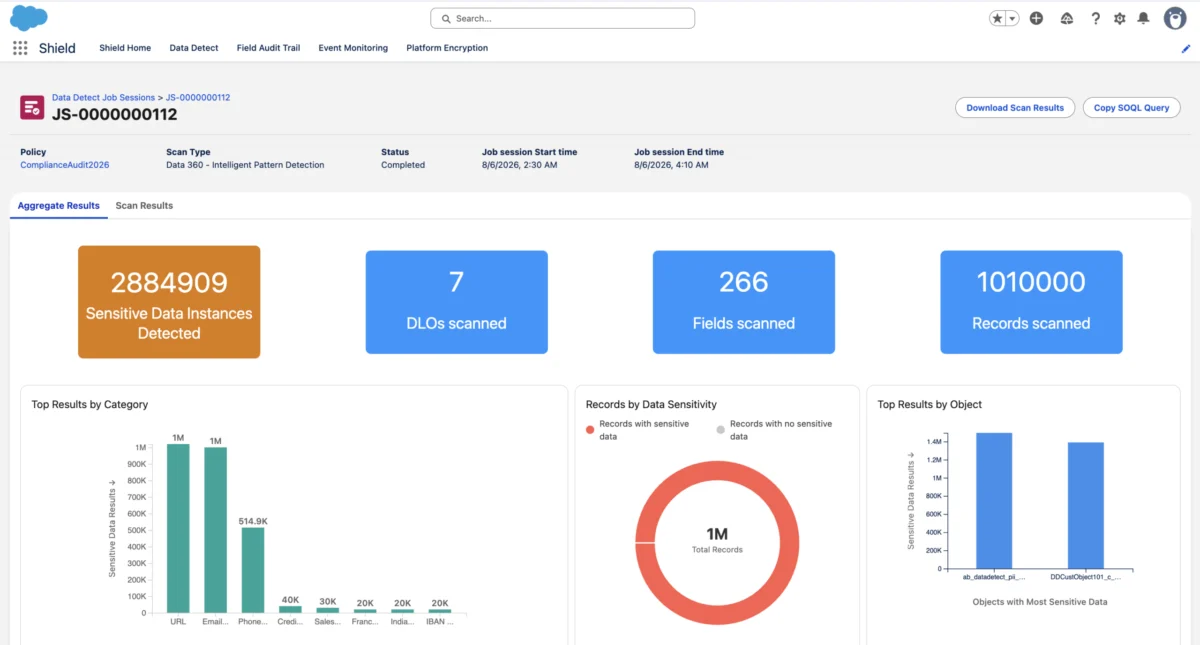
Shield: Data Detect addresses these metrics by automating the heavy lifting of data classification. Instead of security teams spending hundreds of hours manually reviewing database schemas and data lake objects (DLOs), the platform scans environments continuously, surfacing quantifiable risk exposure metrics straight to a centralized dashboard.
Official Perspectives: Industry Leadership on AI Trust and Compliance
Salesforce executives and security architects have consistently emphasized that trust must be the primary currency of the AI revolution.
"Your data is only as secure as your ability to see inside it," notes product leadership within Salesforce’s security division. "As organizations transition from passive data collection to active AI deployment, they cannot afford blind spots. Shield: Data Detect bridges the gap between raw data storage and intelligent, compliant action."
Enterprise security analysts have echoed these sentiments, pointing out that compliance frameworks can no longer be treated as an afterthought or a once-a-year checklist item.
- On Compliance Agility: Industry compliance experts stress that regulatory bodies are taking an increasingly aggressive stance on automated decision-making systems. If an AI agent makes a business or customer-facing decision based on improperly governed or non-compliant data, the enterprise bears full legal accountability.
- On Scalability: CIOs and CISOs have repeatedly emphasized that security tools must scale dynamically with cloud infrastructure. Legacy compliance tools that require manual intervention fail to keep pace with modern data ingestion rates. By embedding detection natively into Data 360, Salesforce ensures that security scales alongside compute and storage resources.
Implications: What Shield: Data Detect Means for the Enterprise Ecosystem
The general availability of Shield: Data Detect for Data 360 carries profound implications across multiple facets of enterprise operations, from IT security to legal compliance and executive leadership.
1. Empowering Secure AI Innovation
For innovation teams and AI developers, the greatest hurdle has often been friction with risk-averse legal and security departments. When security teams cannot verify what data is flowing into an AI model, they naturally default to blocking projects. By providing clear, auditable, and automated discovery findings, Shield: Data Detect creates a common language between developers and security officers, accelerating the safe deployment of Agentforce and other advanced AI initiatives.
2. Streamlining Audits and Regulatory Compliance
Navigating complex global privacy regulations—such as GDPR’s "Right to be Forgotten" or CCPA’s data access requests—requires absolute clarity on where specific data elements live. The actionable intelligence provided by Shield: Data Detect allows compliance officers to quickly query findings, review aggregate data statuses across all scanned DLOs, and generate exportable, auditable reports with minimal operational overhead.
3. Transitioning from Discovery to Active Defense
Discovery is only the first step in the security lifecycle. The architecture behind Shield: Data Detect is designed to translate raw scan results directly into tactical defensive postures. Through intuitive dashboards, administrators can instantly view status indicators, identify vulnerable data points, and adjust security policies in real time. This closes the loop between identifying a risk and neutralizing it.
4. Setting a New Standard for Enterprise Software Architecture
As the enterprise software market matures, native security integration is rapidly replacing third-party bolt-on solutions. By embedding deep data discovery directly into the fabric of Data 360, Salesforce is signaling that data protection cannot exist as a separate, siloed layer. It must be woven into the core infrastructure where data is stored, processed, and utilized by AI agents.
Conclusion
The rollout of Shield: Data Detect for Data 360 marks a defining milestone in the ongoing quest for enterprise AI maturity. By tackling the fundamental challenge of data visibility, Salesforce is equipping organizations to move past the fear of the unknown and embrace automated innovation with confidence.
As autonomous agents become permanent fixtures of the corporate landscape, tools that bridge the gap between deep discovery and auditable defense will separate market leaders from those left struggling to secure their own foundations. For enterprises committed to building scalable, trustworthy AI operations, the path forward begins with absolute clarity—knowing precisely where your data lives, and trusting entirely what your systems are doing with it.



