MENLO PARK, Calif. — In an effort to reshape how online communities connect, share, and discover specialized knowledge, Meta has rolled out significant updates to Forum, its standalone companion app designed specifically for power users of Facebook Groups. First introduced as a limited test in May, the purpose-built platform is expanding its feature set to streamline community engagement, overhaul member recognition systems, and introduce AI-powered search capabilities that tap into real-world human experience.
Available now for download in the United States across iOS and Android devices, Forum bridges the gap between fragmented online discussions by syncing directly with a user’s existing Facebook account. The standalone application consolidates multiple group memberships into a single, centralized hub, allowing members to catch up on updates, monitor niche discussions, and unearth new communities with minimal friction.
Alongside the app’s ongoing rollout, Meta is introducing a streamlined member recognition role to replace legacy badges, expanding AI-driven discovery tools, and testing topic-based navigation to help users dive deeper into specific hobbies, travel destinations, and lifestyle interests.
Main Facts
The latest updates to the Forum ecosystem and Facebook Groups introduce several major architectural and functional changes:
- The Forum App: A dedicated, standalone application built to centralize Facebook Groups. It allows US users to log in with their standard credentials, sync their existing group memberships, and discover new public communities.
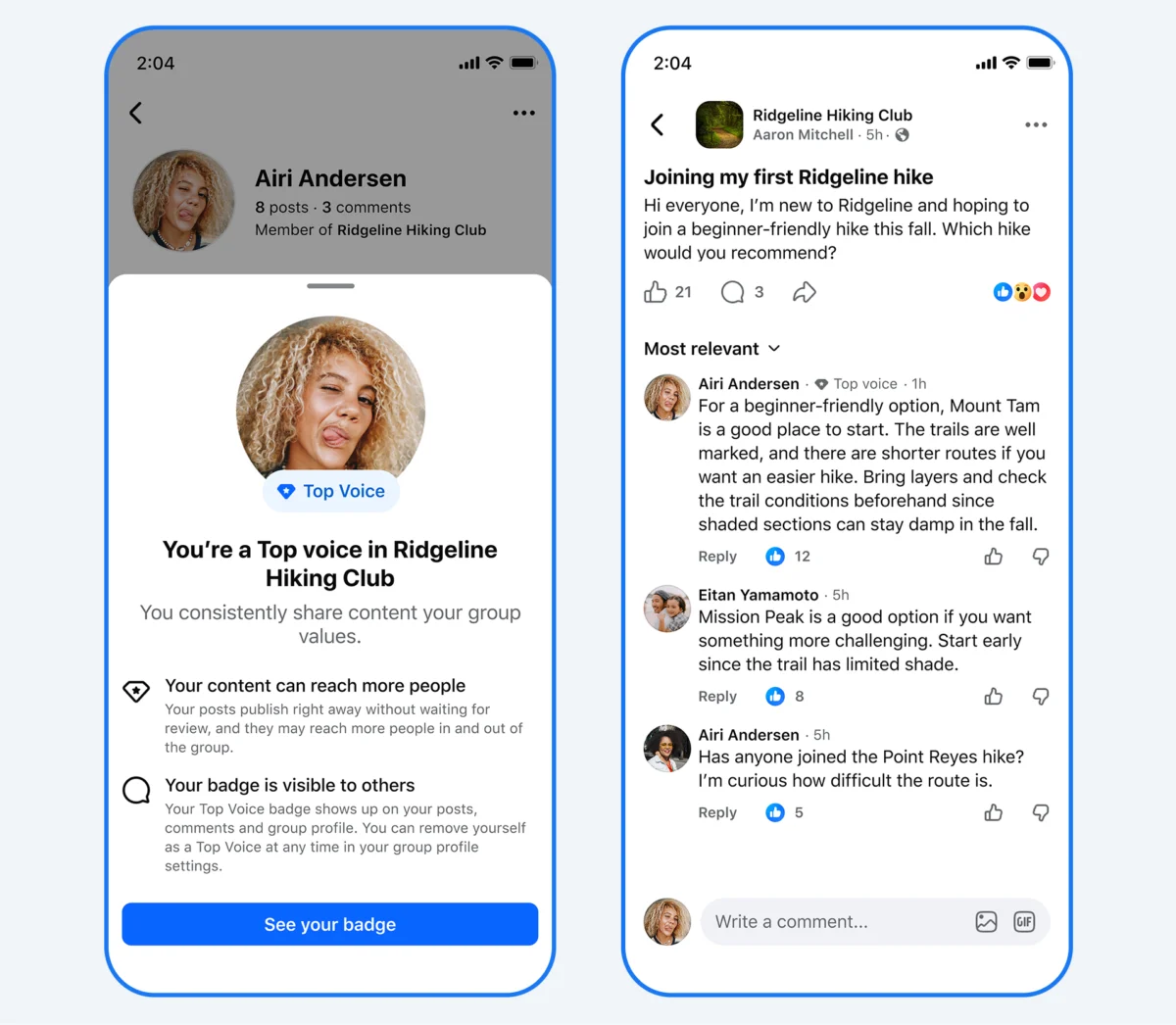
- Overhauled Recognition System: Meta is testing a unified community role to honor top-tier contributors, officially replacing older mechanisms like "Contributor Badges" and "Group Expert" designations.
- Enhanced Perks for Top Voices: Members who earn the new role receive a distinct badge and tangible community benefits, including faster-publishing posts (while remaining strictly bound by Meta’s overarching Community Standards).
- AI-Powered "Ask" Feature: Forum utilizes artificial intelligence to parse through existing group posts and comments, surfacing firsthand recommendations, reviews, and insights from real people across both joined and unjoined public groups.
- Topic Labeling: The platform is testing automated and manual topic tags (such as "Solo Travel" or "Korean Food") to let users filter discussions by subject matter rather than traditional group boundaries.
Chronology: The Evolution of Facebook Groups and Forum
To understand the strategic significance of Forum, it is necessary to examine how Meta has iteratively shifted its social media architecture toward closed, interest-based communities over the last decade.
Phase 1: The Shift from Public Feeds to Private Communities (2017–2021)
As general News Feed engagement shifted toward private messaging and ephemeral stories, Facebook recognized that groups—ranging from neighborhood watch organizations to global fandoms—were among its most resilient and sticky features. Throughout this period, the company introduced group-specific tools, such as "Group Expert" badges, structured learning units, and moderation assistance algorithms, attempting to replicate the utility of legacy forums like Reddit and phpBB within the Facebook ecosystem.
Phase 2: The Conception of Forum (May 2026)
Despite the massive popularity of Facebook Groups, power users frequently complained about notification fatigue, algorithmic suppression of niche threads, and the sheer clutter of managing dozens of distinct communities alongside a traditional social media feed. In May 2026, Meta quietly initiated tests for Forum—a dedicated app built to strip away the distractions of Marketplace, Reels, and personal status updates, focusing entirely on deep-dive group discussions.
Phase 3: Expanding the Toolkit (September 2026)
Building on the initial architecture, Meta advanced the platform in September by introducing a redesigned recognition framework for top contributors and integrating AI-assisted search tools. By decoupling specific community interactions from the core Facebook app, Meta positioned Forum as an incubator for specialized human knowledge.
Supporting Data and Technical Architecture
The underlying mechanics of Forum and its accompanying features reflect Meta’s broader pivot toward utility-driven, intent-based discovery.
Synchronization and Accessibility
Forum relies on secure OAuth authentication tied directly to a user’s primary Facebook profile. Upon logging into the iOS or Android applications, the backend queries the user’s current group roster, mirroring administrative permissions, membership statuses, and notification preferences. This ensures that group admins do not need to rebuild their communities from scratch on a third-party platform; instead, Forum acts as an alternate, streamlined rendering engine for existing Facebook infrastructure.
The Mathematics of Recognition
The newly tested role replaces a fragmented ecosystem of contributor statuses that often varied wildly from group to group. Under the new guidelines, qualification is driven by behavioral metrics:
- Frequency and quality of helpful replies to peer inquiries.
- Generation of peer-to-peer recommendations that receive positive community reinforcement.
- Initiation of conversational threads that spark high-engagement, constructive commentary.
Admins retain primary control, granting the role directly or acting upon algorithmic nominations generated by Meta’s internal systems. To mitigate abuse, the system maintains strict oversight: while designated top voices enjoy accelerated publishing queues, every single post remains subject to automated and human-moderated Community Standards checks.

Official Responses and Strategic Vision
Meta executives have framed the development of Forum not as an attempt to abandon the core Facebook application, but rather as an acknowledgment that modern internet users demand specialized spaces for deep-dive research and peer support.
"Forum is a purpose-built app we’re exploring for the people who want to go deeper on Facebook Groups," Meta noted in an official product release statement. "Synced with your groups on Facebook, Forum brings them together in one place so you can see what’s new and jump into the conversations you care about."
Highlighting the pivotal role of community managers, the company added: "Admins know their communities best, and can spot the members making these contributions and grant the role directly—we’ll also nominate members to help admins identify top voices in their group."
Early feedback from community administrators has been cautiously optimistic. Many large-scale group managers have long struggled with burnout, citing the difficulty of manually sorting through thousands of daily posts to identify reliable, helpful members. By automating parts of the recognition process and providing specialized tools for accelerated publishing, Meta hopes to retain top-tier moderators and contributors who might otherwise migrate to platforms like Discord or Reddit.
Implications for Digital Communities, Search, and Competitors
The launch and expansion of Forum carry profound implications for the digital landscape, touching upon search engine optimization, user behavior, and competitive market dynamics.
1. The Death of Generic Search Queries and the Rise of "Firsthand Experience"
For years, internet users seeking practical advice—such as the best hiking boots for rainy climates or authentic local eateries in a foreign city—relied on search engines that increasingly index AI-generated travel blogs and SEO-optimized affiliate marketing sites.
With Forum’s AI-driven "Ask" feature, Meta is capturing intent-based searches and routing them directly to verified human experiences stored within public and private groups. If successful, Forum could evolve into a formidable competitor to traditional search engines for experiential recommendations, bypassing corporate content farms in favor of crowdsourced peer reviews.
2. Cross-Pollination and Group Discovery
By allowing the "Ask" feature to pull conversations from public groups that a user has not yet joined, Forum creates a powerful discovery funnel. Users searching for a specific topic—say, "Solo Travel"—will not only find individual answers but will also be exposed to entire communities they previously did not know existed. Combined with the new topic labeling system (tapping tags like Solo Travel or Korean Food), the app effectively flattens traditional group boundaries, organizing the entire Facebook ecosystem around conceptual interests rather than isolated clubhouses.
3. Direct Competition with Reddit and Discord
Meta’s strategy with Forum directly mirrors the architectural advantages of Reddit and Discord—platforms prized for their topic-focused structures and separation from personal social graphs. By removing the baggage of the primary Facebook news feed (such as family updates and political news), Meta provides a clean, focused environment where users can engage purely based on shared passions.
4. Challenges and Moderation Overhead
Despite its promise, Forum inherits many of the systemic moderation challenges that have historically plagued Facebook. Consolidating thousands of disparate communities into a single application increases the surface area for misinformation, harassment, and spam. While AI tools and designated top voices can alleviate some administrative pressure, community standards enforcement will remain a high-stakes bottleneck for Meta as the app scales globally.
Looking Ahead
As Meta continues to test and refine Forum in the United States, the company has promised to roll out additional admin-centric features in the coming weeks. The success of the platform will ultimately hinge on whether users embrace a dedicated app for their community interactions, and whether group administrators find the new recognition and publishing tools sufficient to manage increasingly active digital spaces.
For now, Forum stands as a clear signal of Meta’s long-term commitment to the social infrastructure of groups—transforming a casual feature into a targeted, AI-enhanced ecosystem built for the web’s most dedicated communities.