







The landscape of digital product design and content creation has undergone a seismic shift. As of August 2, 2026, the European Union has officially entered a new regulatory chapter with the enforcement of stringent transparency obligations under the EU AI Act. For companies operating within the EU—or serving EU citizens—the era of "stealth AI" has come to an abrupt end.
While the news cycle has been dominated by headlines warning of "sweeping measures" and "massive fines," the reality is far more nuanced. These regulations are not designed to stifle innovation but to foster a transparent digital ecosystem where users can distinguish between human-authored content and machine-generated output. This article breaks down what these mandates mean for product teams, designers, and developers worldwide.
The Main Facts: What the EU AI Act Mandates
At its core, the EU’s new transparency directive, specifically Article 50(4) of the AI Act, seeks to ensure that any individual interacting with AI-generated or AI-manipulated content is explicitly aware of that fact.
The regulation applies to both providers (the entities developing the AI systems) and deployers (the companies integrating these systems into their products). Crucially, this is not a localized European policy; like the GDPR and the European Accessibility Act (EAA) before it, this law has extraterritorial reach. If your platform serves users in the European Union, your AI outputs must comply, regardless of where your headquarters are located.
Key Compliance Triggers
Not every instance of AI usage requires a label. The mandate focuses on instances where transparency is essential to prevent deception or misinformation. Transparency is required for:
- AI-generated content that resembles existing persons, places, or objects.
- Deepfakes and manipulated audio/visual content that could be mistaken for reality.
- Public interest content, including information related to health, safety, environmental, economic, or political discourse.
Chronology and Regulatory Context
The path to this enforcement began with the European Commission’s push for a "Safer and More Transparent AI" ecosystem. Following the publication of the final guidelines, the transition period concluded on August 2, 2026.

This date marks the transition from "voluntary best practices" to "mandatory legal requirements." The timeline for adoption was intentionally set to give organizations time to audit their UX flows. However, the lack of immediate compliance has already led to concerns regarding the "fine-tuning" of interfaces. As we move into the post-August era, regulators are expected to shift from an educational stance to an enforcement-heavy approach, particularly regarding high-impact industries like media, finance, and public policy.
The Myth of the "Sparkle" Icon
For years, the design community has relied on the "sparkle" icon (✨) as a universal shorthand for "AI-powered." However, the European Commission has been explicit: generic iconography is likely insufficient for compliance.
Research, including studies from the NNGroup, suggests that the sparkle icon is fundamentally ambiguous. Users often interpret it as a generic "magic" or "automatic" feature rather than a specific disclaimer of machine generation. Because the legal standard requires the disclosure to be "clear and distinguishable," a subtle, decorative sparkle in the corner of a chat window will not pass muster.

Designing for Compliance
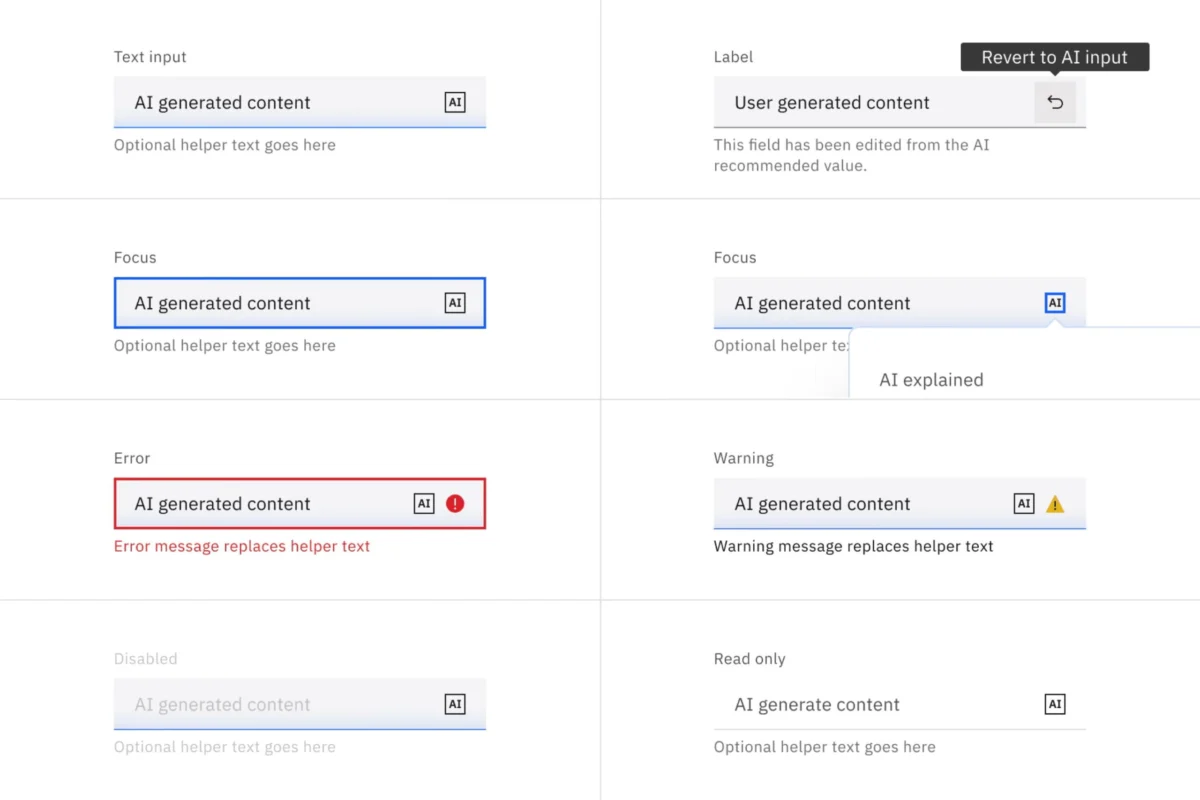
The Commission has released an official set of AI icons to help standardize communication. To ensure compliance, designers should:
- Pair Icons with Plain Text: Never rely on an icon alone. A label should explicitly state "AI-generated" or "Partially AI-modified."
- Ensure Persistence: If content is generated by AI, the label must remain with that content even if it is downloaded, shared, or screenshotted.
- Prioritize Accessibility: Labels must be screen-reader compatible and color-contrast compliant.
- Avoid "Dark Patterns": Hiding disclosures in footers, using low-contrast text, or flashing labels that disappear before the user can read them are explicitly flagged as non-compliant.
The Fine Line Between "Assistance" and "Generation"
One of the most frequent questions from product teams concerns the boundary between human-edited work and machine-generated work. Does a grammar-corrected email require an AI label?
The EU guidance offers a distinction based on "substantive" vs. "minor" edits.

- Non-Disclosure Required: Spellcheck, basic grammar correction, standard formatting, color correction, and machine translation generally do not require a label. These are viewed as assistive tools rather than generative processes.
- Disclosure Required: AI-generated summaries, the creation of composite imagery, substantive rewrites that change the core meaning of text, or the addition/removal of objects from photos are considered "AI-generated."
If a human "skims" an AI-generated article, it does not qualify as an "editorial review." To bypass the labeling requirement, a named human must take explicit editorial responsibility for the output. If the AI does the heavy lifting, the user deserves to know.
Official Responses and Industry Implications
Legal experts and industry bodies have largely welcomed the clarity provided by the final guidelines, even if the compliance burden is significant. Law firms specializing in digital regulation, such as DGLaw, have advised clients to adopt a "conservative disclosure" strategy—labeling anything that borders on the line of realistic, as the cost of non-compliance far outweighs the aesthetic impact of a label.
The implications for B2B and enterprise software are particularly interesting. While closed B2B environments have certain exemptions, the moment that content moves to a public-facing domain, the rules tighten. Product managers are now tasked with updating their design systems to include "AI-disclosure components" as a standard part of their UI libraries, much like they would a cookie consent banner.

Global Patterns: Beyond the EU
The European approach is acting as a "Brussels Effect" blueprint for the rest of the world. Similar regulations are emerging in:
- The United States: State-level laws are targeting synthetic performers and political advertising.
- Canada and Japan: Regulatory bodies are currently reviewing disclosure frameworks that mirror the EU’s emphasis on transparency in public-facing media.
This trend confirms that "AI Transparency" is not a fleeting trend but a fundamental requirement for the next generation of software development. Companies that treat these labels as an opportunity for user trust, rather than a bureaucratic hurdle, will be better positioned to navigate the global market.
Conclusion: The Path Forward
The panic surrounding the new EU rules is largely misplaced. At its core, the regulation is a reflection of a simple, moral imperative: when AI content could be mistaken for human output, the creator must inform the viewer.

For designers and developers, this represents a chance to rebuild the "contract of trust" with users. By building clear, accessible, and honest interfaces, companies can distance themselves from "AI slop" and demonstrate the value of their human-AI collaboration.
As you integrate these changes, consider exploring resources like Design Patterns for AI Interfaces, which provides practical, real-world examples of how to balance legal compliance with a seamless user experience. The goal is not just to avoid fines, but to create a digital world where users are empowered, not tricked, by the tools they use every day.
For those looking to deepen their expertise, consider enrolling in professional UX training focused on the integration of AI. Practical application is the only way to ensure your product remains compliant, competitive, and user-centric in the years ahead.