










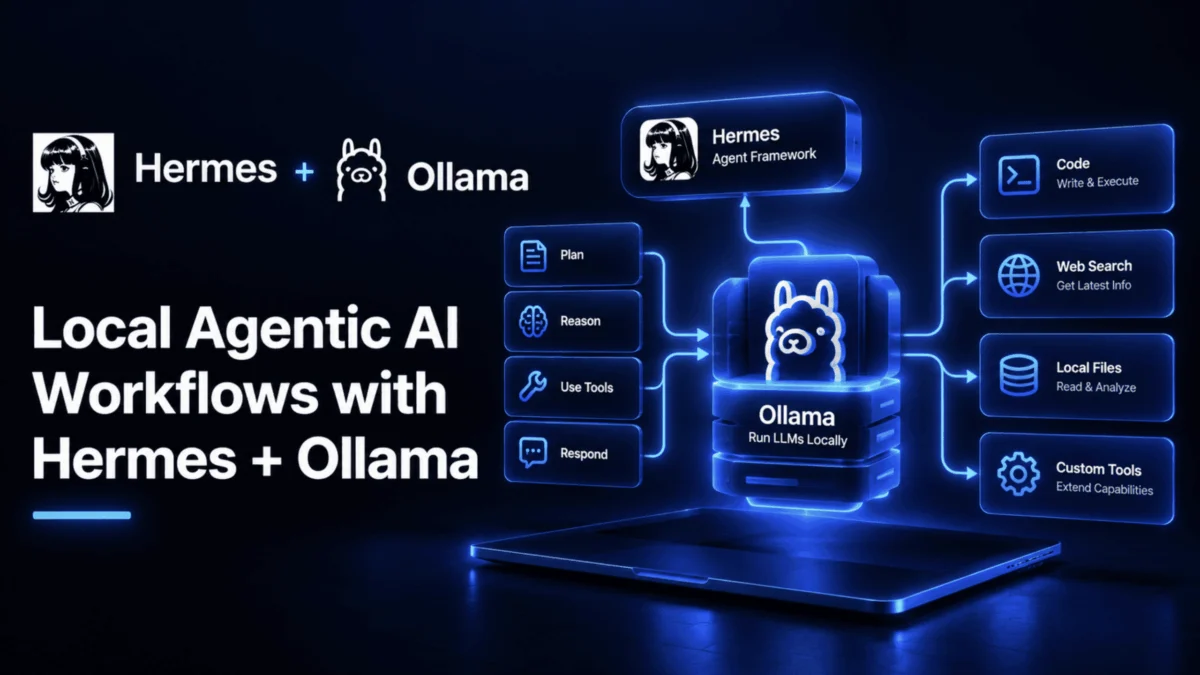
In the rapidly evolving landscape of artificial intelligence, a quiet revolution is taking place. While the industry is largely dominated by massive, cloud-based Large Language Models (LLMs) that require monthly subscriptions and constant data transmission, a growing movement of developers is reclaiming agency over their digital environments. The objective is clear: to build agentic AI workflows that reside entirely on local hardware, ensuring that sensitive code, private files, and personal conversations never leave the user’s machine.
By pairing Hermes Agent—an open-source, highly capable AI orchestration tool from Nous Research—with Ollama, the industry standard for local model serving, users can now construct a private, zero-cost AI assistant. This guide explores how to break free from the constraints of cloud API costs and data privacy concerns while maintaining a professional-grade agentic experience.
The Economics of Privacy: Why Local Matters
A typical coding session involving cloud-based AI APIs can quickly become an expensive endeavor. According to cost breakdowns provided by Nous Research, moderate agentic workloads can range from $0.60 to $0.80 per session, with intensive development workflows scaling to $5.00 or even $20.00. For hobbyists, students, and independent developers, these costs accumulate rapidly.
However, the financial cost is only half the story. The more significant, often overlooked cost is the erosion of data sovereignty. Every time a user interacts with a cloud-based agent, their codebase, project documentation, and private conversations are transmitted to third-party servers. For those working on proprietary projects or handling sensitive data, this is an unacceptable trade-off. Building a local workflow provides a robust alternative: a system that is cost-free at the point of use and guarantees that data remains under the user’s physical control.
Chronology of the Setup: From Installation to Automation
Building a local-first agentic workflow requires a disciplined, step-by-step approach. The process involves establishing the infrastructure for the model, configuring the agentic orchestrator, and finally, optimizing the environment for performance.
1. The Foundation: Installing Ollama
Ollama serves as the heavy-lifting engine, managing the deployment and inference of open-weight models. It acts as a local API server, exposing a standard /v1/chat/completions endpoint that is compatible with the OpenAI API format.
Deployment Steps:
- Installation: Use the official installation script via the terminal:
curl -fsSL https://ollama.com/install.sh | sh. - Verification: Confirm the service is active by running
ollama --versionand hitting the local API:curl http://localhost:11434/api/tags. An empty JSON array is the expected result, signaling that the engine is ready to ingest models. - Model Selection: The choice of model is the most critical decision in the architecture. While smaller models like
llama3.2:3bare efficient for simple Q&A, they lack the "Tool Calling" capability required for true agentic behavior. For complex tasks like file manipulation and web searching, a model with robust tool-calling support, such asgemma4:31b, is essential.
2. Configuring Hermes Agent
Hermes Agent (v0.21.1) acts as the "brain" that orchestrates the local model. It is designed to interpret natural language instructions and translate them into actionable steps—editing files, executing shell commands, and managing sub-agents.
Once installed, Hermes can be pointed to the local Ollama instance via the ~/.hermes/config.yaml file. By setting the provider to custom and the base_url to http://localhost:11434/v1, the agent is fully decoupled from cloud providers. It views your laptop’s local GPU/CPU as its primary compute resource.
Supporting Data: Hardware Requirements and Performance
Local AI performance is inherently tethered to hardware specifications. Understanding the hardware ceiling is vital to managing user expectations regarding latency and model capability.
| Component | Minimum Specification | Recommended Specification |
|---|---|---|
| RAM | 8 GB (for 3B models) | 32+ GB (for 27B+ models) |
| Storage | 5 GB free space | 30+ GB (for multiple model variants) |
| CPU | 4 cores | 8+ cores |
| GPU | Not required | NVIDIA GPU with 8+ GB VRAM |
Performance Metrics:
On modern hardware, a 9B model running on an 8-core CPU can achieve roughly 10 tokens per second (TPS). Scaling up to a 31B model, the speed typically drops to 2–5 TPS. While this is sufficient for a background agent that performs file-system cleanup or documentation analysis, it is less responsive for rapid-fire chat. Leveraging an NVIDIA GPU for partial layer offloading significantly bridges this gap, allowing for a much smoother interaction loop.
Official Perspectives: The Philosophy of Nous Research
Nous Research’s release of Hermes Agent represents a strategic shift in the AI ecosystem. Their documentation emphasizes that the "agentic" nature of the tool is not merely about chat—it is about persistence and sandboxing.
- Persistent Memory: Unlike standard LLMs that reset with every chat session, Hermes is designed to retain knowledge of your project architecture. It builds a history of successful problem-solving, essentially creating a "skills" library that improves in efficacy over time.
- Sandboxing: To protect the host system, Hermes supports multiple isolation backends, including Docker and Modal. This ensures that when the agent executes code, it does so within a controlled container, preventing unintended modifications to the user’s primary file system.
- Messaging Gateway: The architecture allows for cross-platform integration. By connecting the local agent to Telegram or Discord, users can maintain their "local-first" philosophy while enjoying the convenience of mobile accessibility.
Implications: The Hybrid Future
The transition to a fully local agentic workflow does not have to be an all-or-nothing proposition. One of the most sophisticated features of this setup is the ability to configure cloud fallbacks.
In this hybrid architecture, the local gemma4:31b model handles 90% of daily tasks—file organization, script drafting, and summarizing local documentation. However, if the local model hits a "reasoning wall" or encounters an issue it cannot resolve, the system is configured to route only those specific, complex queries to a high-end cloud provider like Anthropic (via OpenRouter).
The "Good Local" Advantage
The implications of this setup are profound for the software industry:
- Zero-Cost Scaling: By shifting the majority of tasks to local compute, the recurring costs of AI development are effectively neutralized.
- Privacy as a Standard: Because the agent is "air-gapped" from the public internet for most tasks, the risk of data leakage is minimized.
- Resilience: The workflow functions without an internet connection, provided the local models are downloaded, making it an essential tool for development in environments with limited or restricted connectivity.
Conclusion: A New Standard for Digital Craft
The construction of a local-first agentic workflow using Hermes and Ollama is more than a technical exercise; it is an assertion of digital sovereignty. By utilizing the power of modern open-weight models, developers can now build an assistant that is not only private and cost-effective but also deeply integrated into their specific workflows.
As the industry moves toward more autonomous agents, the ability to control the "who, where, and how" of AI inference will become a hallmark of professional software development. Whether you are automating your file organization, searching through a decade of personal notes, or managing complex coding projects via a mobile bot, this setup provides a robust, private, and endlessly extensible foundation for the future of AI-assisted labor. The barrier to entry has never been lower, and the cost of complacency—in terms of both dollars and data privacy—has never been higher. The tools are now in your hands; it is time to build.



