



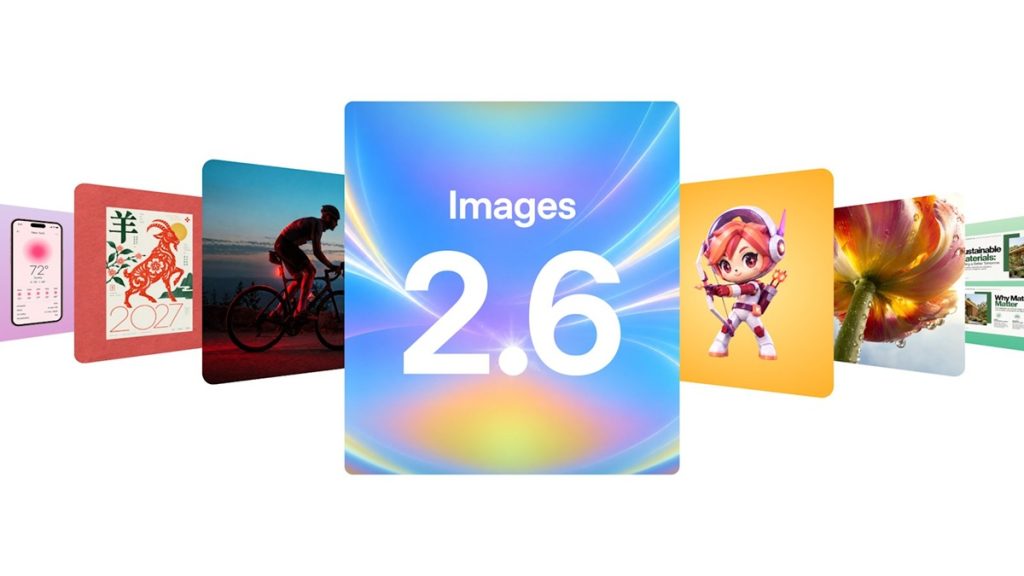
In a significant expansion of its creative toolkit, OpenAI has officially launched Images 2.6, a major upgrade to its generative visual suite integrated across ChatGPT, Codex, and its developer API. This latest iteration marks a pivot from simple static image synthesis to a more dynamic, high-speed ecosystem capable of producing complex animations and professional-grade visuals with unprecedented consistency.
As generative AI continues to weave itself into the fabric of professional workflows, OpenAI’s latest move addresses three critical pain points: generation speed, functional versatility, and content transparency. With the company now processing an staggering 4 billion images per week—an average of 500 million daily—Images 2.6 arrives as a refined engine designed to handle the massive scale of global creative demand.
The Technical Evolution: A Breakdown of Images 2.6
At the heart of the 2.6 update is a fundamental re-architecture of the underlying models. The new suite introduces two distinct specialized engines for the API: GPT-Image-2.6 Flare and GPT-Image-2.6 Sunburst.
Flare: The Speed Specialist
The "Flare" model is engineered for high-velocity environments. It is optimized for use cases where turnaround time is paramount, such as rapid prototyping, automated social media content generation, and ad-hoc visual brainstorming. Flare boasts a 50% increase in generation speed compared to its predecessors. At lower quality settings, Flare can produce a rendered image in as little as six seconds, providing developers with a responsive tool for real-time applications.
Sunburst: The Quality Artisan
Conversely, "Sunburst" is built for high-fidelity requirements. It prioritizes layout precision, intricate detail, and, crucially, temporal and spatial consistency. For users who need to edit images through multiple rounds of prompting, Sunburst ensures that elements remain stable across iterations—a historical weakness in generative AI that OpenAI has specifically targeted to improve professional design workflows.
Chronology: From DALL-E to the 2.6 Ecosystem
The journey to Images 2.6 is the result of a multi-year sprint by OpenAI to dominate the generative media space.
- 2021–2022: The era of DALL-E and DALL-E 2 introduced the world to the concept of "text-to-image." During this period, the technology was largely experimental, characterized by artistic surrealism rather than photorealistic utility.
- 2023: OpenAI shifted focus toward integration. By embedding image generation directly into ChatGPT, the barrier to entry was lowered, turning a niche AI research project into a consumer-facing daily utility.
- Early 2024: The introduction of the Images 2.0 series focused on "controllability." This phase saw the integration of editing tools, allowing users to mask areas of an image and generate new content within those boundaries.
- Late 2026: The launch of Images 2.6 represents a maturation point. The focus has moved beyond mere image creation to animated storytelling. The addition of native GIF generation capabilities suggests that OpenAI is positioning its models not just for static art, but as components for motion design, UI/UX prototyping, and digital marketing.
Supporting Data: The Scale of Generative Media
The statistics provided by OpenAI underscore the sheer magnitude of the generative AI revolution. Handling 500 million images per day is a logistical feat that requires immense compute infrastructure.
Performance Metrics
- Throughput: 500 million images generated per day.
- Latency: Up to 50% faster than the previous generation.
- Response Time: As low as 6 seconds for Flare (low-quality setting).
- Moderation Efficiency: A 77.7% recall rate for detecting sexualized or harmful motion in GIF generation, a challenging metric given the complexity of frame-by-frame content analysis.
API Economics
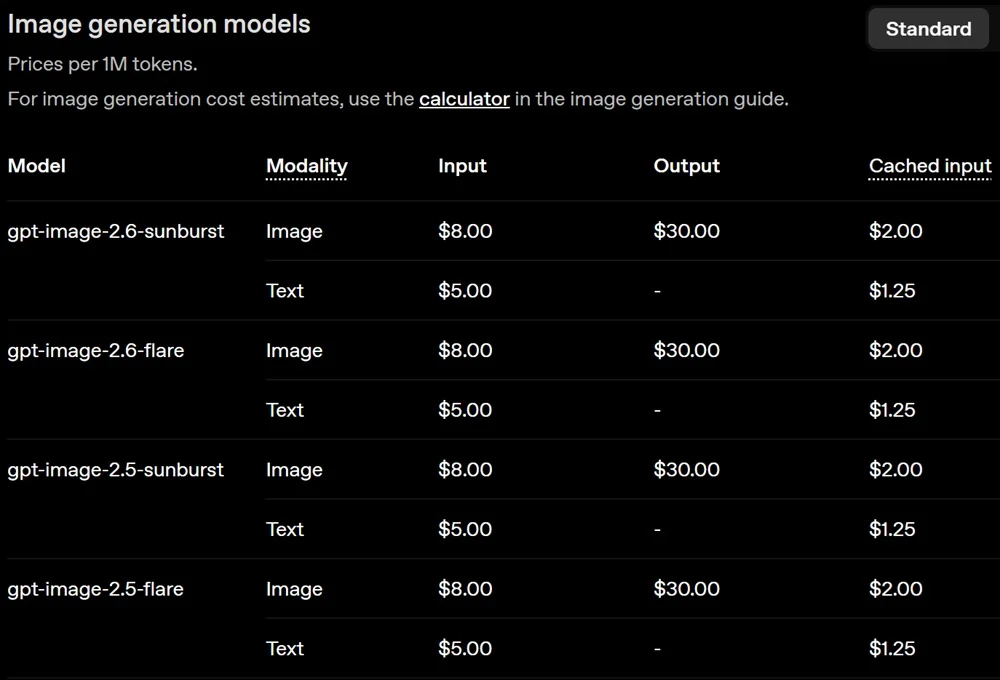
For developers, the cost structure remains a vital consideration. By offering distinct pricing tiers for Flare and Sunburst, OpenAI allows companies to optimize their spend based on their specific output needs—using Flare for high-volume, low-margin tasks and Sunburst for premium, creative-heavy projects. The inclusion of "Batch API" pricing further signals a push into enterprise-grade, bulk-processing workflows.
Official Responses and Strategic Vision
OpenAI has framed the release of Images 2.6 not merely as a feature update, but as a commitment to "Responsible Innovation."
In a statement accompanying the launch, the company emphasized the importance of provenance. As deepfakes and AI-generated misinformation become global concerns, OpenAI has doubled down on its commitment to C2PA (Coalition for Content Provenance and Authenticity) metadata. By embedding this metadata alongside Google DeepMind’s SynthID invisible watermarking, OpenAI is attempting to set an industry standard for digital transparency.
"We recognize that with the power to animate and generate comes the responsibility to safeguard," an OpenAI spokesperson noted. The company highlighted that while its safety systems for static images are mature, GIF generation required a new set of "motion-aware" safeguards. These systems are designed to identify harmful, sexualized, or violent motion patterns that static moderation tools might miss.
Implications: The Future of Work and Creativity
The release of Images 2.6 has profound implications for several industries.
1. The Death of the Placeholder
Startups like Town, which is currently leveraging the Images 2.6 API to build AI work assistants, represent the future of interface design. Instead of static icons or generic stock photos, enterprise software will soon feature dynamic, AI-generated characters that respond to the user’s workflow. This "living UI" could fundamentally change how humans interact with software.
2. Democratizing Motion Design
By allowing users to create GIFs from simple sketches or text prompts, OpenAI is effectively lowering the cost of entry for motion design. Small business owners, social media managers, and indie developers can now generate animated storyboards and social media reactions without the need for expensive software like Adobe After Effects or professional animation teams.

3. The Ethical Tightrope
Despite the advancements, OpenAI acknowledges the limitations of its safeguards. The admission that "motion-related violations remain difficult to detect" serves as a reminder that AI development remains a reactive field. As the technology moves into the realm of video (via potential future releases), the pressure on OpenAI to refine these safety filters will only intensify.
4. The War on Misinformation
The integration of SynthID and C2PA is a defensive posture. By ensuring that its images carry a "digital fingerprint," OpenAI is positioning itself as a leader in "Verified AI." This is a strategic move to gain trust from publishers, news organizations, and government entities that might otherwise be hesitant to adopt generative AI tools due to fears regarding provenance and copyright.
Conclusion: A New Baseline
OpenAI’s Images 2.6 is more than a speed upgrade; it is a declaration that the company is ready to support high-scale, professional-grade animation and design. By balancing the raw performance of the Flare model with the nuanced quality of the Sunburst model, OpenAI has provided a flexible toolset that appeals to both the quick-turnaround requirements of social media and the high-fidelity needs of professional designers.
As we move into 2027, the focus will likely shift from whether AI can generate images to how those images can be verified, integrated, and scaled within the global economy. With 500 million images currently being generated daily, the world is witnessing the largest visual experiment in human history. OpenAI, through its commitment to safety, speed, and provenance, is clearly intending to steer the trajectory of this experiment toward a more structured and transparent future.
Whether this technology ultimately replaces professional designers or serves as the ultimate "force multiplier" for their creative output remains the defining question of the next year. For now, Images 2.6 has set a new, higher baseline for the industry, ensuring that the gap between human imagination and digital execution continues to shrink.