






In an era where the internet serves as the primary gateway to commerce, healthcare, and civic life, the digital world is increasingly becoming a fractured landscape. While technology has advanced at breakneck speed, a significant portion of the global population—1.3 billion people living with disabilities—remains sidelined by websites and applications that are fundamentally unusable for them.
As legal pressures mount and the global economy shifts toward more inclusive digital standards, companies are facing a critical inflection point. AudioEye, a leader in the digital accessibility space, is at the forefront of this movement. By bridging the gap between automated artificial intelligence and human expertise, the company is redefining how businesses approach the "inclusive web."
The Mission: Redefining the Default
At the heart of AudioEye’s operations is a core philosophy: accessibility should not be an afterthought or a reactive scramble to avoid a lawsuit. It should be the default state of the internet.
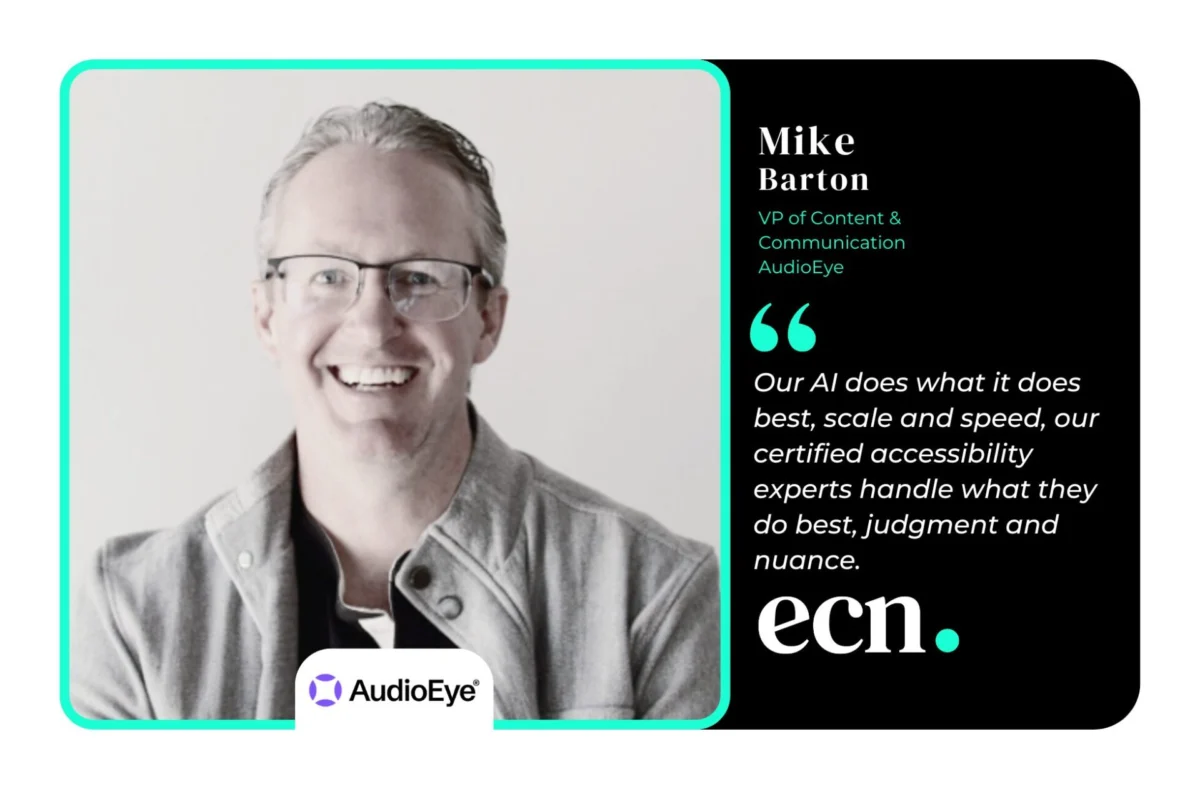
Mike Barton, VP of Content Marketing and Communications at AudioEye, explains that the company’s mission is to provide the most cost-effective and robust accessibility protection in the industry. "Our vision is bigger than just compliance," Barton says. "We envision a digital world where accessibility is a foundational element of web design. Today, we support over 127,000 organizations in ensuring their digital experiences remain open to everyone."
A Two-Decade Evolution: From Niche to Necessity
The journey of digital accessibility has been long and often overlooked. When AudioEye was founded nearly twenty years ago, accessibility was viewed as a peripheral concern—a "checkbox" activity for a handful of organizations.
However, the landscape has shifted dramatically in the last five years. Several factors have converged to bring accessibility to the boardroom:
- Surging Litigation: In the United States, the number of digital accessibility lawsuits has doubled since 2020.
- Global Regulation: The implementation of the European Accessibility Act (EAA) has extended the reach of compliance requirements across borders, forcing international businesses to standardize their digital offerings.
- The AI Revolution: As AI changes how websites are constructed and how content is discovered, the structural integrity of a site—its "accessibility tree"—is becoming as important for SEO as it is for human users.
Through this evolution, AudioEye has refined its strategy. While many competitors have pivoted toward purely automated "quick fixes," AudioEye has doubled down on a hybrid model. "Automation is how you scale, but human expertise is how you get it right," Barton notes. By combining high-speed AI scanning with the nuanced judgment of certified accessibility experts, AudioEye has created a framework that addresses both the breadth and the depth of the challenge.
Digital Accessibility: Defining the Stakes
For the uninitiated, digital accessibility is the practice of designing digital content—websites, apps, and software—to be navigable by all, including those relying on assistive technologies like screen readers.
For businesses, the argument for accessibility has shifted from a moral imperative to a hard-nosed business strategy. The data is compelling:
- Spending Power: People with disabilities represent an estimated $18 trillion in global spending power.
- Customer Retention: Research indicates that seven out of ten users with disabilities will abandon a website if it does not accommodate their needs.
- Loyalty: Once a user with a disability finds a site that is accessible and welcoming, they are significantly more likely to become repeat customers.
Ignoring these users is not just a social oversight; it is a direct leakage of revenue and a failure to capture a massive market segment.
The Hybrid Engine: How the Platform Works
AudioEye’s platform functions as an active, real-time layer on top of a client’s digital infrastructure. It operates through a single line of JavaScript, ensuring that the integration process is frictionless for development teams.
Once deployed, the platform performs a dual-layer function:
- Automated Detection and Resolution: The AI scans the site against Web Content Accessibility Guidelines (WCAG) standards. According to a 2026 study by Adience, AudioEye’s AI detects up to 2.5 times more issues than competing solutions, automatically resolving roughly half of them in real-time.
- Human-in-the-Loop Validation: Because AI cannot grasp intent, context, or the emotional experience of navigating a site, certified specialists—including people with disabilities—perform manual audits. These experts deploy custom fixes that address the "gray areas" that software often misses.
This methodology ensures that approximately 97% of issues are resolved before a company’s internal development team even needs to intervene, allowing developers to focus on product innovation rather than repetitive patching.
Legal Protection and the "Courtroom Dismissal"
Perhaps the most pressing concern for many enterprises is the threat of litigation. AudioEye differentiates itself here by providing more than just software; it provides a defensive shield.
"We are the only vendor with a documented courtroom dismissal," Barton explains. "We provide an expert debunk report and work directly with legal counsel when a claim arrives. We aren’t selling a warranty; we are providing a standard of protection that is 300 to 400 percent higher than our competitors."
By ensuring that compliance is a continuous byproduct of the work rather than a one-time audit, AudioEye helps businesses stay ahead of the regulatory curve, whether it is the Americans with Disabilities Act (ADA) in the U.S. or the EAA in Europe.
The Future: AI, Discovery, and the Universal Web
As we look toward the future, the conversation around accessibility is becoming inextricably linked to the evolution of Artificial Intelligence.
There is a paradoxical challenge emerging: while AI can fix accessibility, the proliferation of general-purpose AI coding tools is also generating a new wave of inaccessible websites, trained on the non-inclusive patterns of the past. AudioEye views this as their next great frontier.
"AI agents are now navigating the web on behalf of users," Barton explains. "These agents read a site’s accessibility tree to find products and information. If your site isn’t accessible, you are effectively invisible to the next generation of AI-driven discovery."
Conclusion: A Moral and Economic Mandate
The trajectory of the digital world is clear: the internet of the future will be either inclusive or irrelevant. Companies that view accessibility as a growth engine—a way to reach more customers, reduce legal risk, and prepare for the age of AI-driven discovery—will define the market leaders of the next decade.
AudioEye’s mission—to ensure the internet works for everyone—is no longer just a noble goal; it is a strategic necessity. As the digital landscape continues to evolve, the bridge between human expertise and automated intelligence will be the architecture upon which a more equitable and efficient digital world is built.