Transforming Cloud Security: AWS Launches ‘Continuum’ to Automate Code Vulnerability Discovery, Validation, and Remediation
SEATTLE — In an era where generative artificial intelligence has dramatically lowered the barrier for malicious actors to weaponize software flaws within minutes of public disclosure, enterprise security teams face an unprecedented deluge of alerts. Modern vulnerability scanners routinely inundate application owners with thousands of findings daily—many of which prove unreachable, completely unexploitable, or already neutralized by existing runtime controls.
To combat this "alert fatigue" and bridge the widening gap between vulnerability discovery and software patching, Amazon Web Services (AWS) has officially announced the general availability of AWS Continuum for code vulnerabilities.
Designed to fundamentally reshape application security, AWS Continuum goes far beyond traditional static analysis. By intelligently synthesizing context from both source code repositories and live cloud infrastructure, the service identifies true security threats, isolates and tests exploits in sandboxed environments, ranks risks based on actual business impact, and automatically generates targeted remediation patches delivered directly as repository pull requests.
Main Facts
AWS Continuum for code vulnerabilities is a comprehensive cloud-native security orchestration and remediation service. Its core value proposition lies in replacing raw, unvetted scanner data with high-certainty, context-aware intelligence.
Dual-Context Graph Engine: Continuum constructs a dynamic relationship graph by ingesting data from connected code repositories (such as GitHub or Amazon S3 buckets) and live AWS environments (via AWS Config and network topology collectors). This allows the service to understand service dependencies, data sensitivity, asset ownership, and network reachability.
Automated Exploit Validation: Rather than relying solely on generic severity scores (such as CVSS ratings that treat a development utility identically to a production payment gateway), Continuum verifies whether a flaw is genuinely exploitable. For reproducible vulnerabilities, it executes exploits in an isolated sandbox, providing concrete proof-of-concept data, source analysis, and exact attack paths.
Direct Pull Request Remediation: For every confirmed vulnerability, Continuum formulates a precise fix—whether a code patch, dependency upgrade, or configuration modification—and pushes it as a ready-to-review pull request directly into the connected code repository.
Human-in-the-Loop Governance: Every remediation strictly adheres to a human-approval model at launch. Security and development teams retain total control, reviewing and merging patches within their standard workflows. Future iterations will introduce configurable guardrails allowing trusted, highly tested remediation classes to apply automatically.
Initial Availability: AWS Continuum is available starting today in the US East (N. Virginia) and US West (Oregon) AWS Regions, with tiered pricing models detailed on the official AWS Continuum pricing portal.
Chronology: The Evolution of Cloud Security Automation
The release of AWS Continuum is the culmination of years of iterative development in cloud security posture management (CSPM), application security testing (AST), and AI-driven workflow automation.
Phase 1: The Scanner Boom and Alert Fatigue (Late 2010s – Early 2020s)
As organizations migrated massive application estates to the cloud, the adoption of shift-left security tools—including Static Application Security Testing (SAST), Software Composition Analysis (SCA), and Dynamic Application Security Testing (DAST)—skyrocketed. While these tools successfully caught vulnerabilities early, they generated an unmanageable volume of noise. Security engineers spent countless hours manually vetting alerts, trying to determine if a reported vulnerability in an obscure library could actually be reached by an external threat actor.
Phase 2: The Generative AI Threat Acceleration (2023 – 2025)
The threat landscape shifted dramatically with the widespread availability of advanced frontier artificial intelligence models. Threat actors weaponized these AI tools to transform theoretical vulnerability disclosures into working, scalable exploit code in a matter of minutes. Traditional security patching cycles—which historically took days or weeks of cross-team coordination between security, infrastructure, and application development groups—became dangerously slow compared to the velocity of automated cyberattacks.
Phase 3: Context-Aware Remediation and the Birth of Continuum (2026)
Recognizing that scoring systems alone were insufficient, AWS engineering teams conceptualized a service that could marry static code intelligence with live runtime context. By analyzing how code executes within a real-world AWS environment, AWS developed Continuum to calculate the true "blast radius" of a security flaw. Following extensive internal testing and preview phases, AWS officially rolled out Continuum for general availability in October 2026, marking a paradigm shift from passive vulnerability reporting to active vulnerability remediation.
Supporting Data and Technical Architecture
The technical sophistication of AWS Continuum relies on several deeply integrated components that operate seamlessly within the AWS Management Console and external version control systems.
1. Environment Setup and Context Gathering
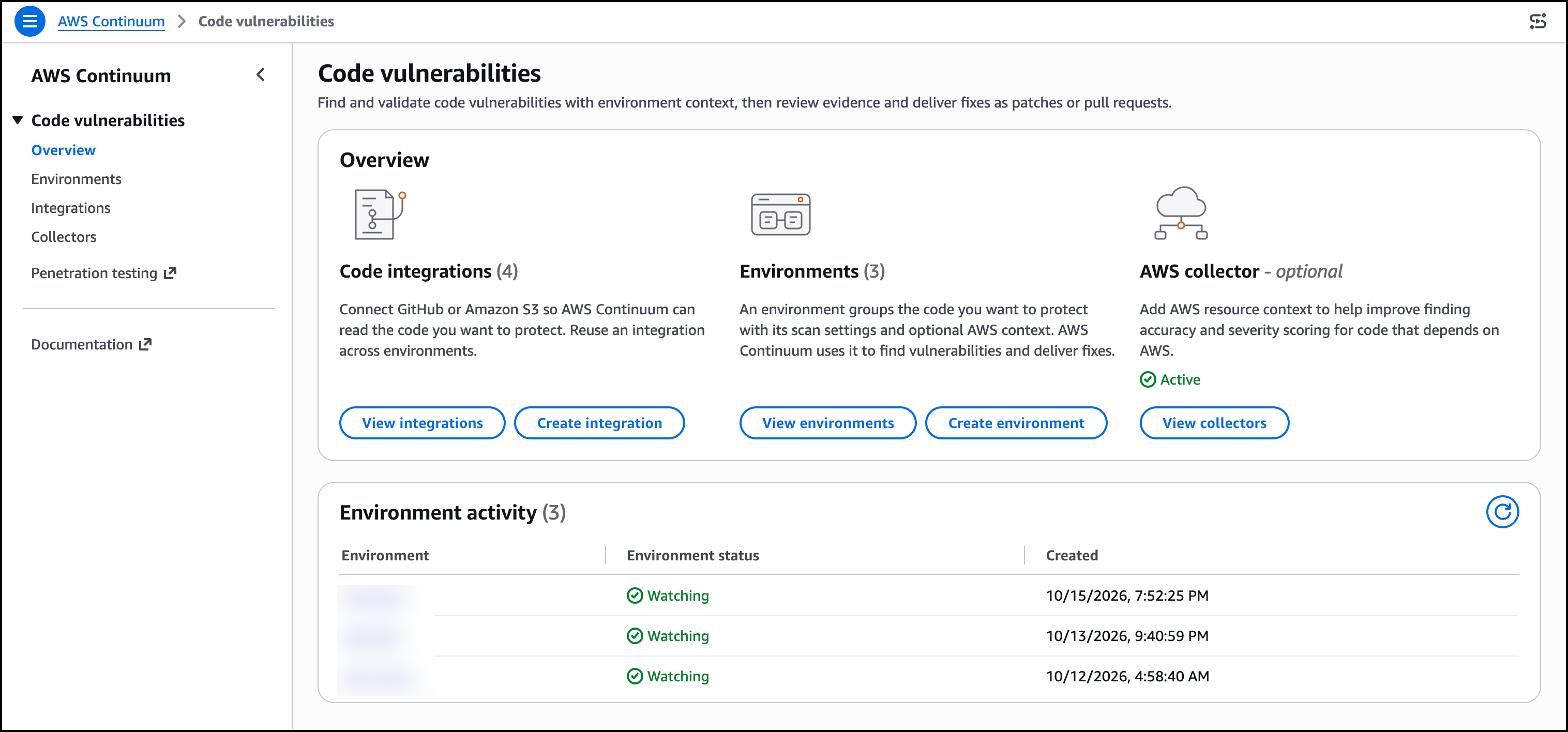
To utilize AWS Continuum, administrators begin by configuring code sources. Integrations can be established directly with GitHub or via Amazon S3 buckets residing in the same AWS account and region where Continuum is activated, securely accessed through dedicated AWS Identity and Access Management (IAM) roles.
To achieve full contextual awareness, organizations deploy an AWS Continuum collector. This collector taps into AWS Config and network configuration telemetry, mapping out:
Network reachability (determining whether a service is exposed to the public internet or isolated within a private VPC).
Service dependencies and data flows (identifying proximity to high-value assets such as customer data stores, authentication services, and payment pipelines).
Resource ownership and business-criticality ratings.
2. The Anatomy of a Validated Finding
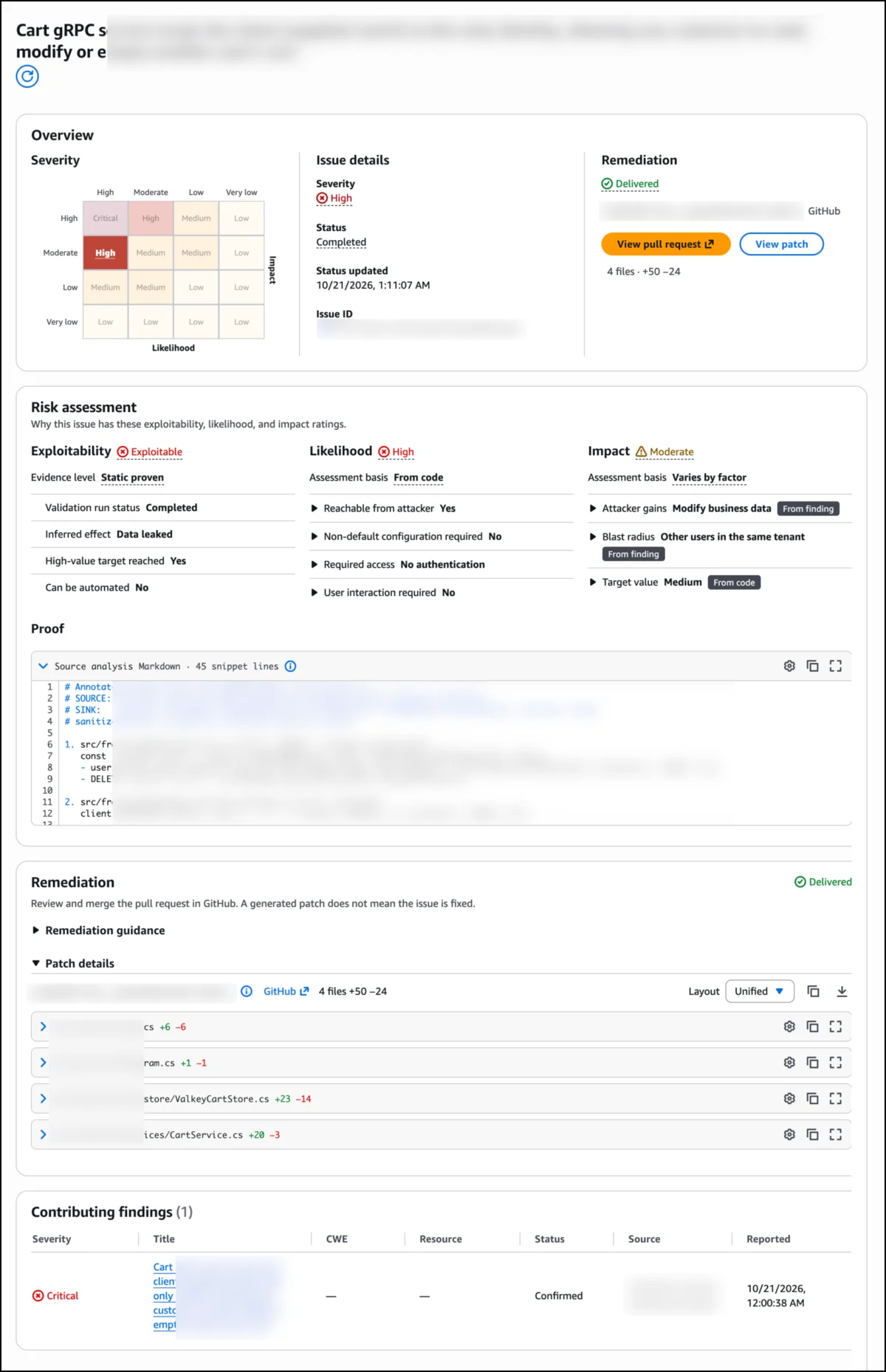
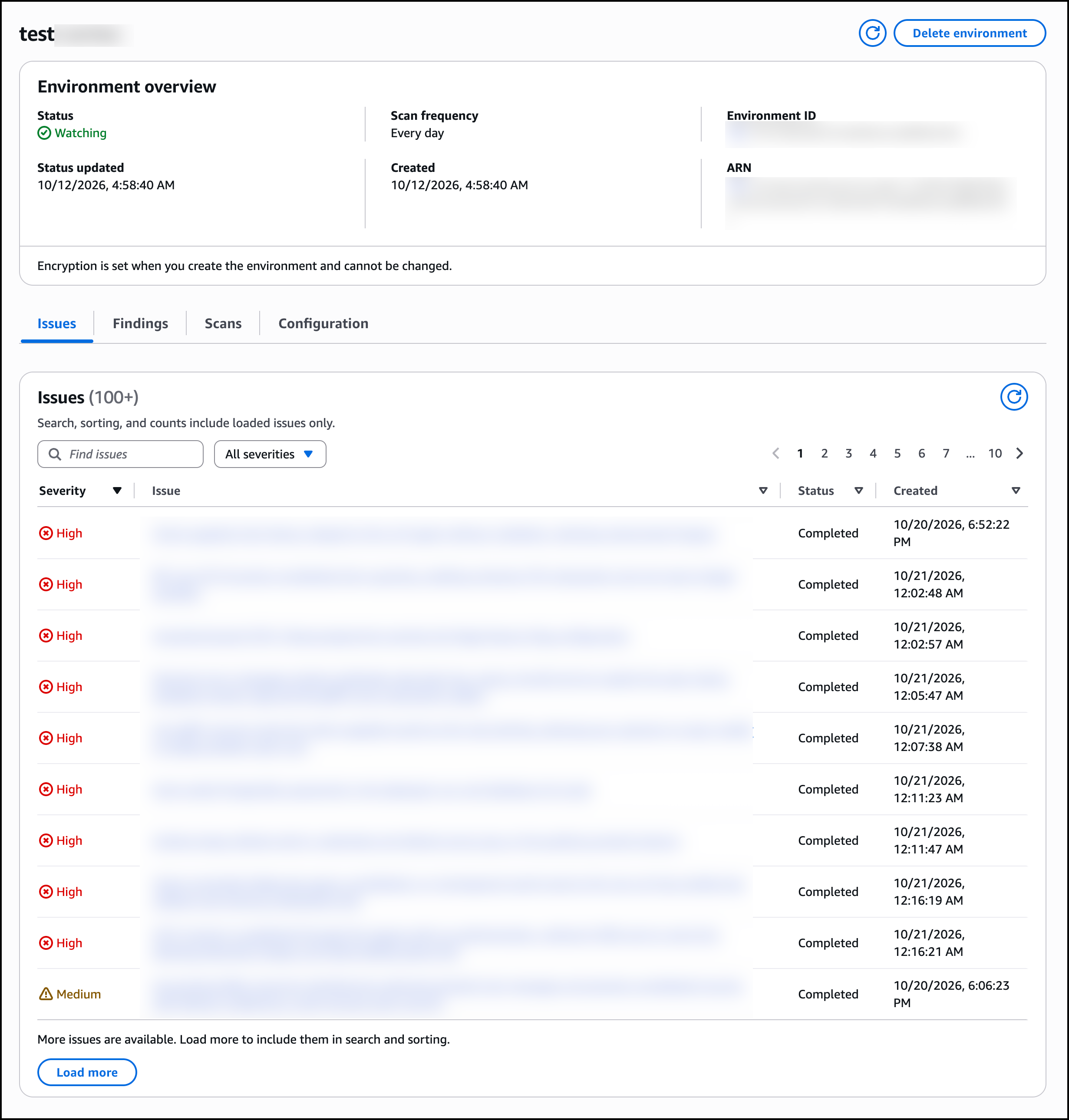
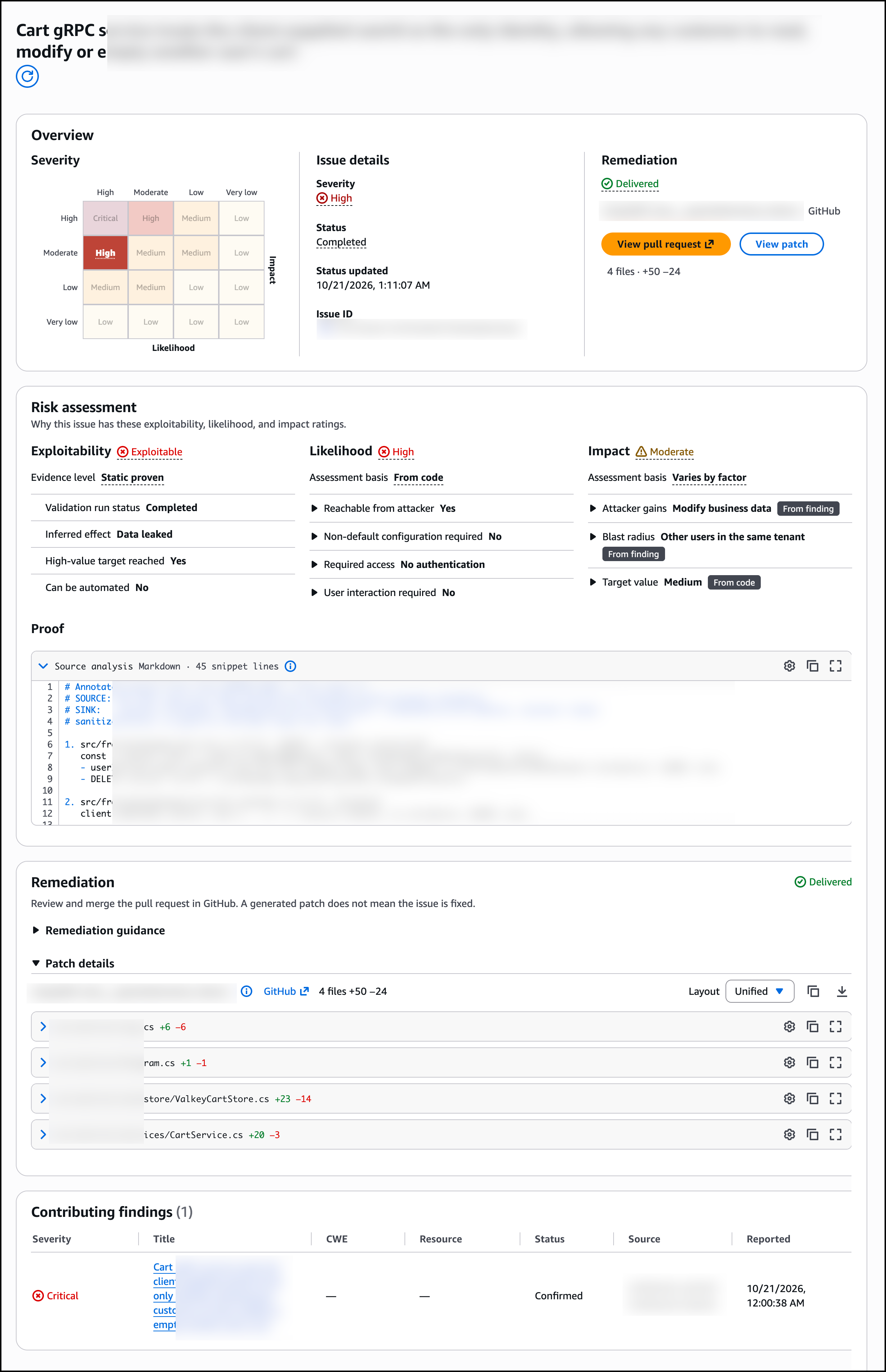
When a scan completes, the Continuum console shifts focus from raw scanner outputs to a prioritized Issues tab. Each issue provides a multidimensional risk assessment:
Exploitability & Evidence Level: Rated through static proven analysis or dynamic sandbox execution (e.g., confirming if a vulnerability requires zero authentication and no user interaction).
Likelihood & Impact: Evaluates the attacker’s path, potential data modification capabilities, and tenant-wide blast radius.
Proof & Source Analysis: Supplies the exact reproduction steps, proof-of-concept code, and supporting code paths directly inside the console and the associated GitHub pull request.
3. Streamlined Pull Request Workflow
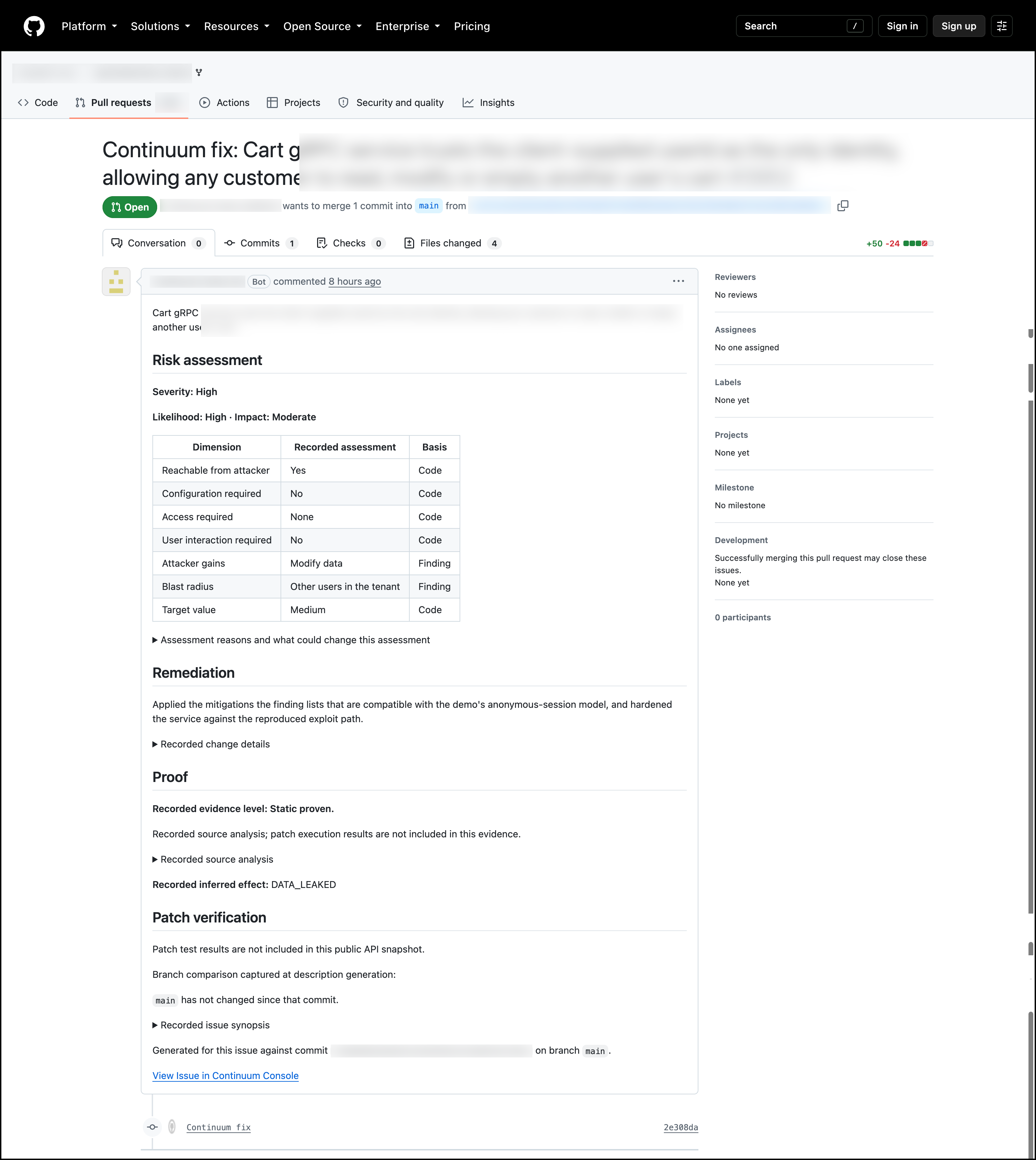
In practice, a developer or security engineer managing a cart service vulnerability might see a High-severity finding marked as "Exploitable." Instead of manually writing a patch, they find that Continuum has already generated a pull request titled "Continuum fix" modifying the necessary files (e.g., adding 50 lines and removing 24 across four files).
The pull request description mirrors the rich risk assessment, remediation summary, and proof data found in the AWS console. Reviewers can evaluate the evidence, test coverage, and code changes entirely within their native GitHub workflow before executing the merge.
Official Responses and Industry Perspectives
AWS leadership and industry analysts have emphasized that Continuum represents a necessary evolution in how enterprises defend their software supply chains.
"In today’s threat landscape, speed is everything. When bad actors can weaponize a CVE in minutes using AI, security teams cannot afford to spend days manually investigating whether a vulnerability is reachable," noted security engineering spokespeople during the launch. "AWS Continuum bridges the gap between discovery and remediation by providing mathematical proof of exploitability while keeping engineers firmly in the driver’s seat via trusted pull requests."
Early enterprise adopters participating in initial rollouts have echoed these sentiments, highlighting the dramatic reduction in mean time to remediate (MTTR). By eliminating false positives and unreachable findings—which often account for over 50% of raw scanner outputs—security personnel can redirect their focus toward architectural hardening and complex threat hunting.
Furthermore, compliance and governance advocates have praised the human-in-the-loop design. By ensuring that every automated patch must pass through standard human code-review and merge gates, AWS has balanced the urgency of automated defense with the rigorous quality control required in enterprise software deployment.
Implications for the Future of Application Security
The commercial release of AWS Continuum signals profound long-term implications for software development life cycles (SDLC) and the cybersecurity job market.
1. The Redefinition of Vulnerability Management
Traditional Vulnerability Management (VM) and Application Security Posture Management (ASPM) tools have historically focused on inventorying risks. Continuum redefines the category as Autonomous Remediation Management. By connecting code analysis directly to infrastructure runtime context and automated patch generation, the metric that matters shifts away from how many vulnerabilities were found toward how quickly verified risks were safely closed.
2. Evolving Roles for Security and Development Teams
As automated tools like Continuum assume the heavy lifting of exploit verification and patch drafting, the roles of security engineers and developers are evolving:
Security Engineers transition from triage clerks—sorting through thousands of ambiguous alerts—to governance architects who define safety guardrails, confidence gates, and risk thresholds.
Developers spend less time decoding obscure CVE write-ups and writing boilerplate security patches, shifting instead toward reviewing context-rich, pre-tested pull requests that integrate smoothly into their daily coding pipelines.
3. The Road Ahead: Autonomous Guardrails
While AWS Continuum currently operates strictly under human supervision—requiring manual review and merging of every proposed pull request—AWS has signaled a clear roadmap toward fully autonomous remediation.
In future updates, organizations will be empowered to establish strict automated confidence gates. Once a class of remediation (such as routine dependency upgrades or specific input validation patches) achieves a proven historical success rate, meets rigorous automated test coverage thresholds, and operates within strict scope bounds, Continuum will be authorized to apply fixes autonomously without human intervention.
Conclusion
As cloud environments grow increasingly complex and cyber adversaries leverage artificial intelligence to accelerate attacks, static defenses are no longer enough. With AWS Continuum for code vulnerabilities, AWS has delivered a powerful, context-driven solution that cuts through alert noise, proves real-world risk, and streamlines code repair—marking a monumental step forward in proactive cloud security.