







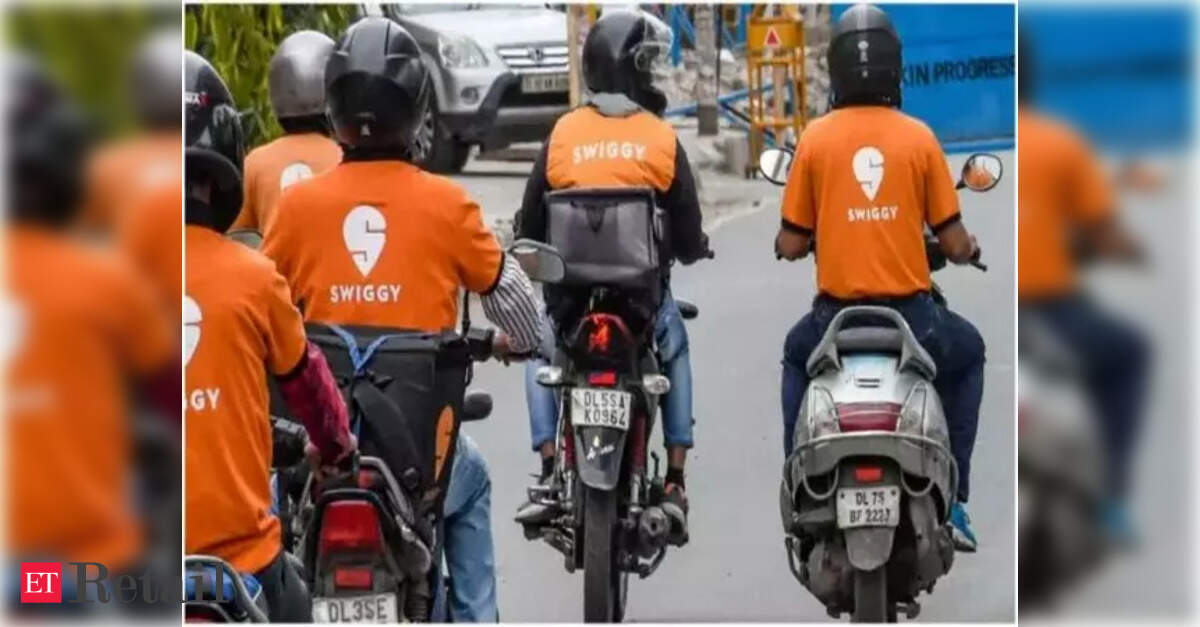
The euphoria surrounding Swiggy’s public listing has met a harsh reality check. In a brutal trading session on Friday, shares of the food delivery and quick commerce giant plummeted by 15%, closing at ₹179.65 on the BSE. This sharp correction wiped out approximately ₹9,000 crore in market capitalization, signaling a growing investor fatigue regarding the company’s aggressive, loss-making expansion into the quick commerce sector, Instamart. While Swiggy’s core food delivery business remains a robust cash generator, the narrative has been hijacked by the ballooning losses and unclear path to profitability for its grocery-delivery arm.
The Market Reaction: A Cascade of Downgrades
The selloff was not merely a reaction to intraday price action but a calculated response from the institutional investor community. Following the release of Swiggy’s Q2 financial results, a wave of brokerage houses—including JM Financial, Nuvama, Nomura, and Emkay Global—slashed their target prices, citing concerns over execution, capital allocation, and the sustainability of the quick commerce model.
JM Financial, taking a particularly bearish stance, maintained a "REDUCE" rating and aggressively cut its price target from ₹255 to ₹200. Nuvama echoed this sentiment, trimming its target to ₹200. Even the more optimistic Nomura, which retained a "BUY" rating, was forced to adjust its target downward from ₹435 to ₹300, while Emkay Global moved its target to ₹310 from ₹350. The consensus is clear: the market is no longer willing to subsidize growth at the cost of unit economics.
Chronology: From Growth Hype to Profitability Pressure
Swiggy’s journey over the last quarter has been defined by a frantic race to scale. The company added 69 new dark stores during the quarter, expanding its network to 1,240 locations. While management argued this expansion was necessary to capture market share, the financial data told a different story.
- Q2 Disconnect: Despite a 13.4% sequential growth in Net Order Value (NOV), Instamart’s contribution margin deteriorated from a negative 0.3% in the previous quarter to a negative 1.4%.
- The Loss Spiral: Adjusted EBITDA losses for Instamart widened significantly, climbing from ₹778 crore to ₹895 crore.
- Operational Intensity: While orders per dark store showed a slight improvement—rising to 1,192 from 1,089—analysts were quick to point out that this growth was heavily fueled by aggressive, high-cost marketing and promotional spending rather than organic demand.
For the market, the timeline of profitability has become a moving target. Investors are now questioning whether the "blitzscaling" strategy employed by Swiggy is sustainable in an environment where capital is no longer cheap and shareholders demand fiscal discipline.
Supporting Data: The Anatomy of the Deficit
To understand the investor backlash, one must look at the granular breakdown of Swiggy’s business units. The contrast between the core food business and the experimental ventures is stark.
The Cash Cow: Food Delivery
Swiggy’s food delivery segment continues to perform as a reliable engine. The Gross Order Value (GOV) for this segment grew 17.7% year-on-year to ₹10,054 crore. More importantly, the adjusted EBITDA rose 42% year-on-year to ₹341 crore, with margins expanding from 2.8% to 3.4%. Nomura’s analysts emphasize that this segment is a "cash cow" capable of generating upwards of ₹1,300–1,900 crore in EBITDA by FY27-FY28.
The Drain: Instamart and Platform Innovations
The problems lie in the ancillary businesses. Instamart’s unit economics have failed to show the required leverage, even as volume grows. Furthermore, Swiggy’s "Platform Innovations" division, which includes the experimental "Toing" service, saw its losses widen to ₹162 crore from ₹131 crore.
JM Financial has been particularly vocal about the "zero rationale" behind Toing, noting that it cannibalizes resources and overlaps with existing infrastructure without providing clear, incremental value. The brokerage suggests that Swiggy would be better served by shuttering these distractions and focusing entirely on the core food and grocery delivery battle.
Official Responses and Management Outlook
Swiggy’s management has attempted to calm investors by framing the current losses as a "peak" period of investment. Executives have stated that the business could reach a break-even point once it hits 2.3 times its current scale, translating to an annualized NOV of approximately ₹6,000 crore, up from the current ₹2,600 crore.
Furthermore, management estimates that a contribution of ₹30 per order is the magic number required to turn the tide. However, this forward-looking guidance has been met with skepticism. Analysts at JM Financial described the Q2 performance as "Instamart: Losses delivered instantly," and explicitly stated they remain "unconvinced about any real path to profitability in the foreseeable future," citing what they termed "continued poor execution."
Competitive Implications: The Zomato/Eternal Divergence
The most alarming factor for Swiggy shareholders is the widening performance gap between Swiggy and its primary rival, Zomato (referred to as "Eternal" in some brokerage notes).

- Food Delivery: While Swiggy grew its food GOV by 17.7% YoY, Zomato/Eternal reported 21.5% growth in NOV.
- Quick Commerce: Swiggy’s Instamart NOV rose 13.4% sequentially, whereas the competitor saw a 22.2% jump in the same metric.
This divergence suggests that Swiggy is not only spending more to acquire customers but is also losing ground in its core food delivery business. The market is increasingly concerned that Swiggy is trapped in a "catch-up" cycle—spending heavily to close the gap in quick commerce while simultaneously losing its competitive edge in the food delivery market that sustains the entire ecosystem.
Future Outlook: The Path to Investor Confidence
For Swiggy to regain the trust of the street, analysts suggest a pivot from growth-at-all-costs to a focus on sustainable unit economics. Emkay Global, while maintaining a balanced view, noted that the company must demonstrate:
- Sustained Double-Digit Sequential Growth: Growth must be consistent and organic.
- Customer Retention: Improving the Lifetime Value (LTV) of customers rather than relying on discounts.
- Monetization: Better utilization of dark stores and delivery networks to lower the cost per delivery.
Until these metrics show tangible improvement, the valuation of the quick commerce business will remain under pressure. Investors are no longer rewarding "potential"; they are demanding "proof."
Conclusion
Swiggy finds itself at a critical juncture. The transition from a food-first company to a multi-category, quick-commerce-led platform is proving to be a high-stakes gamble. The Q2 results have served as a wake-up call, proving that the market’s patience with "experimental" losses is finite. As the company moves into the next two quarters, the pressure will be on management to rationalize costs, consolidate their experimental services, and prove that Instamart can move from a cash-burner to a self-sustaining profit center. Failure to do so may result in further valuation erosion, forcing Swiggy to reconsider its aggressive, expansionist strategy in an increasingly unforgiving market.