










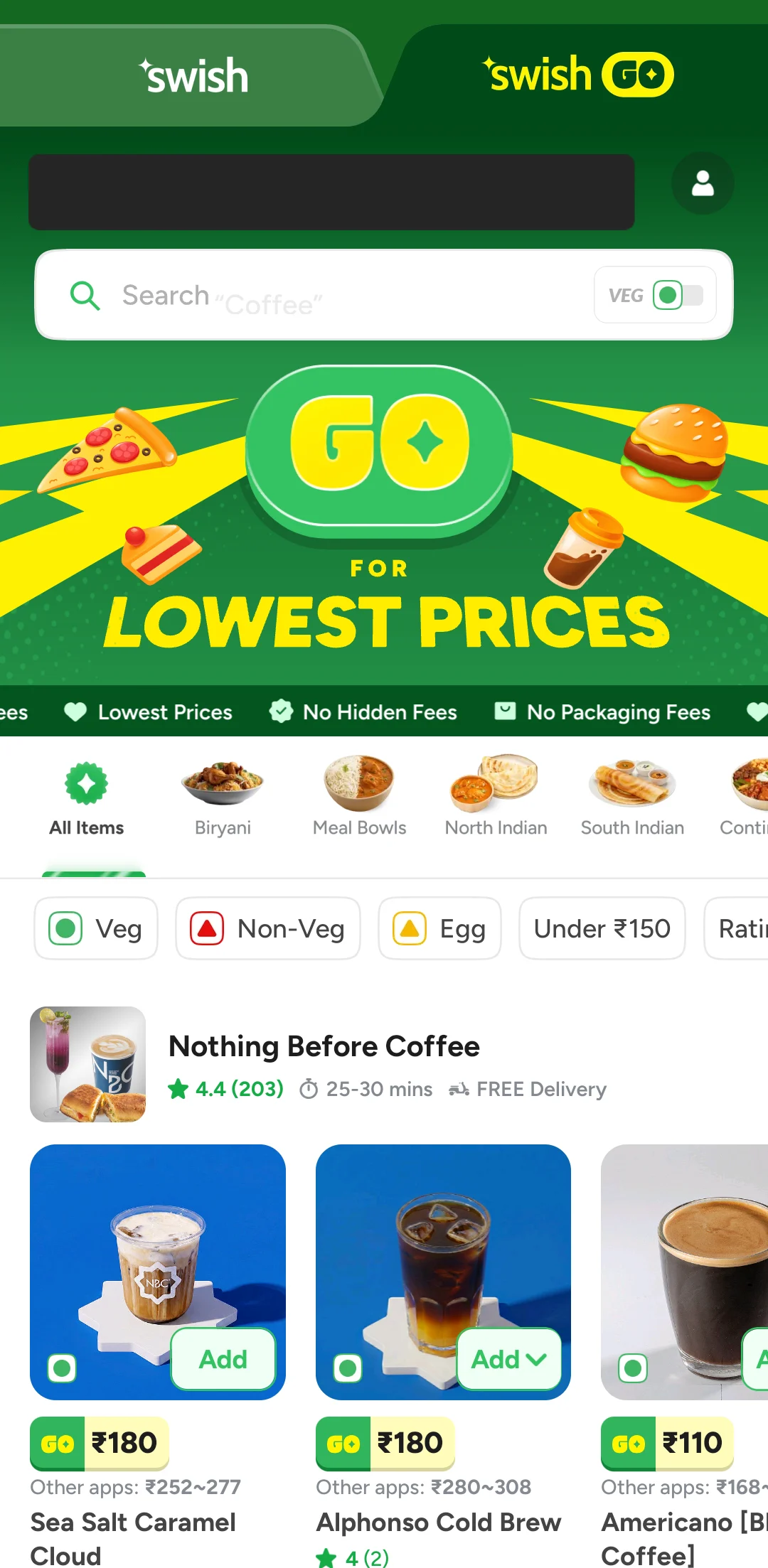
BENGALURU — In a strategic shift that marks a major milestone in its two-year operational history, quick food delivery startup Swish is expanding beyond its proprietary kitchen network. The company has quietly rolled out Swish Go, a new feature on its application that facilitates food delivery from external, third-party restaurants and cloud kitchens.
This development signals a significant divergence from the full-stack, vertically integrated model that defined Swish since its inception. Previously, customers could only order meals prepared in kitchens owned, operated, and managed directly by the startup. By opening its platform to external food service operators, Swish is stepping into the traditional aggregator territory currently dominated by industry behemoths like Zomato and Swiggy.
The launch of Swish Go also underscores the rapidly evolving landscape of Indian quick-commerce and food tech, where companies are constantly experimenting with hybrid fulfillment models, ultra-fast delivery windows, and aggressive pricing strategies to capture consumer loyalty.
Chronology and Rollout: From In-House Kitchens to Open Aggregation
Founded in 2024 by Aniket Shah, Ujjwal Sukheja, and Saran S., Swish burst onto the scene with a clear value proposition: ultra-fast, 15-minute food delivery. To maintain strict quality control and guarantee these rapid delivery turnaround times, the startup adopted a strictly full-stack operational model. Under this setup, Swish operated its own cloud kitchens, managing everything from recipe formulation and cooking to final delivery via its logistics network.
Over the past two years, this approach helped the startup scale its presence to nearly 50 pin codes across major urban centers, including Bengaluru, Gurugram, Noida, Delhi, and Ghaziabad.
However, scaling a 15-minute, full-stack model requires immense capital expenditure and operational oversight. Recognizing the limitations of relying solely on proprietary kitchens for exponential growth, Swish began developing Swish Go.
The new service is currently being piloted in select pin codes across Bengaluru. Early iterations of the app show that Swish has already onboarded several popular Quick Service Restaurant (QSR) brands and cloud kitchens, including Nothing Before Coffee, Mealy, and Taaka Chinese.
Unlike the core Swish app, which prides itself on a rigid 15-minute fulfillment window, Swish Go does not guarantee ultra-fast delivery. Orders placed through the new feature are expected to take longer to arrive, mirroring the standard delivery timelines of conventional aggregators.
Supporting Data and Financial Backing
Swish’s pivot comes on the back of aggressive fundraising rounds that have cemented its status as a rising star in the Indian startup ecosystem. To date, the startup has raised approximately $78 million in external funding from prominent venture capital firms and institutional investors, including Hara Global, Bain Capital Ventures, Accel, Alteria Capital, and Stride Ventures.
Most recently, Swish secured $24 million in a funding round led by Bertelsmann India Investments, funds that are now visibly being deployed toward diversifying its product offerings and expanding its logistics network.

Despite these financial cushions, the path of ultra-fast food delivery has proven treacherous for the broader industry:
- The Collapse of SNACC: Earlier this year, food delivery giant Swiggy pulled the plug on its 15-minute food delivery experiment, SNACC, reportedly due to severe economic headwinds and thin margins.
- The Exit of Zing: Similarly, Delhi-NCR-based quick-food startup Zing was forced to shut its doors entirely, with founders acknowledging that they had vastly overestimated consumer demand for hyper-accelerated food delivery.
While competitors struggled with the economics of ultra-fast delivery, Swish’s vertically integrated model was initially heralded as a potential antidote. However, by launching Swish Go, the startup acknowledges that capturing a larger share of the wallet requires tapping into the vast, established ecosystem of independent restaurants rather than competing with them through proprietary kitchens alone.
Competitive Landscape: Taking on Swiggy’s Toing and Rapido’s Ownly
The most striking aspect of Swish Go is its aggressive pricing strategy. The service is being heavily marketed as a zero-packaging-fee and zero-platform-fee offering. This transparent, low-cost positioning places Swish Go in direct competition with a new wave of alternative food delivery initiatives designed to undercut traditional aggregator commissions:
- Rapido’s Ownly: Mobility startup Rapido made waves by launching Ownly, a service aimed squarely at restaurant owners frustrated by the high take rates and commissions charged by legacy giants like Zomato and Swiggy. Ownly operates on a zero-commission model, passing direct cost savings down to the consumer.
- Swiggy’s Toing: In response to margin pressures and the rising popularity of low-cost alternatives, Swiggy launched Toing to expand the overall food-delivery market. Toing focuses on affordability without relying on deep, unsustainable discounting. Instead, it achieves lower costs by reducing merchant commissions, bundling orders in batches, and restricting the delivery radius.
By positioning Swish Go with zero platform and packaging fees, Swish is entering this exact fray—banking on cost-conscious consumers who are increasingly fatigued by the mounting stack of hidden service charges, surge pricing, and packaging fees levied by traditional platforms.
Official Responses and Stakeholder Stance
As of press time, Swish has not officially commented on the long-term roadmap for Swish Go or whether the pilot will soon be scaled to its other active markets in the National Capital Region (NCR). Inc42 has reached out to the startup’s leadership team with detailed inquiries regarding the platform commission structure for onboarded vendors, logistics integration, and future expansion plans. This report will be updated as soon as an official response is received.
Strategic Implications and Future Outlook
Swish Go represents a fascinating evolutionary step for a startup that was once defined entirely by its rejection of the traditional aggregator model. By bridging the gap between its lightning-fast proprietary kitchen model and a flexible third-party marketplace, Swish is transforming into a multi-tiered food tech player.
1. Diversification of Revenue Streams
Relying solely on in-house kitchens caps a company’s culinary variety. By integrating third-party QSRs and local cloud kitchens, Swish instantly broadens its menu catalogue, making the app sticky for a wider demographic of users who want variety alongside speed.
2. Navigating Unit Economics
The absence of platform and packaging fees on Swish Go suggests that the company is absorbing initial acquisition costs to build merchant density and consumer habituation. The critical challenge moving forward will be sustaining these waived fees without eroding unit economics—a trap that has claimed numerous quick-commerce and food-tech ventures in the past.
3. Escalating the Affordability Wars
The Indian food delivery market is transitioning from a duopoly into a multi-front war zone. With legacy players trimming commissions through specialized apps like Toing, mobility giants expanding into food logistics via Ownly, and quick-delivery disruptors like Swish broadening their horizons, consumers and restaurants are poised to benefit from lower costs and increased choices.
As the Bengaluru pilot of Swish Go progresses, all eyes will be on whether Swish can successfully manage the balancing act of running a high-speed, full-stack kitchen network alongside a traditional, asset-light third-party delivery marketplace.



