










For platform engineering teams, running Artificial Intelligence workloads on Kubernetes has long been an exercise in "franken-stacking." A production-ready AI environment rarely consists of a single tool; instead, it is a complex, fragile assembly of queueing systems, distributed runtimes, specialized GPU health checks, and a labyrinth of bespoke submission scripts that hold the entire ecosystem together.
Recognizing the immense operational tax this architecture imposes on organizations, the Azure Kubernetes Service (AKS) engineering team has officially open-sourced TauGrid. By collapsing this fragmented assembly process into a single, cohesive Helm deployment, Microsoft is aiming to standardize how enterprises deploy and manage AI at scale.
The Architecture of Complexity: Why TauGrid Was Born
The primary challenge for modern platform teams is the "integration gap." To run a serious AI training or inference pipeline, an engineer must typically glue together several disparate open-source projects: Kueue for job queueing and admission control, KubeRay for orchestrating distributed Ray clusters, and a custom monitoring stack to track the health of expensive GPU hardware.
TauGrid functions as a self-hosted platform designed to bridge this gap. By unifying these components, TauGrid effectively creates a "Platform-as-a-Service" (PaaS) layer directly on top of a Kubernetes cluster. It is written primarily in Go, ensuring high performance and native integration with the Kubernetes API, while providing a clear abstraction layer between the platform engineers who manage the infrastructure and the researchers who write the code.
Key Technical Components
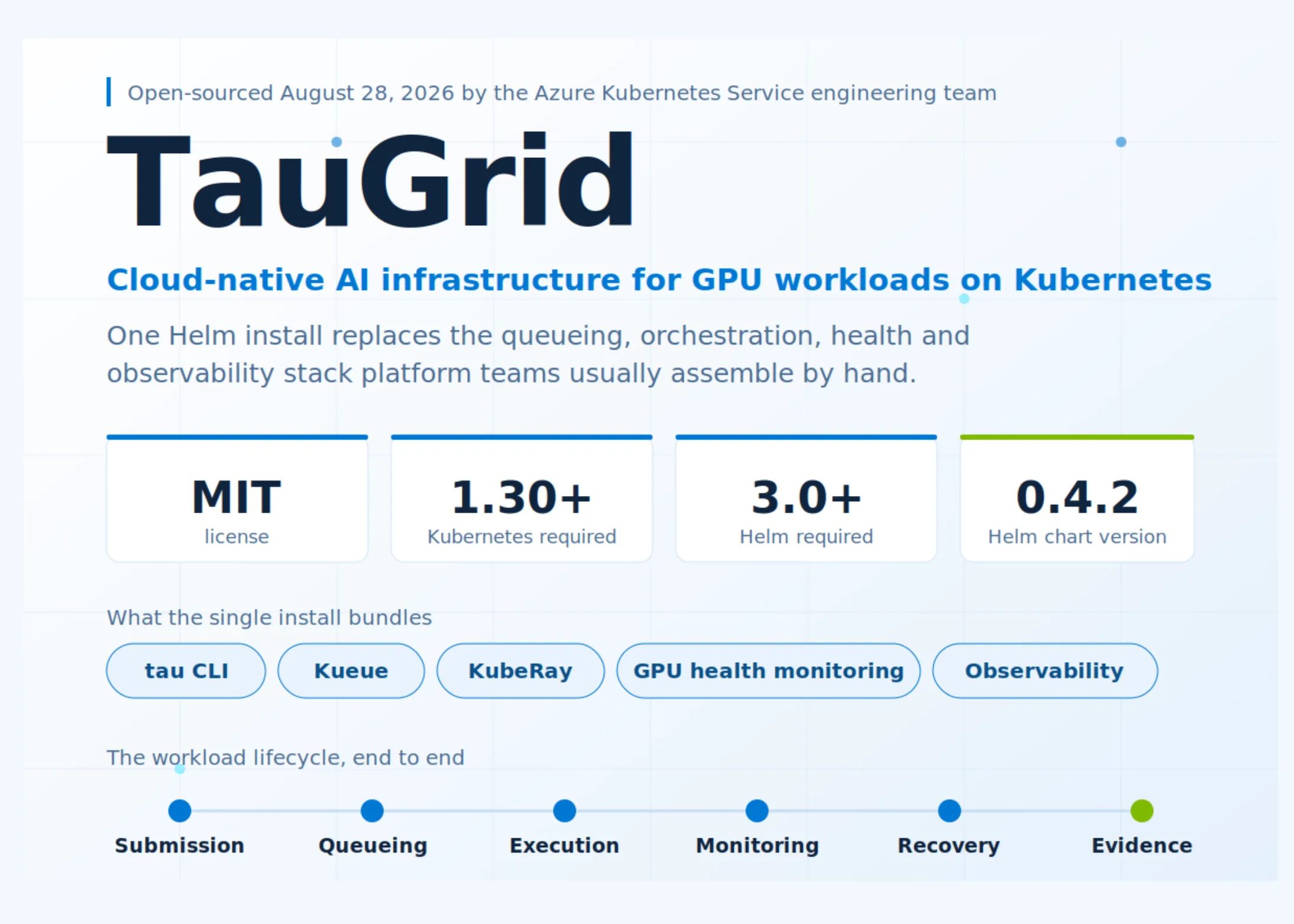
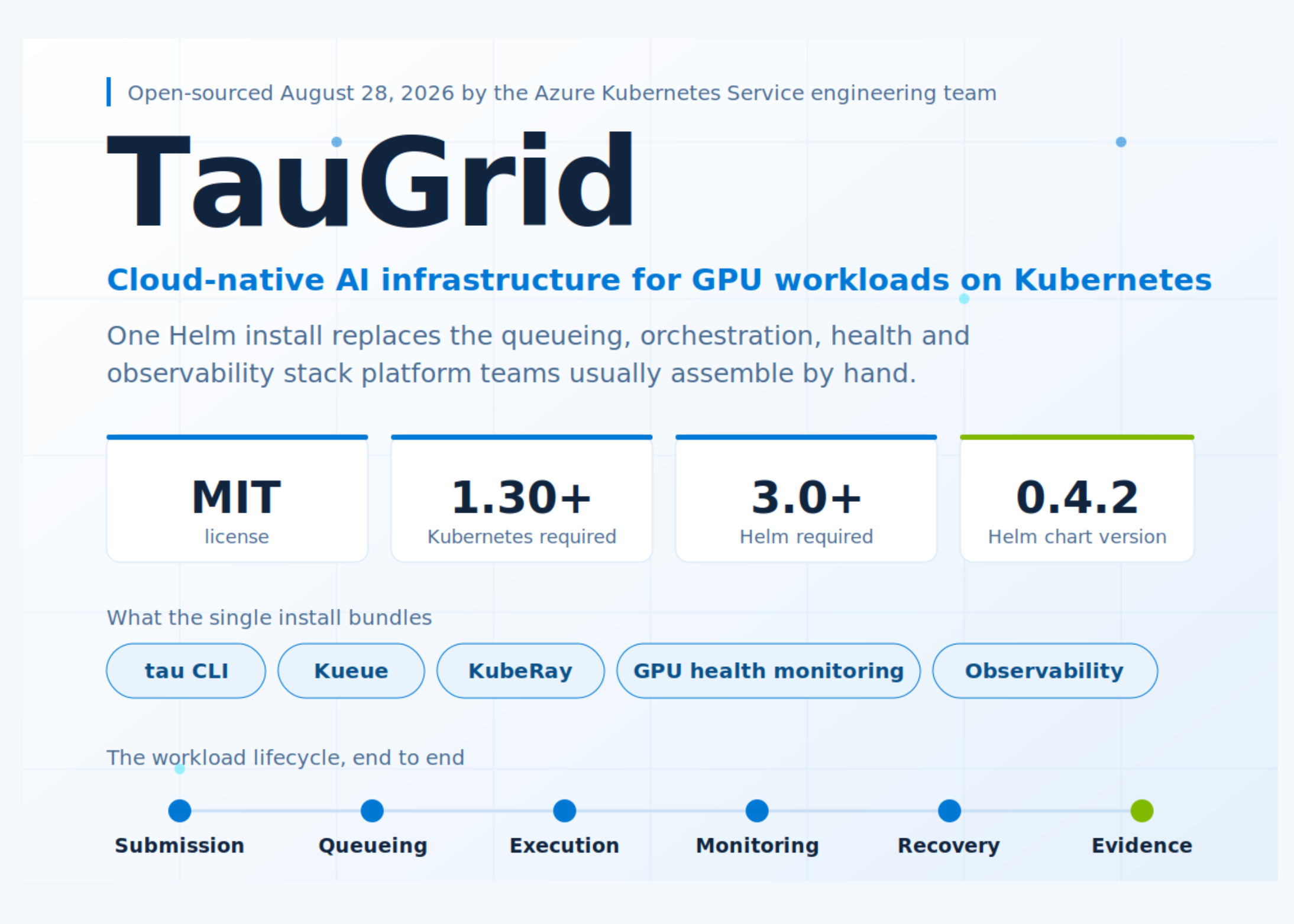
TauGrid’s power lies in its modularity. It replaces the "hand-built" integration with a unified management plane consisting of five primary pillars:
- The Tau CLI: A developer-friendly interface that allows researchers to submit workloads without ever needing to touch a Kubernetes YAML file or understand the intricacies of cluster orchestration.
- Workload Queueing (Kueue): By leveraging the industry-standard Kueue project, TauGrid ensures that multiple teams sharing a single cluster do not suffer from resource contention. It manages quotas, priority, and fair-share scheduling.
- Ray Orchestration (KubeRay): TauGrid simplifies the deployment of Ray clusters, allowing for seamless scaling of distributed training jobs.
- GPU Health Monitoring: The platform includes automated node-level monitoring, which is critical for AI workloads where a single malfunctioning GPU can lead to silent, costly failures.
- Unified Observability: A dashboarding layer that captures the full lifecycle of an AI job, from submission to completion.
The Life of a Job: From Submission to Evidence
The workflow designed by the AKS team is intentionally linear, reducing the cognitive load on data scientists. A typical job lifecycle follows a six-stage process: Submission, Queueing, Execution, Monitoring, Recovery, and Evidence.
1. Submission and Configuration
The developer interaction starts with a simple tau.yaml file. This declarative configuration removes the need for researchers to be Kubernetes experts. A typical GPU training job for a PyTorch workload might look like this:
schema_version: 1
name: aks-gpu-quickstart
run:
  entrypoint: train.py
  workload_kind: rayjob
compute:
  gpus: 1
  workers: 1
  cpus: 16
  memory: 64Gi
runtime:
  image: mcr.microsoft.com/aks/ai-runtime/ray:py3.12-ray2.56.0-cuda13.0
  pip:
    - torch>=2.4.0
2. Queueing and Admission
Once tau run is invoked, the system resolves platform policies. If the cluster is busy, the job enters a ClusterQueue. This is where the magic of Kueue comes into play; it evaluates the job against pre-defined quotas. If a researcher requests more GPUs than are available, the job waits in a queue rather than crashing the cluster or failing silently.
3. Execution and Recovery
The platform handles the heavy lifting of scheduling the job on healthy GPU nodes. A standout feature of TauGrid is its Recovery logic. AI training runs can last for days, and hardware failure is a statistical inevitability. TauGrid is designed to handle retries and can, depending on the implementation, support resumption from checkpoints.
4. Evidence and Reproducibility
Perhaps the most significant value for enterprise teams is the "Evidence" stage. TauGrid records comprehensive metadata, configuration, logs, metrics, and execution history. This creates an audit trail that makes experiments reproducible—a cornerstone of scientific integrity in machine learning.
Deployment and Operational Prerequisites
TauGrid is MIT-licensed and distributed via the Microsoft Container Registry (MCR) as public OCI artifacts. This accessibility signals Microsoft’s intent to position TauGrid as a cloud-agnostic tool, despite its origins within the Azure ecosystem.
Prerequisites
To deploy TauGrid, users require:
- A Kubernetes cluster (version 1.30 or later).
- GPU-enabled nodes.
kubectland Helm 3.0 or higher.
The installation process is remarkably streamlined:
helm install taugrid
  oci://mcr.microsoft.com/aks/ai-runtime/helm/taugrid
  --version 0.4.2
  --namespace tau-system
  --create-namespace
Implications for the AI Infrastructure Landscape
The release of TauGrid marks a shift in how cloud providers view the "AI stack." Previously, infrastructure was viewed as a collection of services (Managed Kubernetes, Managed Storage, Managed Monitoring). TauGrid represents a pivot toward providing an "opinionated layer" that sits atop these services.
Cloud-Agnostic Ambitions
While developed by the AKS team, the design philosophy of TauGrid is notably open. The platform does not, by default, send telemetry back to Microsoft. Furthermore, while some integrations currently lean toward Azure-native tools—such as observability via Azure Data Explorer—the project roadmap explicitly invites community contributions to ensure compatibility with on-premises hardware and other cloud providers (AWS, GCP).
Reducing "Day 2" Operational Costs
For many companies, the biggest cost of running AI is not the GPU time itself, but the engineering time required to maintain the infrastructure. By providing a standardized, supported path for managing Ray and Kueue, Microsoft is effectively lowering the barrier to entry for smaller teams that lack the resources to build custom platform abstractions.
The Path Forward: Community and Evolution
The release of TauGrid on GitHub marks the beginning of its life as an open-source project. The AKS team has made it clear that they intend for this to be a community-driven initiative. The modularity of the system suggests that, in the future, we may see "pluggable" backends for different monitoring tools, storage providers, and specialized hardware accelerators.
For platform engineers currently struggling to manage the chaos of GPU-enabled Kubernetes clusters, TauGrid offers a compelling, battle-tested alternative. By shifting from bespoke "glue code" to a standardized Helm-driven model, organizations can spend less time fixing their platform and more time running the models that drive their business.
As organizations navigate the complexities of scaling generative AI, tools like TauGrid will likely become the standard for "AI Platform Engineering." Whether this project achieves widespread adoption across the multi-cloud ecosystem remains to be seen, but the initial technical offering provides a strong foundation for a more stable, reproducible, and efficient AI infrastructure.
For more information, visit the Azure/taugrid repository on GitHub or read the official announcement on the AKS Engineering Blog.



