










The landscape of the personal computing hardware market is undergoing a seismic, and often painful, transformation. Only six weeks ago, the tech industry was reeling from reports that AI development firms were systematically dismantling and scanning ultra-rare, out-of-print books to feed into data-hungry Large Language Model (LLM) training sets—a move critics labeled a "cultural crime against humanity." Today, the voracious appetite of the artificial intelligence sector has pivoted from the archives of human history to the shelves of modern retailers, with Nvidia’s flagship consumer-grade GPU, the RTX 5090, serving as the primary target.
For the average gamer or creative professional, the RTX 5090 has become a ghost. Across the United States and Europe, the card has effectively vanished from legitimate retail channels. In its place, a predatory secondary market has emerged, with third-party resellers demanding premiums of 200 to 300 percent above the manufacturer’s suggested retail price (MSRP). The cause is an unprecedented industrial-scale acquisition of consumer hardware by AI entities, a trend that is fundamentally disrupting the delicate supply chain of the PC enthusiast ecosystem.
A Chronology of the Disappearance
The timeline of this hardware crisis is as sharp as it is sudden. When Nvidia launched the RTX 5090 in January 2025 with an MSRP of $1,999, it was marketed as the definitive "king" of consumer gaming—a powerhouse designed for 4K ray-tracing and high-fidelity rendering. For a brief window, it was a high-end luxury item available to those with the budget and the patience to secure one.
By the summer of 2026, the situation had shifted toward a total vacuum. Reports from industry observers and price trackers, such as Tom’s Hardware, confirmed a grim reality by mid-September: the cheapest available unit in the US market had climbed to a staggering $6,389. This represents a 3.2x increase over the original launch price.
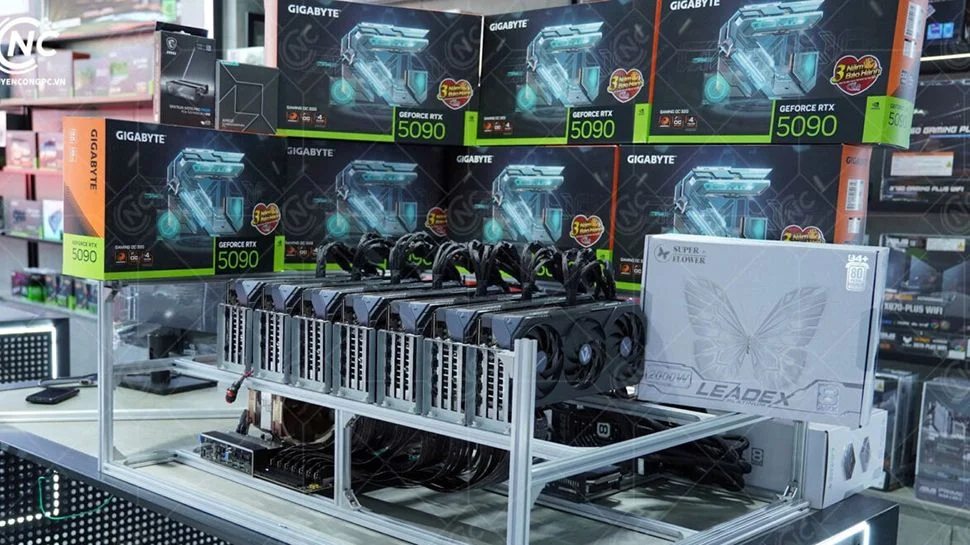
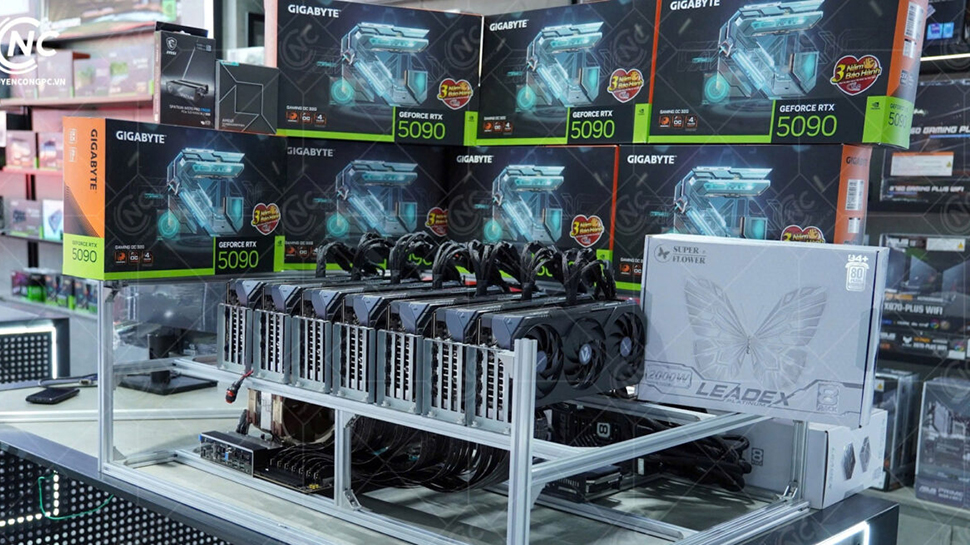
The most alarming visual evidence of this phenomenon emerged from Hong Kong. Images widely circulated by the tech outlet HKEPC showed entire wooden pallets stacked high with factory-boxed RTX 5090 units. These were not destined for the shelves of a PC hobbyist’s local Micro Center; they were photographed at AI server assembly facilities, prepared to be unboxed and integrated into multi-GPU clusters. These images—republished by industry staples like Guru3D, VideoCardz, and TechPowerUp—served as the smoking gun for a supply chain crisis that has seen the "retail" market bypassed entirely by institutional buyers.
The Evidence: Fact vs. Digital Fiction
The circulation of these photos has sparked a fierce debate regarding the veracity of the "pallets of GPUs" narrative. Skepticism is high, and for good reason. Kevin Hofer, writing for the Swiss retailer Digitec, conducted a forensic examination of the images in question. He pointed out blatant anomalies in the box lettering, noting that the text on the packages included gibberish strings like "50B0" or "50R0," which do not correspond to any known Nvidia product branding.
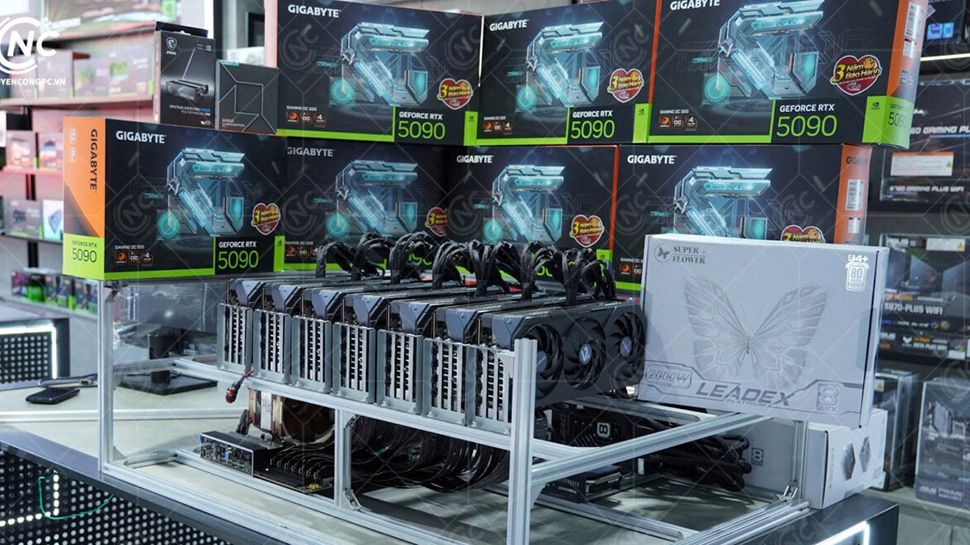
These artifacts suggest that some of the imagery fueling the current panic may be AI-generated—a twist that adds a layer of irony to the situation. Despite these concerns, the underlying reality of the shortage remains indisputable. Whether or not specific photos were "hallucinated" by a generative model, the market data from major retailers like Amazon, Newegg, and Best Buy confirms that first-party inventory has evaporated.
Even with disclaimers, the existence of such reports creates a self-fulfilling prophecy. This "fear of missing out" (FOMO) phenomenon forces consumers and small businesses to scramble for remaining stock, further driving prices upward and ensuring that the few remaining cards on the market are sold at exorbitant, scalper-level prices.
Why the RTX 5090? Analyzing the AI Value Proposition
To understand why a company would choose to buy thousands of consumer-grade RTX 5090s rather than enterprise-grade solutions, one must look at the economics of the current AI boom. The RTX 5090 is built on the Blackwell architecture and features the GB202 chip, paired with 32GB of high-speed GDDR7 memory.
For many AI start-ups, the enterprise-grade Nvidia RTX PRO 6000 has become prohibitively expensive. Nvidia has pushed the pricing of its workstation-class cards to an eye-watering $16,000, effectively doubling the cost of entry for many projects. While the PRO 6000 offers 96GB of VRAM—a massive advantage for training large models—it also carries a massive cost-to-performance premium.
In contrast, a triple-stack of RTX 5090s can, in certain parallel processing tasks, outperform a single enterprise card for a fraction of the total cost. Furthermore, Chinese OEMs have reportedly found ways to modify the RTX 5090 to support up to 96GB of VRAM, making it a "budget" alternative that can bypass some of the crippling costs associated with professional server hardware. This has turned the consumer GPU into a "commodity" asset, a role historically occupied by specialized hardware that is now beyond the reach of all but the largest tech conglomerates.
The Regulatory and Legal Quagmire
Nvidia’s own policies appear to be failing to stem the tide. Since 2017, the company’s GeForce driver End User License Agreement (EULA) has contained a "No Datacenter Deployment" clause, explicitly forbidding the use of consumer-grade cards in professional server environments. Historically, Nvidia has enforced its will through technological constraints, such as the Lite Hash Rate (LHR) limiter introduced to thwart crypto miners during the GPU shortages of 2021.
However, the current situation feels different. The release of the China-specific "RTX 5090 D"—a card designed to comply with US export restrictions by throttling AI performance—shows that Nvidia is capable of engineering limits. Yet, the current behavior suggests a level of indifference. With the AI sector becoming the primary engine of global tech spending, the needs of the gaming community are increasingly viewed as a secondary concern. The company is, after all, currently the world’s most valuable entity, and the sheer volume of cards being moved into the AI space generates revenue that far outweighs the goodwill of the PC gaming demographic.
The Implications for the PC Ecosystem
The implications of this trend are profound and potentially long-lasting. We are witnessing the "commodification of the enthusiast space." When a retail product becomes a component of an industrial machine, the price floor for that product is no longer set by what a consumer is willing to pay for leisure, but by the "return on investment" (ROI) that an AI firm can extract from the card’s compute cycles.
If this trend continues, the traditional PC gaming build may become a luxury reserved only for the ultra-wealthy. We are already seeing a ripple effect: as the flagship RTX 5090 becomes unaffordable, the demand—and consequently the prices—for the tier-below hardware increases. This creates a cascading inflation effect that ripples through the entire GPU stack.
Furthermore, this shift threatens the long-term viability of small-scale AI development. While it might seem like a win for start-ups to access "cheaper" compute, it creates a market where hardware is constantly in flux, subject to the whims of speculators, and increasingly difficult to source. The lack of reliable hardware availability acts as a tax on innovation, effectively gatekeeping the AI field for those who cannot afford to buy inventory by the pallet.
Conclusion: A Market in Search of Equilibrium
As of late 2026, the GPU market remains in a state of high-intensity volatility. While Nvidia may eventually increase production or introduce further restrictions, the fundamental incentive—the extreme profitability of AI training—remains unchanged.
The industry is caught in a difficult transition. The RTX 5090 is, by all metrics, a triumph of engineering for gaming and local AI research, but it has been thrust into a role for which it was never intended. For the consumer, the path forward is bleak: until there is either a collapse in the AI bubble or a massive shift in how these companies source their compute, the shelves will likely remain empty, and the price tags will remain astronomical. The era of the accessible high-end GPU appears to be coming to a close, replaced by an era where hardware is the fuel for a new, insatiable digital furnace.



