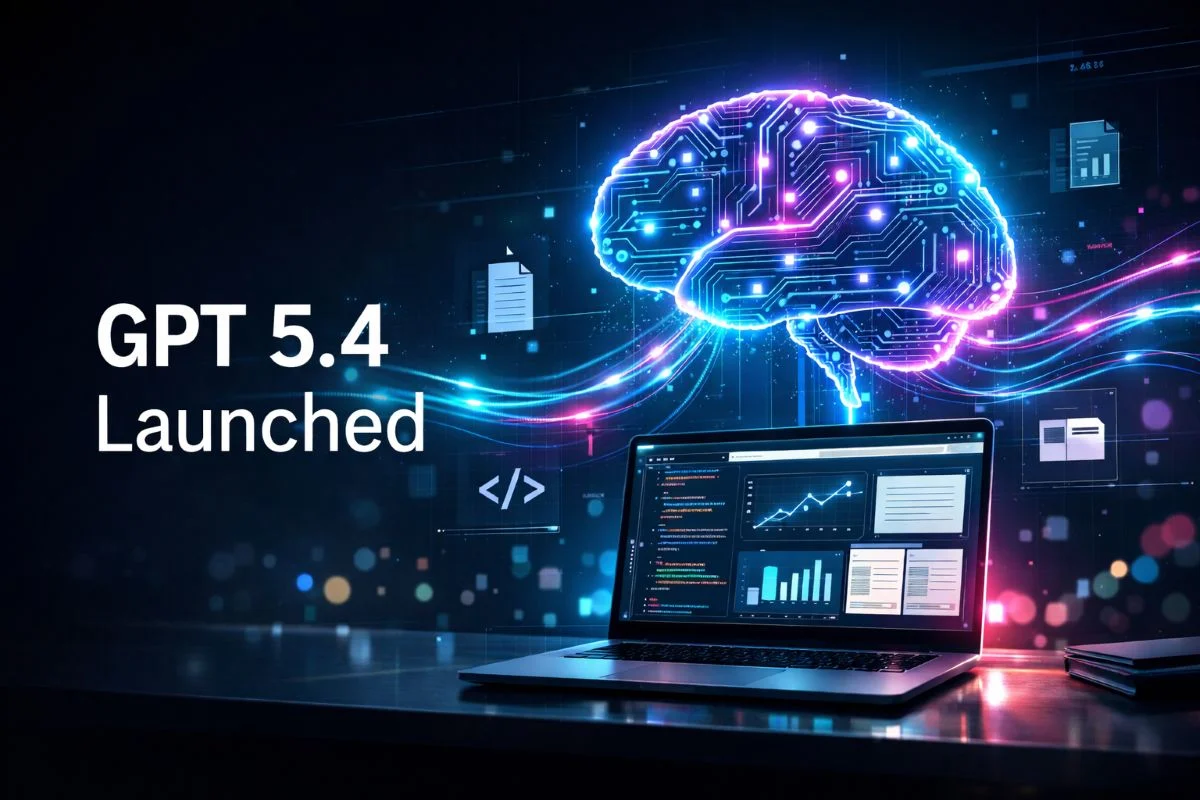
The landscape of artificial intelligence underwent a tectonic shift on March 5, 2026, when OpenAI officially unveiled GPT-5.4. Moving beyond the iterative improvements seen in previous models, GPT-5.4 marks a transition from a reactive chatbot interface to a proactive, agentic digital collaborator. By synthesizing advanced reasoning architectures with deep-tier coding capabilities and native workflow automation, OpenAI has set a new benchmark for what professional-grade AI can achieve in a modern enterprise environment.
The Evolution of Intelligence: Chronology and Context
The release of GPT-5.4 is the culmination of a deliberate, rapid-fire release strategy that defined the 2025–2026 period for OpenAI.
- Early 2025: The introduction of the GPT-5 series established a foundation of unified reasoning.
- December 2025: OpenAI released GPT-5.2, which introduced the "Thinking" paradigm—a method of chain-of-thought processing that significantly boosted factuality and long-task stability.
- February 2026: The release of GPT-5.3 and the specialized "Codex" variant pushed the model’s architectural limits in programming and agentic task execution.
- March 5, 2026: The launch of GPT-5.4 consolidated these disparate advancements into a singular, cohesive frontier model.
This timeline reflects a strategic pivot: OpenAI has transitioned from general-purpose large language models to specialized, highly reliable systems that prioritize "instruction adherence" over mere conversational fluency. As of June 5, 2026, legacy models like GPT-5.2 Thinking will be deprecated, marking the total transition of the platform to the 5.4 architecture.
Architecture and Core Capabilities
GPT-5.4 is not merely an incremental update; it is a fundamental restructuring of how the model processes information. At its heart, the model is designed for the "long-haul"—handling multi-step workflows that require extended reasoning without degradation of logic.
Advanced Reasoning and "Thinking" Protocols
The signature feature of GPT-5.4 is its evolved "Thinking" capability. Unlike standard LLMs that generate the next token based on probability, GPT-5.4 employs an internal verification loop. Before delivering a final answer, the model simulates potential outcomes, checks for logical fallacies, and corrects its own path. This makes it an invaluable asset for:
- Strategic Financial Analysis: Parsing quarterly earnings reports against market trends.
- Complex Legal Review: Identifying contradictions in multi-hundred-page contract documentation.
- Scientific Research: Synthesizing disparate academic papers into coherent, actionable summaries.
Industry-Leading Coding and Agentic Programming
Integrating the logic of the GPT-5.3 Codex, the 5.4 update introduces an environment where the AI acts as a pair programmer rather than a simple code-completion tool. It excels in:
- Refactoring Legacy Codebases: Converting outdated syntax into modern, efficient frameworks.
- Frontend UI Generation: Translating natural language descriptions into structured React, Vue, or Tailwind components.
- Debugging Logic Trees: Identifying "silent" bugs in complex distributed systems that are often missed by traditional static analysis tools.
The Professional Utility: Workflow Automation
One of the most significant shifts in GPT-5.4 is its deep integration with professional productivity tools. OpenAI has designed the model to interact with the "office stack" natively.
Seamless Tool Usage
GPT-5.4 is capable of executing tasks across disparate applications. For instance, a user can provide a raw data set in a spreadsheet, request a trend analysis, and have the model generate a professional presentation deck—all within a single, continuous workflow.
- Automated Document Synthesis: The model can ingest PDF documents, whitepapers, and email chains, synthesizing them into a coherent project brief while maintaining source citation.
- Data Interpretation: By utilizing its advanced math-reasoning engines, it can perform statistical analysis that rivals specialized data science software, providing insights that are human-readable and actionable.
Implications for the Enterprise
For corporations, the release of GPT-5.4 signals a transition from "AI as a toy" to "AI as an employee." The model’s enhanced instruction-following capability is the linchpin here. In previous versions, prompt engineering was an art form; in GPT-5.4, the model is sufficiently robust to handle ambiguous instructions by asking clarifying questions before committing to an action.
Scaling Operations
Organizations are already deploying GPT-5.4 for:
- Customer Support Tier 2/3: Managing complex queries that require historical data retrieval and policy interpretation.
- DevOps Automation: Writing and executing infrastructure-as-code scripts that automatically scale cloud resources based on real-time traffic analysis.
- Enterprise Knowledge Management: Acting as a "living repository" for company policy, where employees can ask questions and receive answers linked to internal documentation rather than general web data.
Comparative Analysis: How GPT-5.4 Leads the Pack
| Feature | GPT-4o/5 | GPT-5.2 | GPT-5.4 |
|---|---|---|---|
| Reasoning | General | Reasoning-focused | Advanced "Pro" Thinking |
| Context Window | Standard | Extended | 1M+ Tokens |
| Coding | Basic | Moderate | Expert/Agentic |
| Task Stability | Low (Hallucination risk) | Medium | High (Reliability-focused) |
| Workflow | Manual prompt-response | Semi-automated | Native automation |
Official Response and Developer Access
OpenAI’s leadership has framed GPT-5.4 as the "Standard Bearer" for the next generation of computing. During the launch, the technical team emphasized that the goal was "reducing the cognitive load on the user."
For developers, access to the GPT-5.4 API is tiered, allowing for a balance between cost-efficiency and high-performance throughput. The API supports fine-tuning, enabling enterprises to train the model on their proprietary data without exposing sensitive information to the public dataset.
Limitations and Ethical Considerations
Despite the hype, OpenAI remains transparent about the limitations. GPT-5.4, while significantly more accurate, is not infallible.
- Critical Verification: For high-stakes decisions in medicine, law, or engineering, human oversight remains mandatory.
- Data Privacy: While Enterprise tiers offer enhanced privacy, users must remain cognizant of the data they feed into the model.
- Energy Consumption: The increased reasoning power comes at the cost of higher computational energy, a factor that is currently being addressed through optimized data center cooling and green energy initiatives by OpenAI’s infrastructure partners.
The Road Ahead: The Future of AI
The launch of GPT-5.4 is a waypoint, not a destination. As we look beyond 2026, the trajectory of AI development points toward "autonomous agents"—models that do not just assist with tasks but autonomously manage projects from inception to completion.
We are entering an era where the AI model is a digital coworker. It understands context, remembers past interactions across sessions, and proactively suggests improvements. For the professional, the student, and the developer, GPT-5.4 is more than a tool—it is the baseline for modern digital literacy. Those who master the integration of these models into their daily workflows will find themselves with an unprecedented competitive advantage in an increasingly automated world.
References and Further Reading:
- OpenAI Official Release Notes (March 2026)
- The Technical Architecture of GPT-5.4: A Deep Dive (OpenAI Blog)
- Enterprise Integration Guides for GPT-5.4
- OpenAI API Documentation (v5.4)