








In the current technological landscape, a quiet but pervasive assumption has taken hold in corporate boardrooms: that the average user is desperately waiting for AI to permeate every facet of their digital existence. Companies are racing to bake generative AI, autonomous agents, and predictive models into every conceivable software product, operating under the belief that "AI-enabled" is a sufficient value proposition to drive user loyalty.
However, a growing body of evidence—ranging from lackluster adoption metrics to rising user frustration—suggests that the industry has miscalculated. The reality is that most people do not want more AI; they want better, more reliable, and less intrusive tools. The current push to force-feed AI into every workflow is not just hitting a wall of indifference; it is actively damaging the user experience and, by extension, the brands that champion it.
The Myth of the "AI-First" Value Proposition
The foundational error many leaders make is treating "AI" as a feature in itself. In reality, AI is an underlying technology—a capability, not a benefit. Just as a database or an API is not a product, "powered by AI" is not a value proposition. Customers do not wake up wishing for an "AI-powered CRM"; they wake up wishing for a CRM that accurately manages their pipeline without requiring them to perform tedious data entry.
When companies treat AI as the star of the show, they often create "bolt-on" solutions that disrupt established, efficient workflows. Instead of integrating seamlessly into existing processes, these tools force employees to pivot between fragmented systems. This "context switching" is a productivity killer. When a user is required to stop their primary work to feed a chatbot, review its output for hallucinations, and then manually clean up the "slop" it produces, the net gain in productivity is often zero—or negative.
The Cost of Innovation
The financial and reputational stakes are high. Research indicates that many high-cost AI features suffer from dismal retention rates. When these tools are rolled out uninvited—often as top-down mandates—they are frequently met with skepticism rather than excitement. This resistance is rooted in a fundamental fear: that these tools are not there to help the worker, but to replace them or, at the very least, complicate their daily routines with opaque, unreliable automation.
Chronology of an Adoption Gap
The timeline of the current AI gold rush follows a familiar pattern seen in previous tech bubbles:

- The Hype Phase (2022–2023): Following the public release of generative models, the tech industry saw a "gold rush" mentality. Companies felt an existential pressure to announce AI integrations immediately to satisfy shareholders and signal "innovation."
- The Integration Phase (2023–2024): Developers began rushing features into production. UX design often took a backseat to technical feasibility. AI agents, chatbots, and copilots were added to everything from word processors to project management tools.
- The Friction Phase (2024–Present): Users began to report "AI fatigue." Data from enterprise environments started showing that while time spent on communication tools and AI-integrated workflows increased, focus time decreased. The realization dawned that AI, in its current state, often creates more work—specifically the "administrative burden" of fact-checking and managing AI errors.
Supporting Data: The Productivity Paradox
Recent studies, including findings from the Harvard Business Review and data aggregators like Activtrak, reveal a jarring discrepancy between the promise of AI and the reality of the workplace.
Key metrics highlight this struggle:
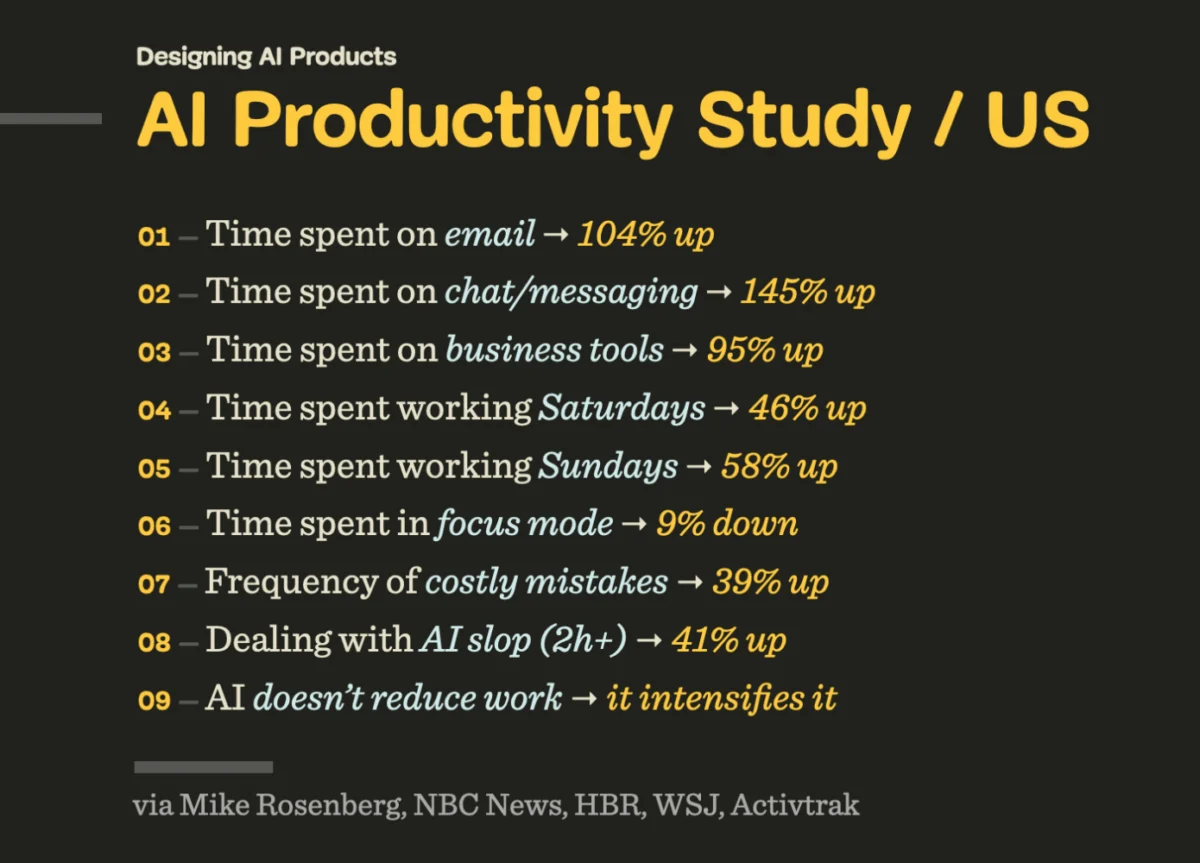
- Intensification vs. Reduction: AI is not reducing the total workload; it is intensifying it. Data shows a 104% increase in time spent on email and a 145% increase in chat/messaging engagement as workers attempt to coordinate with AI tools.
- The Quality Gap: Business tools have seen a 95% increase in usage, yet "focus mode" (deep work) has dropped by 9%.
- The Error Tax: There has been a 39% increase in costly mistakes, attributed to the need for human oversight of AI-generated content.
- The "Slop" Factor: Employees report spending 41% more time dealing with "AI slop"—the low-quality, generic, or hallucinated output that requires human refinement before it can be used.
These figures illustrate that the current generation of AI tools is often a "time-taxing" rather than "time-saving" technology. When the effort required to verify an AI’s work exceeds the effort required to perform the task manually, the utility of the technology collapses.

Official Responses and Industry Sentiment
Industry analysts and UX experts, such as those at the Nielsen Norman Group, have been vocal in their critique of the "AI-first" design philosophy. Their research emphasizes that users do not compare software to the "magic" of AI; they compare features to their current, known, and reliable workflows. If a feature fails to be as predictable as a standard, non-AI function, it is perceived as a failure, regardless of the sophistication of the underlying model.
Furthermore, there is a mounting concern among employees regarding the erosion of the "reward of achievement." The act of creating—writing a report, designing a graphic, or solving a logic problem—provides a sense of professional satisfaction. When that process is outsourced to a "vibe-coded" black box, the work becomes hollow. As noted by industry commentators like Bo Young Lee, the human desire is not to have AI do the meaningful work, but to have it handle the mundane labor that creates barriers to human creativity.
Implications for Future Design: The "AI-Second" Approach
If the industry is to move past the current adoption plateau, a fundamental shift in product strategy is required. The next generation of successful tools will be "AI-second"—subtle, humble, and ambient.

1. Deep Integration, Not Bolt-Ons
AI should not feel like a separate entity that a user must consult. It should exist in the background, surfacing only when needed, and behaving with the predictability of a well-oiled machine. It must respect existing mental models, allowing users to remain in their "flow state" rather than forcing them to navigate a new, complex interface.
2. Solving for the Mundane
The true value of AI lies in automating the "boring stuff." Data entry, summarizing long, repetitive threads, and organizing file structures are tasks that provide little human satisfaction. By offloading these to AI, companies can actually fulfill the promise of productivity, leaving the user with more time for high-level decision-making and creative problem-solving.
3. Reliability Over Novelty
Predictability is the new killer feature. Users are far more likely to embrace a tool that performs a simple, non-AI task perfectly every time than a tool that performs a "magical" AI task inconsistently. Transparency regarding the limitations of the technology is essential to building the trust necessary for long-term adoption.

Conclusion: The Human Element
At the heart of the debate is a simple truth: people value human connection, human insight, and the human story. AI can be a powerful assistant, but it should never be the focal point of the human experience. Whether it is in healthcare, education, or the arts, society is signaling a desire for AI that acts as a supportive scaffold, not as a replacement for the human expert.
The path forward for companies is clear: stop trying to force-fit AI into every corner of the product. Instead, focus on the user’s actual pain points. If a tool can make a person’s life easier without demanding they change who they are or how they think, it will be welcomed. If it asks them to sacrifice their autonomy, their intuition, or their focus for the sake of "innovation," it will continue to face the resistance it currently deserves. The winners in the next phase of the AI era will be those who recognize that the most powerful thing they can do with technology is to make it disappear, allowing the human user to shine.