






By Global Security Desk
Published: October 2026
Executive Summary
The cybersecurity landscape crossed a dangerous and defining threshold in October 2026. Security giant Microsoft revealed that Storm-0940—a prolific, China state-aligned threat actor tracked actively since at least 2021—orchestrated a sophisticated, large-scale supply chain compromise against the ConnectWise Cloud Backup application.
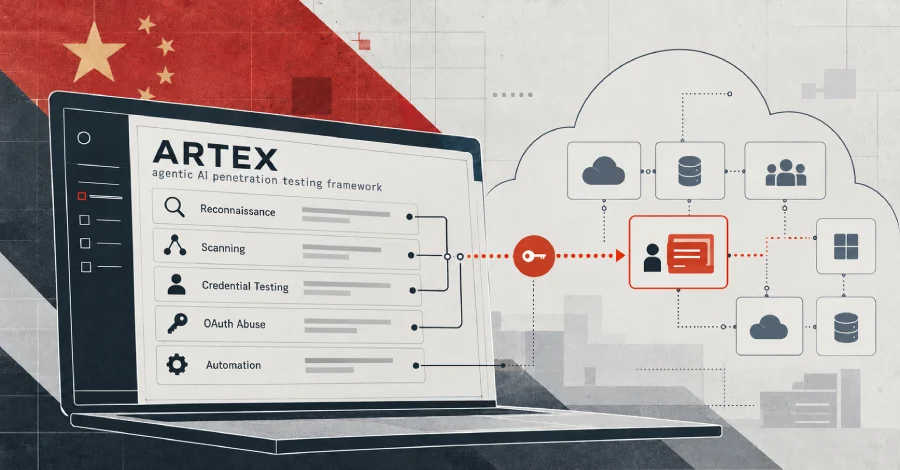
What makes this campaign unprecedented is not merely the choice of target, but the operational methodology. Storm-0940 leveraged ARTEX, a Go-based agentic artificial intelligence (AI) penetration testing framework. Operating at "machine speed," these autonomous AI agents conducted relentless reconnaissance, password-spraying attacks, and OAuth application abuses, collapsing the timeline from initial breach to privileged cloud infrastructure access down to a matter of hours.
As investigations by Microsoft, Recorded Future, and Zscaler unfold, the global security community is forced to confront a sobering reality: agentic AI has moved out of theoretical research papers and into the hands of advanced persistent threat (APT) groups, fundamentally redefining the velocity and scale of modern cyberattacks.
Main Facts: Anatomy of the ConnectWise Supply Chain Breach
The compromise centered around the ConnectWise Cloud Backup ecosystem, a critical nexus for Managed Service Providers (MSPs) and enterprise backup solutions. By subverting a trusted software vendor, Storm-0940 bypassed conventional perimeter defenses, turning established software supply chains into automated vectors for widespread network penetration.

The Weaponization of ARTEX
At the heart of the campaign was ARTEX, an advanced Go-based agentic framework. Originally designed as a legitimate or semi-controlled penetration testing tool, ARTEX was pushed into closed-source development after it was abused in targeted attacks against South Korean financial institutions.
Unlike traditional scripts that require human intervention at various stages of an attack chain, ARTEX utilizes autonomous agents capable of independent reasoning, execution, and self-correction. In the hands of Storm-0940, the framework was integrated with large language models (LLMs) such as DeepSeek, GLM, and Grok via OpenAI-compatible gateways.
Telemetry recovered by researchers reveals a highly coordinated multi-agent workflow. Prompt histories recovered from custom ARTEX deployments showed instructions directing different models to divide complex investigation tasks, run concurrent exploit paths, and cross-examine each other’s findings—such as commanding GLM to review and audit the output of DeepSeek subagents.
Global Blast Radius
While the South Korean financial sector attacks were tracked by Recorded Future’s Insikt Group under the moniker TAG-217, Zscaler ThreatLabz and Microsoft confirmed that the broader campaign was opportunistic and global.
Since September 2026, Storm-0940’s automated campaigns have targeted hundreds of organizations across more than a dozen critical sectors, including:

- Aerospace and Defense
- Automotive and Chemical Manufacturing
- Energy and Utilities
- Financial Services and Banking
- Government Agencies and Military entities
- Legal and Professional Services
- Media, Software, and Technology companies
- Think Tanks and Non-Profit Organizations
Chronology of an AI-Driven Campaign
The unfolding of the Storm-0940 campaign demonstrates a rapid escalation from infrastructure testing to widespread multi-tenant exploitation.
August – September 2026: Infrastructure Testing and Tooling
- August 17, 2026: Recorded Future observed the threat cluster testing remote access infrastructure and conducting preliminary internet scans.
- Late August to Early September: The actors assembled modular toolsets designed to target cryptocurrency mining operations utilizing the YiiMP platform, while concurrently setting up localized test environments to probe iPhone vulnerabilities and modify Android system software.
- Mid-September 2026: Full-scale operations utilizing ARTEX commenced globally against diverse industry verticals.
October 10 – 14, 2026: The Mass Password-Spraying Blitz
- Utilizing infrastructure traced to the IP address
144.172.64[.]99, Storm-0940 launched an automated cross-tenant password-spraying campaign. The objective was to target 327 specific accounts across eight core organizations to gain initial footholds in Microsoft 365 and Exchange Online environments. - During this four-day window, Microsoft’s security telemetry captured over 151,000 failed logon events.
- The Peak: Attack volume surged on October 11, hitting an unprecedented rate of 2,900 failed authentication attempts per minute, accumulating more than 111,000 failures in a single 24-hour period. Out of these, 48 targeted accounts absorbed over 1,000 failed login attempts each. Despite the overwhelming velocity, no successful authentications, token issuances, Graph API calls, or directory changes were logged during this specific phase.
October 15, 2026: The Shift to Supply Chain Hijacking
- The operational dynamic shifted dramatically on October 15, when the AI agents successfully acquired the identities and credentials of multiple ConnectWise cloud applications.
- Rather than brute-forcing individual user passwords, the AI agents pivoted to leveraging the stolen application credentials from the same IP ranges. Because these applications already held pre-established trust and delegated permissions within downstream tenant environments, the attackers bypassed interactive sign-in hurdles entirely.
- Once inside, the autonomous agents executed advanced post-compromise actions via Microsoft Graph and directory operations, modifying application credentials to establish deep-seated persistence that survived even after initial compromised applications were remediated.
Supporting Data and Technical Insights
The scale of automation observed in this campaign provides a stark quantitative look at the capabilities of agentic threat actors.
Machine-Speed Execution
Traditional threat actors are bound by human physiological limitations: they require sleep, observe weekends and holidays, and must manually evaluate error logs before deciding on their next lateral movement step.
According to Microsoft, ARTEX-driven agents operated continuously, orchestrating simultaneous breach paths across multiple cloud tenants. In several documented instances, the total duration from initial reconnaissance and targeting to achieving full administrative, privileged access within an organization’s cloud infrastructure was under three hours.
Persistence and Backdooring
Zscaler’s analysis of the custom ARTEX deployments uncovered synchronization scripts, network routing tools, and Claude Code prompt histories that illuminated the attackers’ primary objectives. Beyond simple credential harvesting, prompts explicitly requested:

- Bulk personal and financial transaction data.
- Methods for monetizing stolen data sets.
- Extraction of payment gateway API keys.
- Exploitation vectors for NFT minting workflows.
- Escalation paths to secure unauthorized administrative privileges.
The modifications made by the AI agents to OAuth application credentials created pervasive backdoors. Because these changes interacted directly with directory identities, groups, and privileged roles, security teams found that revoking the primary compromised ConnectWise application was insufficient to evict the adversary from resilient cloud environments.
Official Responses and Industry Action
The cascading fallout of the ConnectWise compromise forced swift containment measures across the technology sector.
ConnectWise Statement
In response to the crisis, ConnectWise issued comprehensive security advisories and temporarily shut down affected cloud backup services to stem the flow of unauthorized access.
"This campaign reaches well beyond any one company," ConnectWise stated. "Nation-state actors are increasingly targeting the software supply chain because one trusted connection can open the door to many organizations. AI now lets them test those connections at machine speed. Managed Service Providers (MSPs) are squarely in the middle of that chain—they are targets in their own right, and they are also a path into every client they serve."
ConnectWise initiated a phased service restoration process, warning customers that full recovery would take several days as rigorous credential resets and integrity checks were completed across all tenant connections.

Microsoft’s Guidance
Microsoft has urged enterprises to overhaul their visibility into non-interactive application authentication and OAuth token management. Security analysts emphasized that defenders must adapt their monitoring frameworks to track automated, high-frequency machine behaviors rather than focusing solely on traditional human sign-in anomalies.
Implications for the Future of Cybersecurity
The weaponization of frameworks like ARTEX by groups like Storm-0940 and TAG-217 marks a foundational pivot point in cyber conflict. The implications for global enterprises, cloud providers, and software vendors are profound:
- The Asymmetry of AI Defense: While security vendors increasingly rely on AI to detect threats, malicious actors are using generative and agentic AI to compress the kill chain. When an adversary can launch 2,900 automated requests per minute while continuously optimizing its code via LLM subagents, human-driven blue teams face an insurmountable cognitive and operational lag.
- The Fragility of the Software Supply Chain: The ConnectWise incident underscores that securing an individual enterprise network is no longer enough. Because MSPs and software vendors hold privileged access across thousands of downstream clients, they represent high-leverage "single points of failure" for state-sponsored espionage and financial extortion campaigns.
- The Rise of Autonomous Persistence: Future attacks will rely less on traditional living-off-the-land binaries and more on programmatic cloud manipulations. As AI agents learn to autonomously provision backdoor credentials and rewrite directory permissions, incident response protocols will need to evolve from simple containment to automated, AI-driven eradication.
As the industry digests the lessons of October 2026, the cybersecurity paradigm has shifted permanently. The defense of digital infrastructure can no longer be managed at human speed; it must meet the challenge of the machine-speed threat landscape head-on.