








Whether you are launching a personal blog, a creative portfolio, or a high-traffic e-commerce empire, every digital endeavor begins with one fundamental requirement: a website. However, a common misconception among beginners is that a domain name and a website design are all that is required to go live. In reality, your website needs a "home"—a place where its files, databases, and media reside so they can be accessed by the world. This is the role of web hosting.
Understanding the mechanics of web hosting is not merely a technical necessity; it is a strategic business decision. Your choice of host directly influences your site’s loading speed, security, and uptime—all critical components that search engines like Google use to determine your site’s credibility and search ranking.
Main Facts: What is Web Hosting?
At its core, web hosting is a service that allocates space on a server for your website’s files. Think of a server as a specialized, high-performance computer that remains powered on 24/7, connected to the internet via a high-speed data connection. When a user types your domain name into their browser, the server acts as a digital librarian, retrieving the necessary files—HTML, CSS, images, and scripts—and transmitting them to the visitor’s device.
Without a web hosting provider, your website remains a collection of files trapped on your personal computer, invisible to the rest of the world. Hosting companies maintain massive data centers filled with these servers, providing the infrastructure, cooling, power, and connectivity required to keep your site reachable across the globe.
The SEO Connection
While hosting is a backend service, it has significant implications for your Search Engine Optimization (SEO) strategy. If your host is unreliable, your site may experience frequent downtime, causing search engine crawlers to fail when attempting to index your pages. Furthermore, slow server response times are a primary driver of high bounce rates. Modern search algorithms prioritize "Core Web Vitals," which measure page load speed and stability. Consequently, investing in high-quality hosting is an investment in your site’s visibility.
Chronology: Navigating the Hosting Journey
For those new to the digital landscape, the journey to a live website typically follows a logical progression of decisions:
- Defining Requirements: Before shopping, you must evaluate your site’s scope. Is it a static portfolio or a database-heavy online store?
- Choosing a Model: Decide between "fully-hosted" platforms (like Shopify or WordPress.com) or "self-hosted" solutions (like WordPress.org).
- Selecting a Provider: Once the model is chosen, you must research providers based on server location, storage, and scalability.
- Deployment: Using tools like AI website builders or manual file uploads, you push your content to the live environment.
- Ongoing Maintenance: Monitoring uptime, managing backups, and scaling resources as your audience grows.
Fully-Hosted vs. Self-Hosted: The Ownership Debate
The first major fork in the road for any site owner is the choice between a fully-hosted and a self-hosted architecture.
Fully-hosted services offer a "walled garden" approach. Platforms like Shopify or WordPress.com handle the technical heavy lifting: server maintenance, security patching, and software updates are all managed by the provider. This is ideal for small business owners who prioritize speed to market over granular control.

Self-hosted platforms, most notably WordPress.org, grant the user full autonomy. You are responsible for selecting your own hosting provider, installing the software, and managing your own security protocols. While this requires a steeper learning curve, it provides absolute ownership of your data and the flexibility to customize every line of code. For those seeking to build a unique brand, the self-hosted route is almost always the superior long-term choice.
Supporting Data: How to Choose the Right Provider
With thousands of hosting providers in the market, selecting the right one requires a systematic approach. Data suggests that the following four variables are the primary indicators of a host’s quality:
1. Server Location
Data transmission is subject to the laws of physics. The physical distance between your data center and your target audience significantly impacts latency. If your customer base is concentrated in Europe, hosting your site on a server located in the US will introduce unnecessary delay. Many premium hosts allow you to choose your server region during sign-up.
2. Scalability and Storage
Not all storage is created equal. High-end providers offer SSD (Solid State Drive) storage, which is exponentially faster than older HDD (Hard Disk Drive) technology. Furthermore, consider your projected growth. A simple blog may start on a shared plan, but if you expect a viral marketing campaign, you need a provider that allows for "one-click" upgrades to VPS or Dedicated resources.
3. Audience Volume and Bandwidth
Every visitor to your site consumes bandwidth. If you expect thousands of daily hits, you must ensure your plan provides unmetered or high-capacity bandwidth to prevent your site from being throttled or taken offline during traffic spikes.
4. Ancillary Services
The best hosts are not just "pipes" for your data; they are partners. Look for value-added services such as:
- SSL Certificates: Essential for security and SEO.
- Automated Backups: Your insurance policy against human error or cyber-attacks.
- Email Hosting: Professionalizing your communications with a domain-based email address.
- One-Click Installers: Streamlining the setup of platforms like WordPress.
Emerging Tech: The Rise of AI-Assisted Hosting
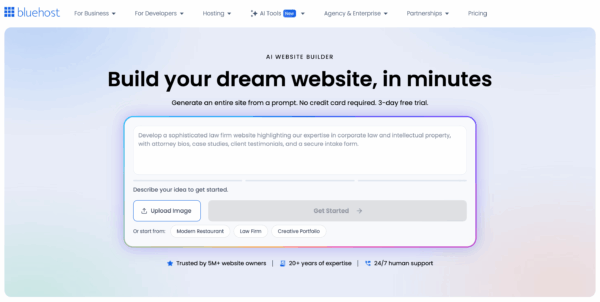
A significant shift in the market is the integration of Artificial Intelligence into the hosting experience. For instance, recent advancements like the Bluehost AI Website Builder have lowered the barrier to entry. These tools allow users to build professional-grade sites by simply chatting with an AI assistant. This represents a democratization of web development, where the infrastructure and design process are unified, enabling small businesses to go from concept to live store in a matter of hours.
Different Types of Hosting: A Comparative Analysis
To understand what you are paying for, you must understand the three primary hosting architectures:
Shared Hosting
In this model, your website lives on a server with hundreds of other sites. You share CPU, RAM, and bandwidth.
- Pros: Extremely affordable and user-friendly.
- Cons: "Noisy neighbors" can impact your site performance. If another site on the server experiences a traffic surge, your site may slow down.
VPS Hosting (Virtual Private Server)
VPS occupies the middle ground. While your site still sits on a physical server with others, the server is partitioned into "virtual" environments. You are guaranteed a set amount of resources that cannot be touched by other users.
- Pros: Better performance, increased security, and greater control over software settings.
- Cons: Requires more technical knowledge to manage effectively.
Dedicated Hosting
The gold standard for enterprise-level sites. You rent an entire physical server. You do not share it with anyone.
- Pros: Maximum power, security, and customization.
- Cons: Expensive and requires significant administrative oversight.
Implications: Making the Switch
Many site owners eventually reach a point where their current host no longer meets their needs. Switching hosts is a significant technical undertaking, but it is a necessary step for scaling.
Official Response from Industry Experts:
Most reputable hosting providers offer migration support. When interviewing potential new hosts, ask: "Do you offer a managed migration service?" A quality provider will often handle the transfer of your database and files, minimizing downtime. If they do not, you should be prepared to hire a developer to ensure the integrity of your data is maintained during the transition.
Conclusion
Choosing a web host is a foundational decision that influences every aspect of your site’s future performance. Whether you opt for the simplicity of a fully-hosted platform or the total control of a self-hosted environment, ensure that your provider aligns with your long-term goals.
Prioritize reliability, location, and support over bargain-bin pricing. Remember: your hosting is the digital real estate upon which your brand is built. Choose a location that is sturdy, scalable, and prepared for your success. As you grow, do not hesitate to reassess your requirements—the most successful digital ventures are those that evolve their infrastructure alongside their traffic.