





By Global Tech & Education Correspondent
Published: September 2026
Main Facts
In an era where digital literacy is no longer a luxury but a fundamental prerequisite for economic participation, open-source educational programs are bridging the gap between theoretical learning and practical application. Recent data from the WordPress Education initiative highlights a massive surge in global engagement, showcasing how structured community-driven programs are transforming students into creators, developers, and community leaders.
At the heart of this movement are two primary frameworks: WordPress Campus Connect and WordPress Credits.
- WordPress Campus Connect brings free, hands-on, volunteer-led WordPress workshops directly to middle schools, high schools, and universities utilizing a standardized shared curriculum.
- WordPress Credits takes experiential learning a step further by placing university and high school students into structured, mentored internships where they contribute directly to the core WordPress software—which powers over 40 percent of the web—while earning formal academic credit.
The impact of these initiatives was brought into sharp focus during July, a landmark month that saw hundreds of students across Bangladesh, Uganda, Spain, and Costa Rica step up to build digital infrastructure from scratch. From constructing 108 websites in two weeks across two campuses in Kishoreganj, Bangladesh, to pivoting a fully booked technical workshop when faced with a complete unexpected power outage in rural Uganda, these programs are proving that passion, community, and open-source technology can overcome almost any barrier.
With WordPress Credits surpassing 226 graduates in July alone—up from 199 the previous month—and expanding its network to 38 partner institutions across 16 countries, the initiative is rapidly scaling its mission to democratize web development education on a global scale.
Chronology of Global Events
The rapid expansion of WordPress educational outreach in mid-2026 demonstrates the agility and decentralized nature of the open-source community. A chronological look at July’s standout milestones reveals a truly global campaign:

Early July: The Kishoreganj Digital Sprint (Bangladesh)
In the first two weeks of July, organizer Muhibul Haque spearheaded a massive dual-campus initiative in Kishoreganj, Bangladesh. Working in collaboration with local educators, the program launched first at Kishoreganj University, where participating students successfully designed and deployed 38 fully functional websites.
Shortly thereafter, the initiative moved to the Kishoreganj Polytechnic Institute. Despite logistical hurdles, guest speaker Shipon Karmakar traveled more than 80 kilometers to support the event, helping students build an additional 70 websites. By the end of the two-week sprint, over 150 students had directly participated, laying the foundation for a burgeoning tech hub in the region.
Mid-July: Innovation and Adaptability in Spain and Uganda
Mid-July brought contrasting environments that tested the resilience of workshop organizers. In Mataró, Spain, Josep Morán led a pair of intensive four-hour sessions for 100 vocational students at Escola Pia Sta. Anna. Utilizing modern tools like WordPress Playground and AI assistance, these students successfully developed and deployed a working plugin designed to calculate optimal shore-fishing times for the local coastal community.
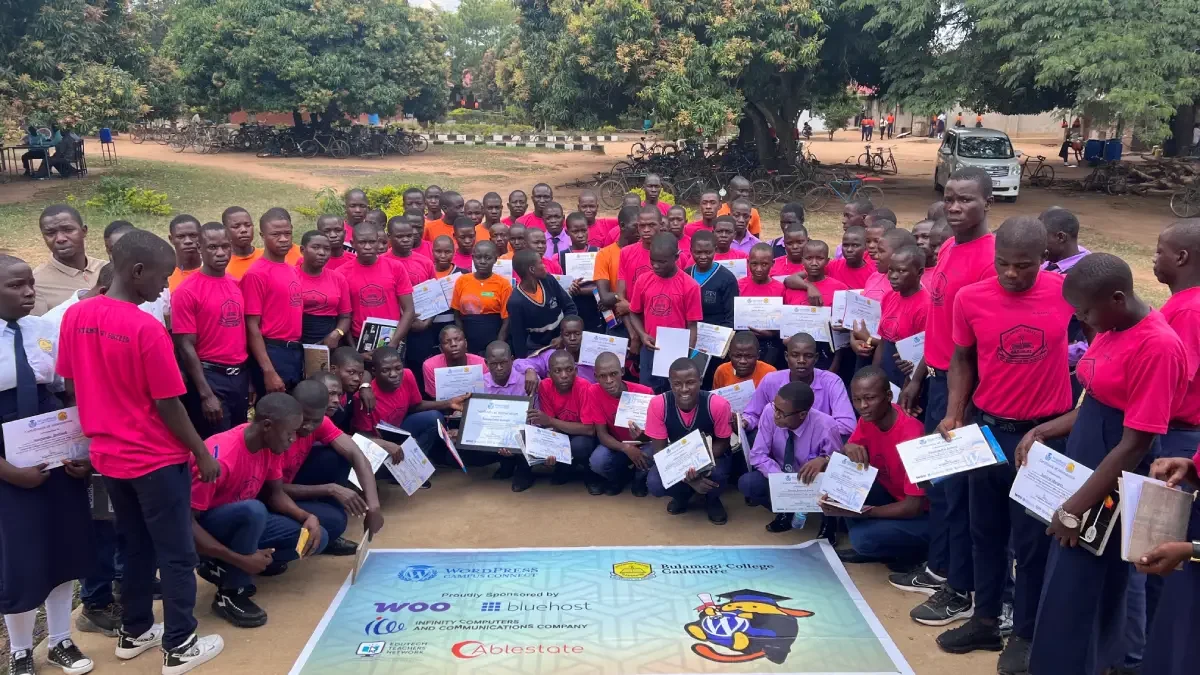
Concurrently, preparations were finalized for a workshop at Bulamogi College Gadumire in eastern Uganda—an event born from the persistence of former student Mariam Nairuba. When the workshop team arrived on July 29, they were met with over 100 eager learners and a critical revelation: the school had no electricity.
Rather than conceding defeat, the organizers shifted gears. They transformed the dark classroom into an interactive town hall, engaging students in a vibrant Q&A session about digital security, open-source philosophies, and career pathways in software development.
Late July: Peer-Led Empowerment in Costa Rica
Closing out the month, Rita Robles Loaiza published two transformative educational pilots in Costa Rica, cementing the concept that "students who just learned this are the best people to teach it next."

- Pilot One: Three students from the second WordPress Credits cohort at Universidad Fidélitas designed and delivered a high-impact workshop for 40 high school girls. Hosted at Patrones Hermosos—a premier science and engineering camp run jointly by Tecnológico de Monterrey and MIT—the participants achieved a 100 percent satisfaction rate, with every single student building and presenting their own website.
- Pilot Two: A cohort of 13 students at Liceo Experimental Bilüe José Figueres Ferrer—the first high school in the Americas to adopt WordPress Credits—began collaborating with the Costa Rican Spanish Polyglots team to translate WordPress core into es_CR as part of their community service graduation requirements.
Supporting Data and Quantitative Impact
The qualitative success stories of individual workshops are strongly reinforced by impressive quantitative metrics. The July 2026 Monthly Education Buzz Report outlines steady, compounding growth across all major operational pillars:
- Growth in Academic Partnerships: The WordPress Credits program now actively collaborates with 38 distinct educational institutions spread across 16 countries, providing formal academic validation for open-source contributions.
- Graduate Milestone: The cumulative number of WordPress Credits graduates reached 226 in July, representing a solid month-over-month increase from June’s total of 199 graduates.
- Massive Output in Single Sprints: Just two campuses in Kishoreganj, Bangladesh, yielded 108 live websites created entirely by novice student developers within a narrow 14-day window.
- Demographics and Inclusion: Programs like the Costa Rican STEM camp collaboration achieved a 100% completion and satisfaction rate among female high school participants, directly targeting the persistent gender gap in technology sectors.
- Global Footprint: Beyond the headline events, international momentum continued with student-led Campus Connect sessions at institutions such as the Kyoto University of Advanced Science in Japan, and self-sustaining Student Clubs launching in urban centers like Dhaka, Bangladesh.
Official Responses and Perspectives
The rapid adoption of WordPress educational initiatives has garnered praise from educators, community leaders, and student participants alike, highlighting the mutual benefits of open-source mentorship.
"When you strip away the electricity, what you are left with is human curiosity. The room exploded with questions about whether they could build the web themselves. That raw enthusiasm is why we do this."
— Moses Ssebunya, Campus Connect Organizer (Reflecting on the Bulamogi College Gadumire workshop)
Educators participating in the WordPress Credits internship model have similarly lauded the bridge it builds between the classroom and the professional marketplace. By allowing students to contribute code, documentation, and translations directly to a globally utilized platform, universities and polytechnics are finding it easier to justify practical technical training as rigorous academic coursework.
Student participants frequently emphasize the psychological shift that occurs when they realize open-source software is not an impenetrable black box, but a collaborative ecosystem they can actively shape. As noted in feedback forms from the Escola Pia Sta. Anna workshop in Spain, the combination of earning a recognized certification and learning skills that directly map onto the local job market provides a profound sense of agency and economic hope.
Implications for the Future of Global Tech Education
The long-term implications of initiatives like Campus Connect and WordPress Credits extend far beyond the immediate production of websites or software translations. They point toward a scalable, decentralized model for technical education that sidesteps many of the financial and infrastructural barriers traditionally associated with computer science training.

1. Democratization of Tech Literacy
By relying on free, open-source software, lightweight modern deployment tools (such as WordPress Playground), and peer-to-peer instruction, these programs bypass the need for expensive proprietary software licenses or high-end laboratory hardware. As demonstrated in Uganda, even unexpected infrastructural limitations like a lack of electricity can be partially mitigated by focusing heavily on foundational digital concepts, critical thinking, and open-source philosophy.
2. Localization and Cultural Preservation
Projects like the es_CR translation initiative in Costa Rica highlight how technical education can simultaneously serve community needs. By empowering high school students to translate digital interfaces into their local linguistic and cultural contexts, the internet becomes more accessible to regional populations while instilling a deep sense of civic pride in the student contributors.
3. Replicability and Sustainable Scaling
A critical bottleneck in global tech education is the scarcity of trained educators. The WordPress Education framework addresses this by creating rigorously documented, highly replicable guides—such as the manual produced by the Universidad Fidélitas student cohort. By training students to become teachers, and providing them with modular curricula, the ecosystem creates a self-sustaining loop of mentorship that requires minimal centralized overhead to expand.
Looking Ahead
As the Monthly Education Buzz Report for July 2026 illustrates, the appetite for practical, open-source learning is accelerating worldwide. With active student-led chapters now operating everywhere from Kyoto to Dhaka, and institutional partnerships deepening across four continents, WordPress Education is proving that the future of web development belongs to anyone willing to learn, build, and share.
For educators, students, or community leaders interested in bringing Campus Connect or WordPress Credits to their local institutions at zero cost, resource guides and onboarding materials are publicly available through the official WordPress Community and Education blogs.